Screenshots
See it in action
A modern, intuitive interface designed for productivity.
Warning: May cause sudden urges to containerize everything.
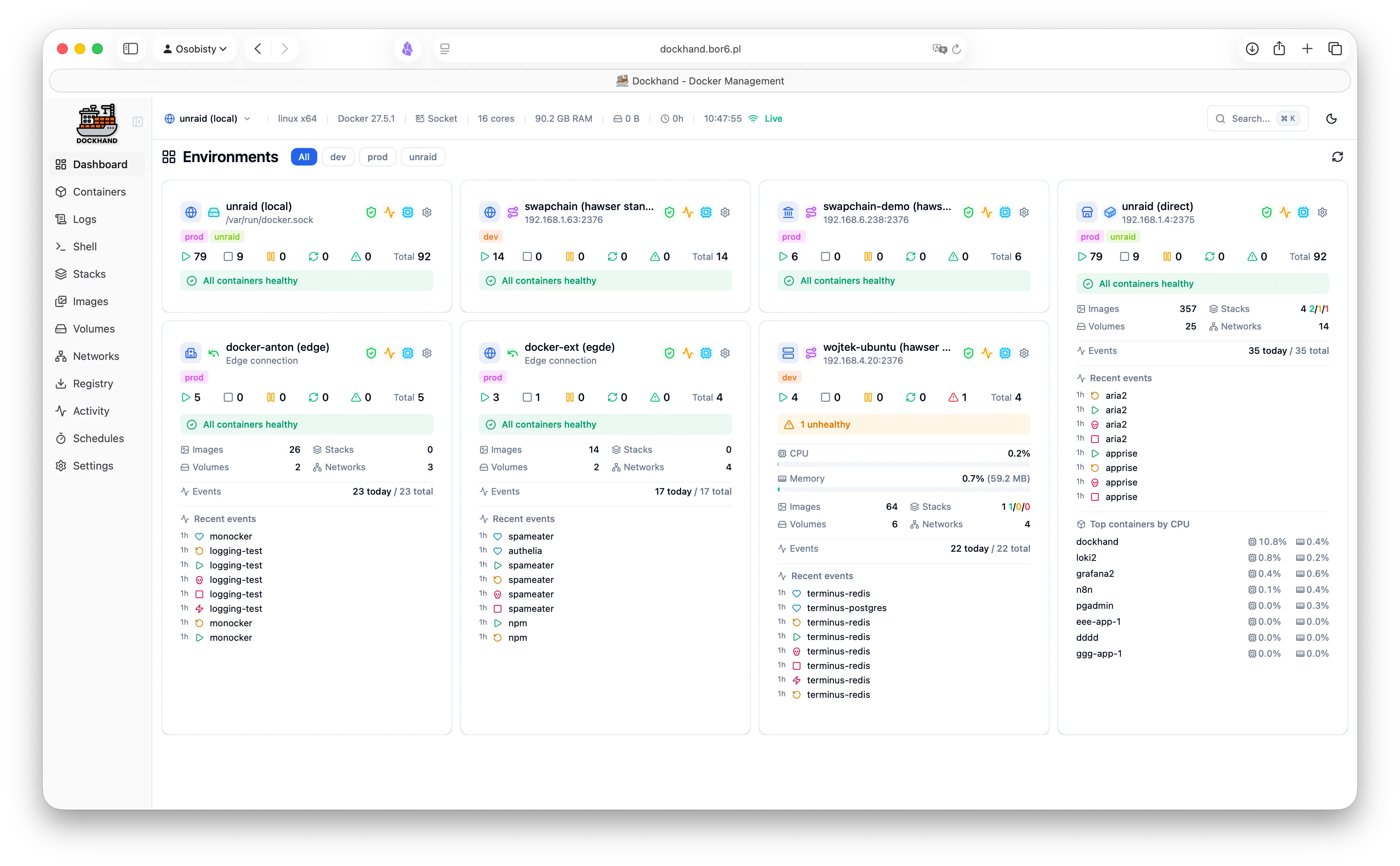
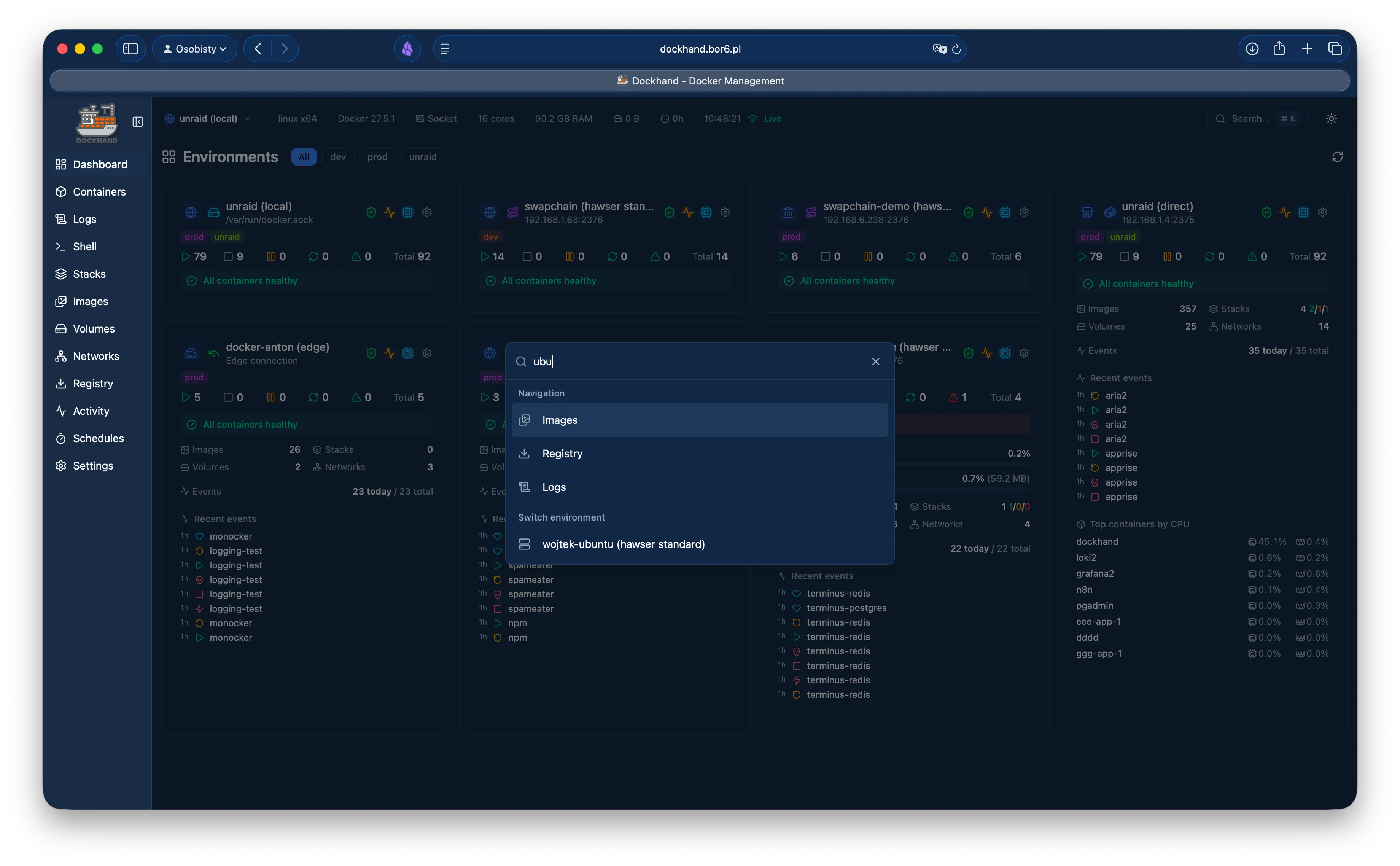
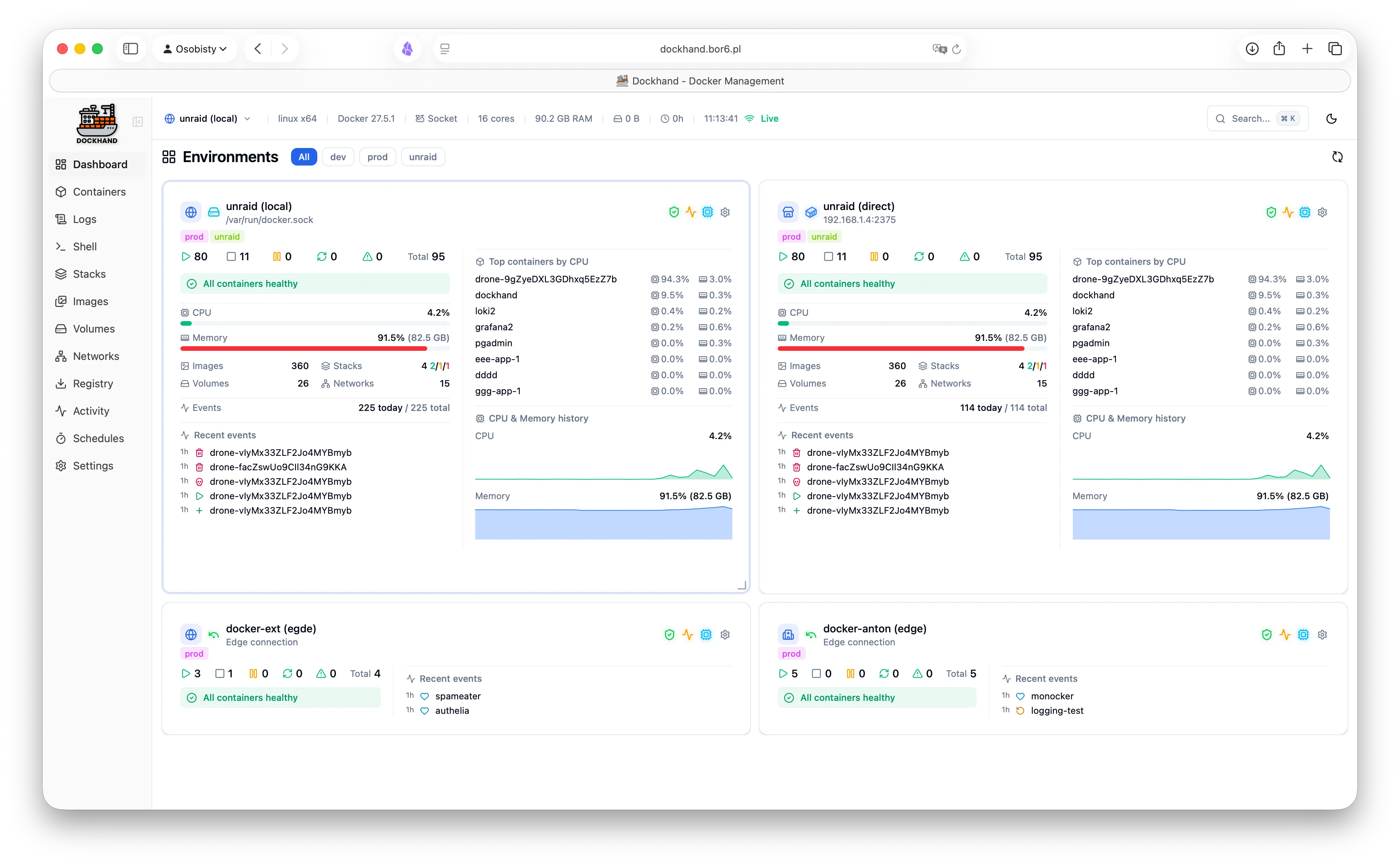
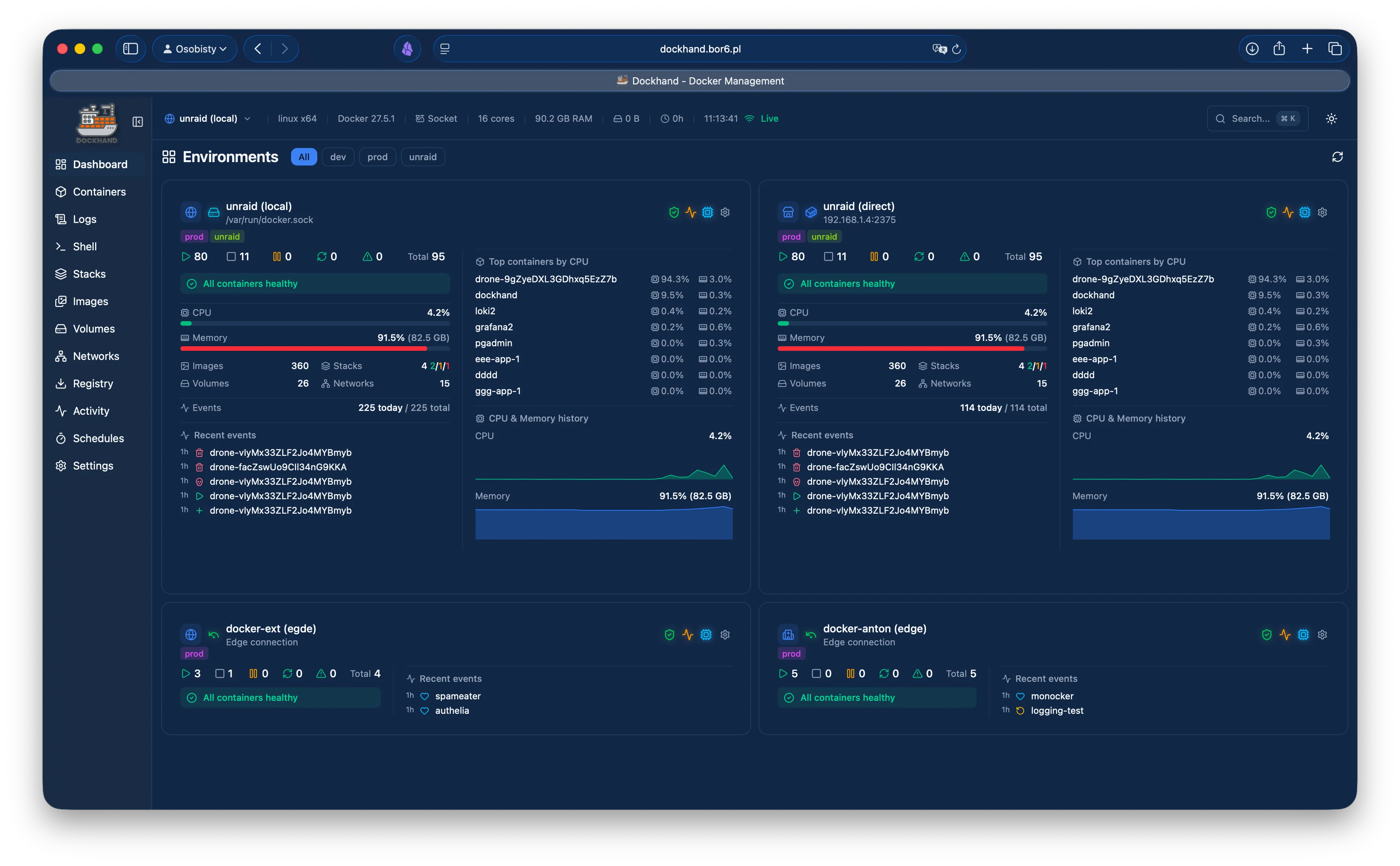
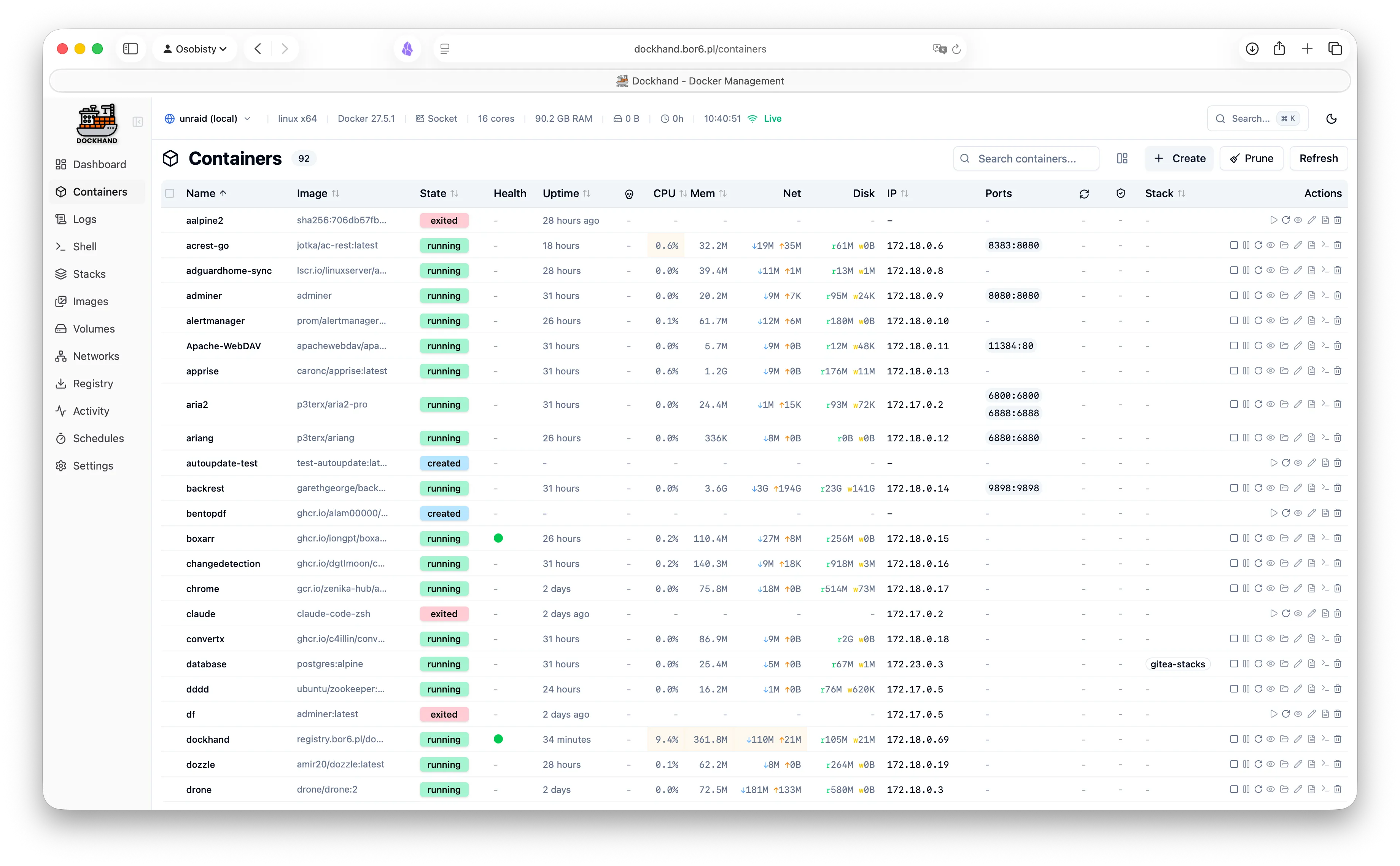
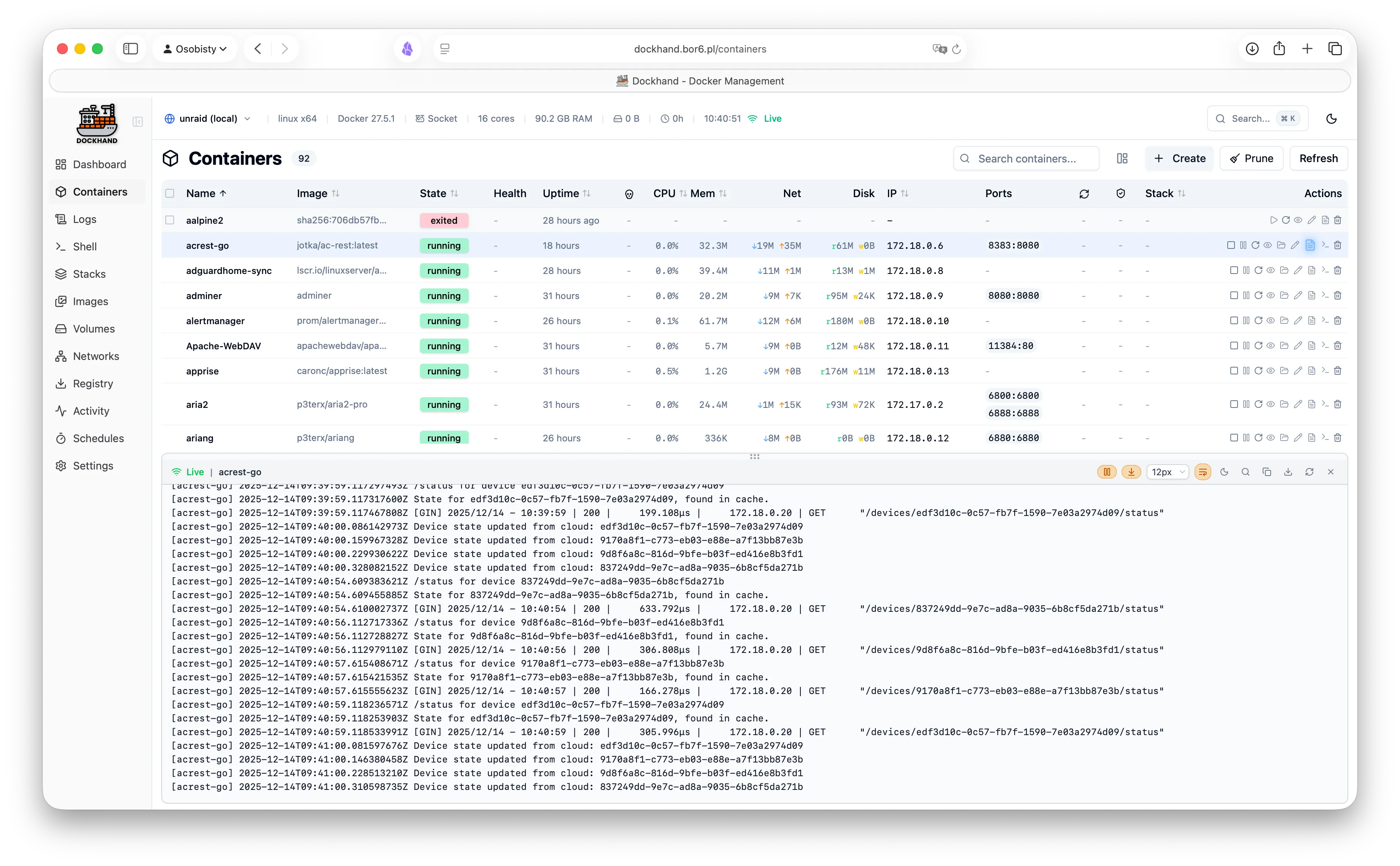
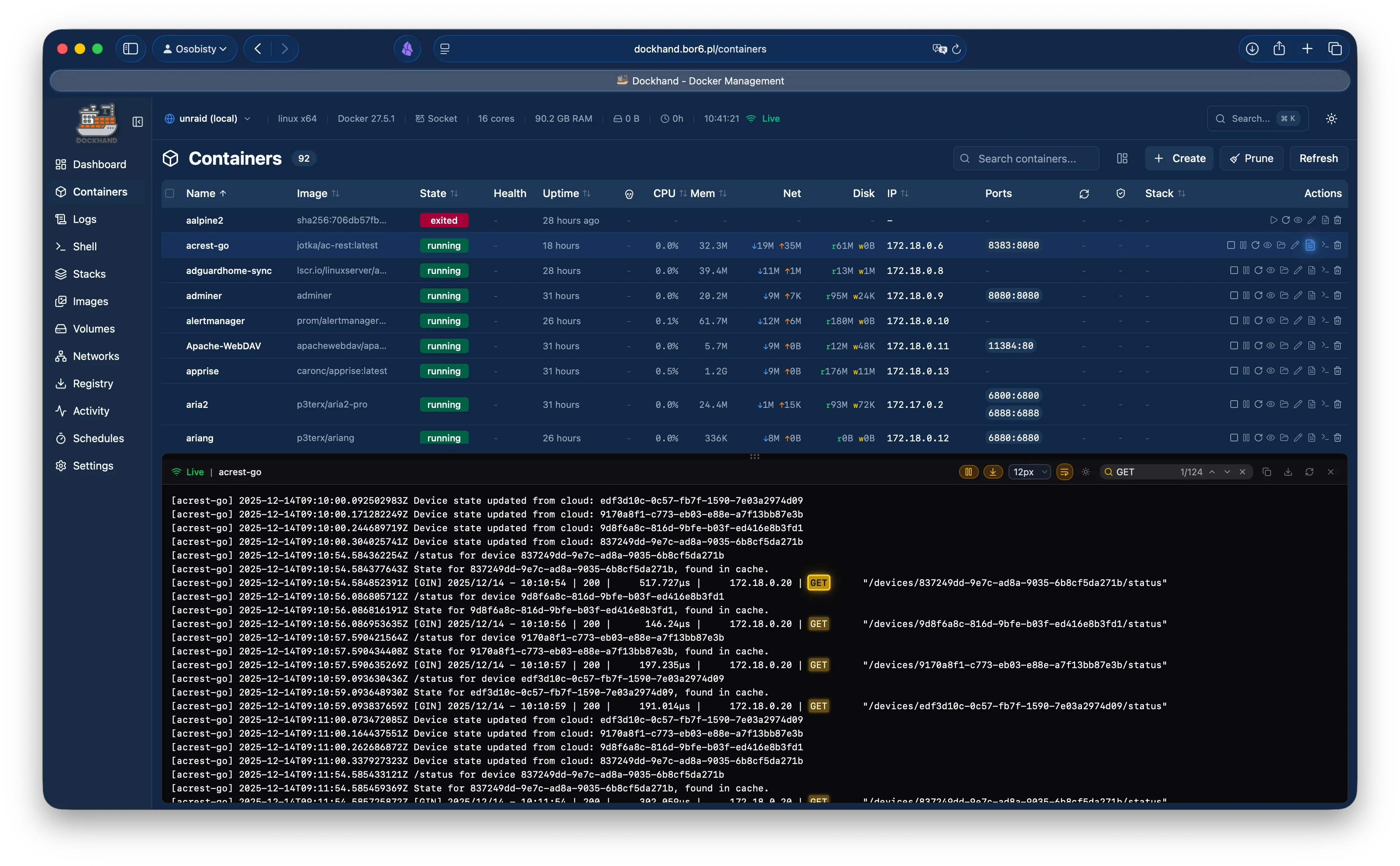
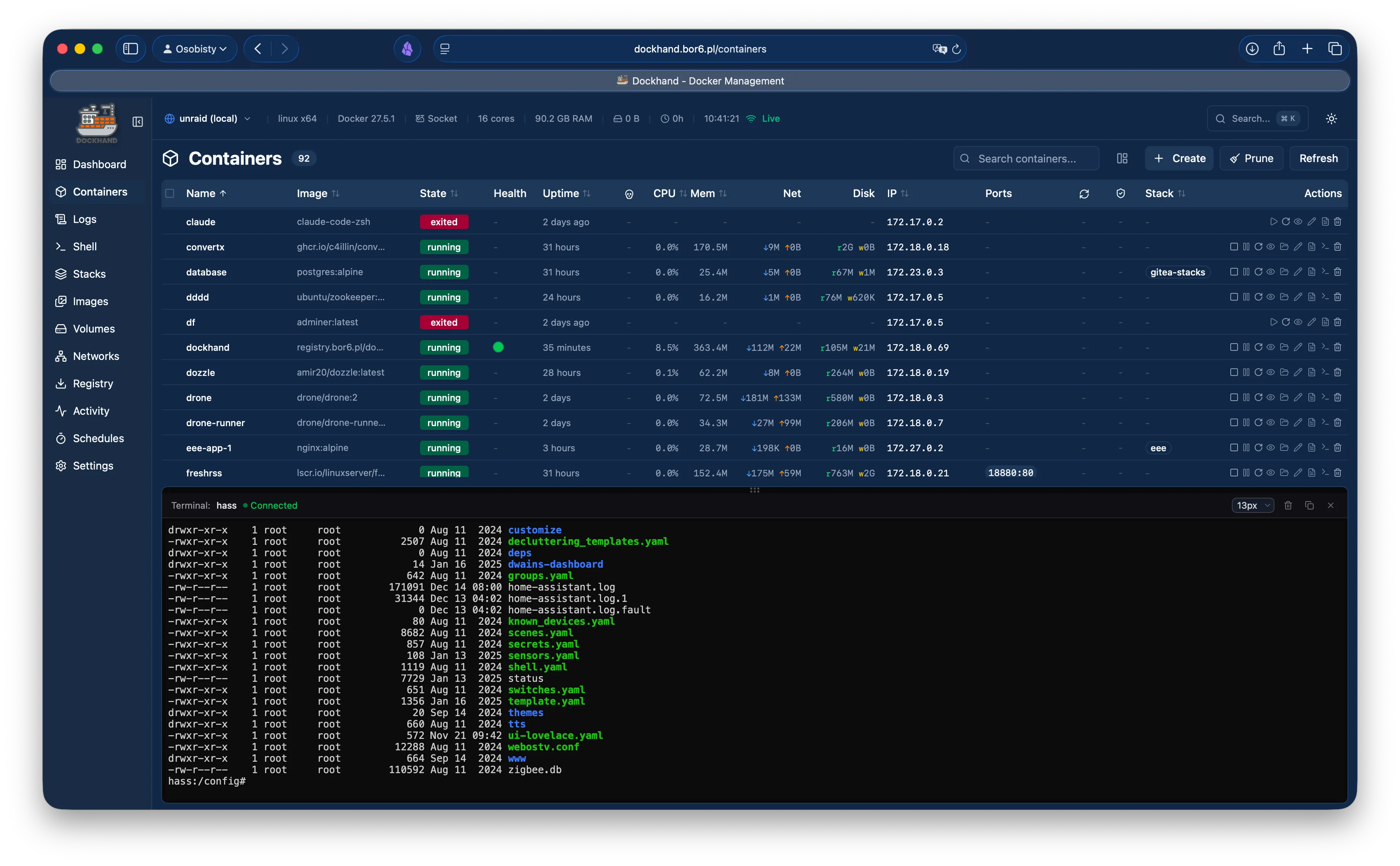
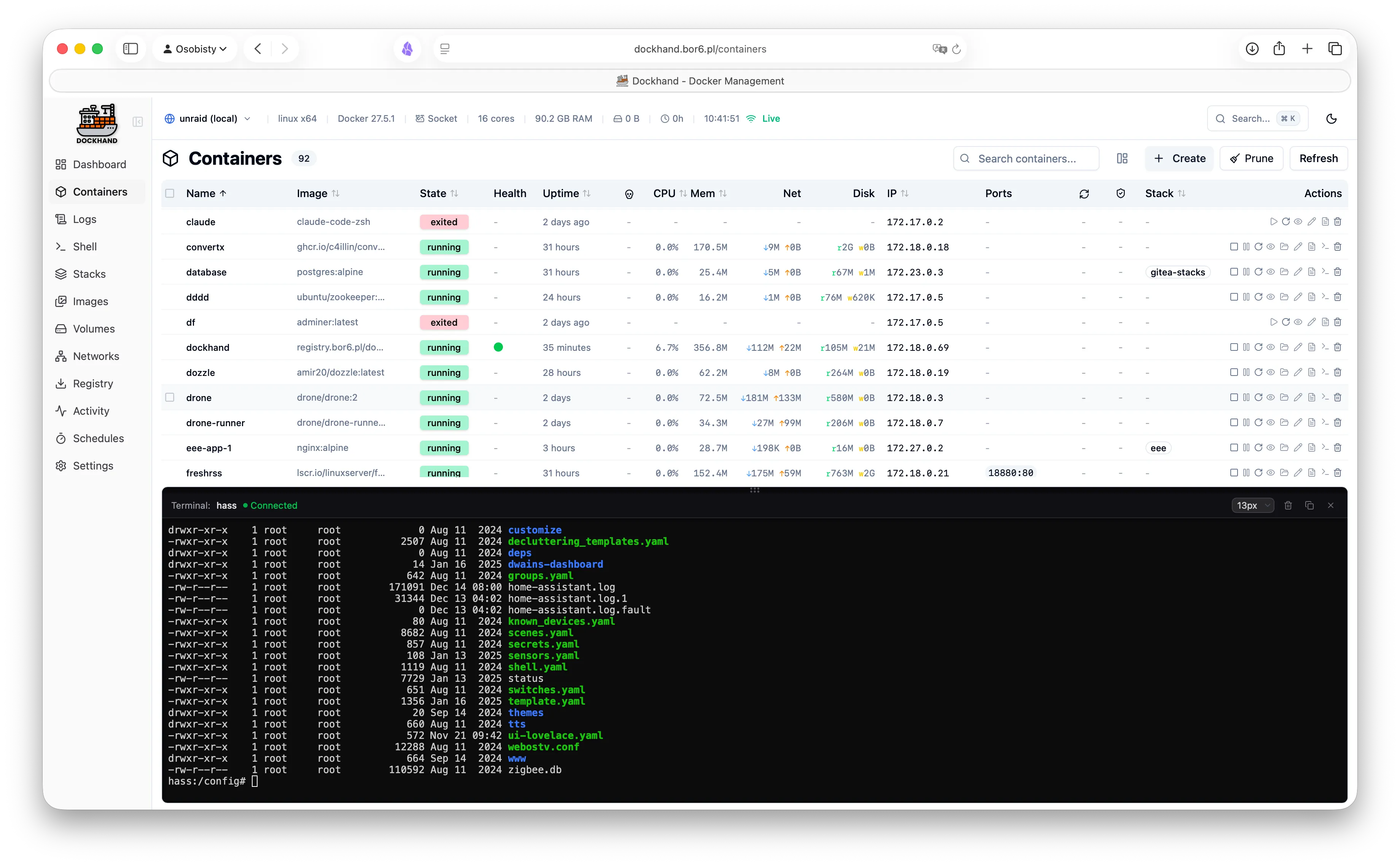
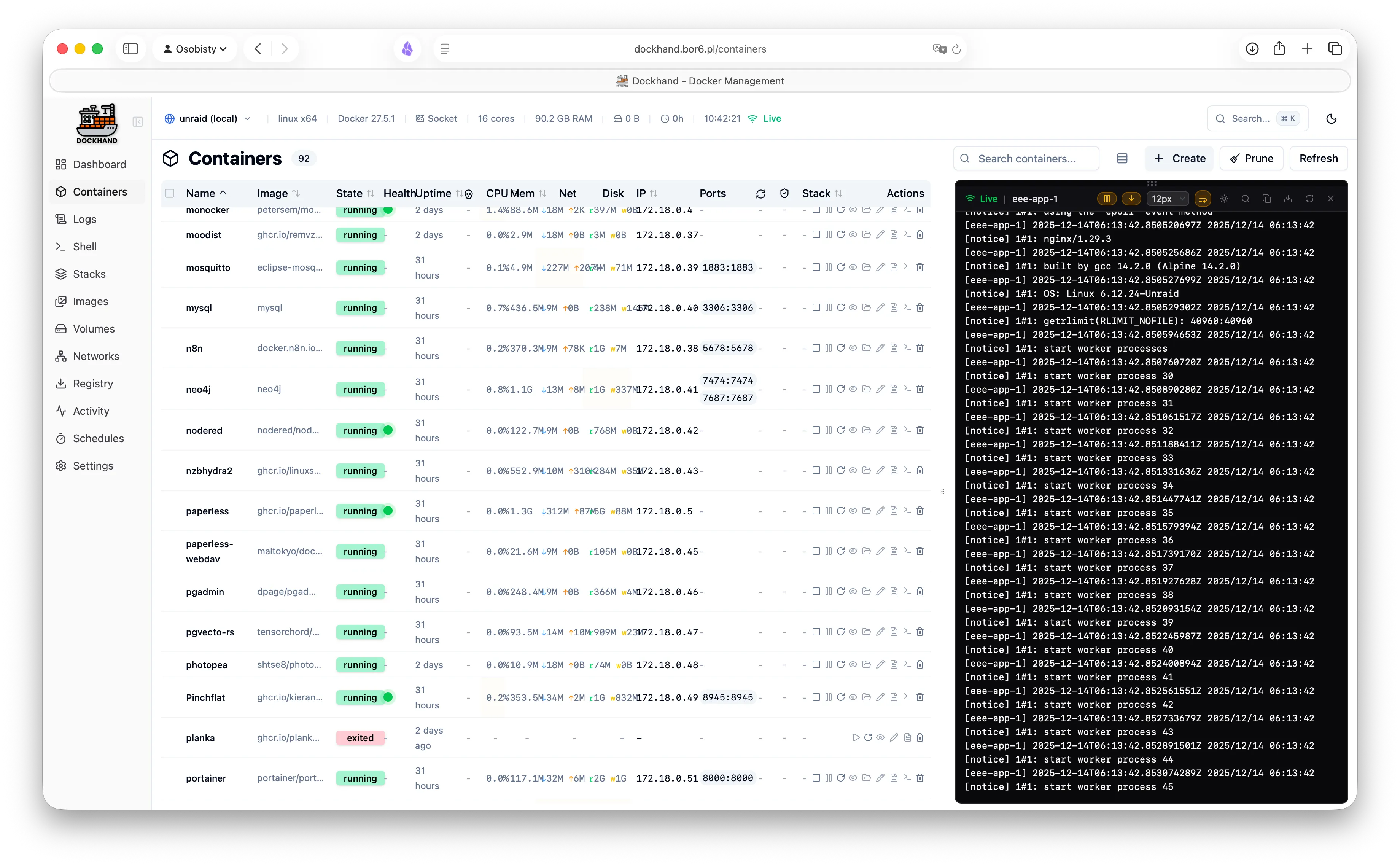
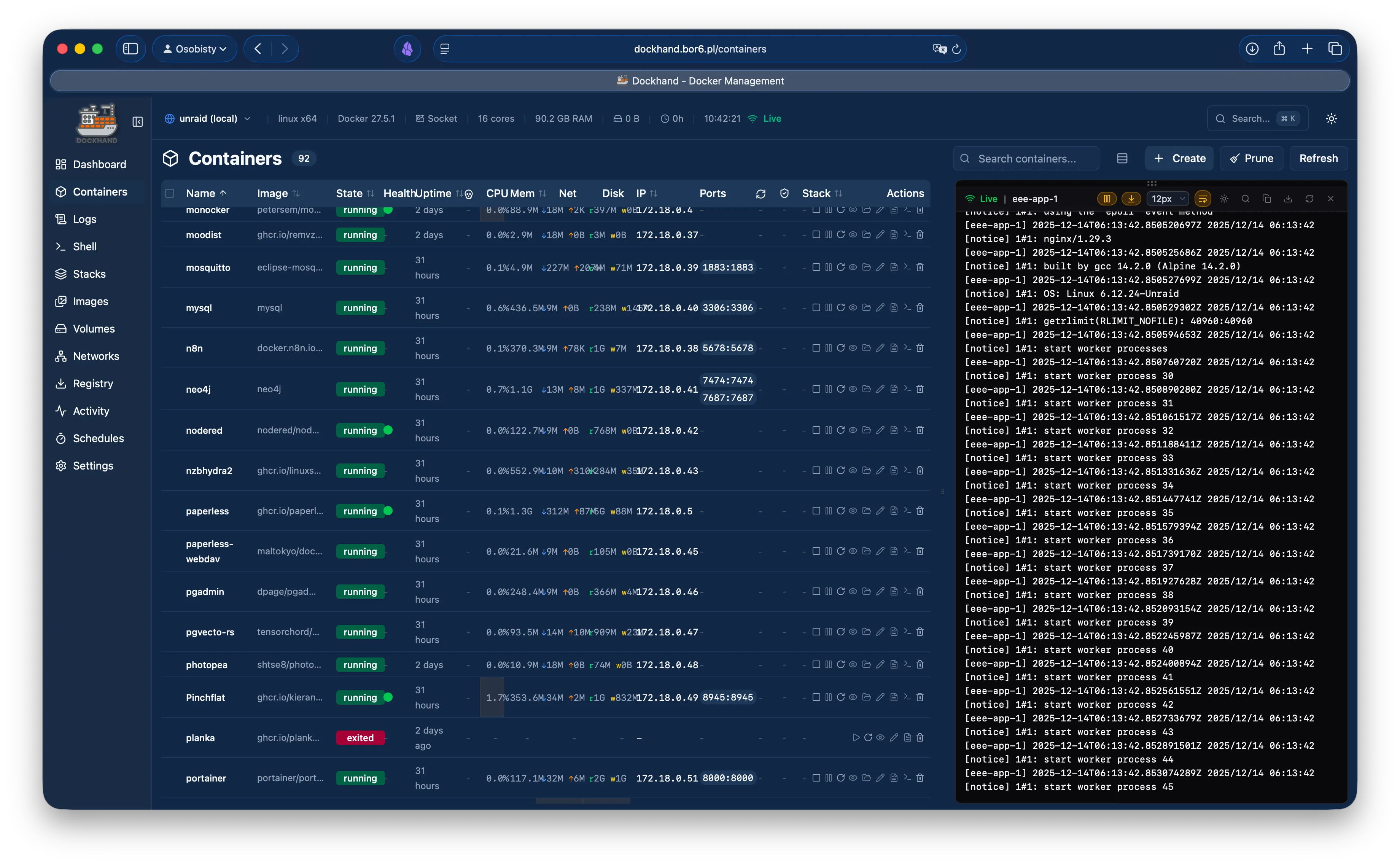
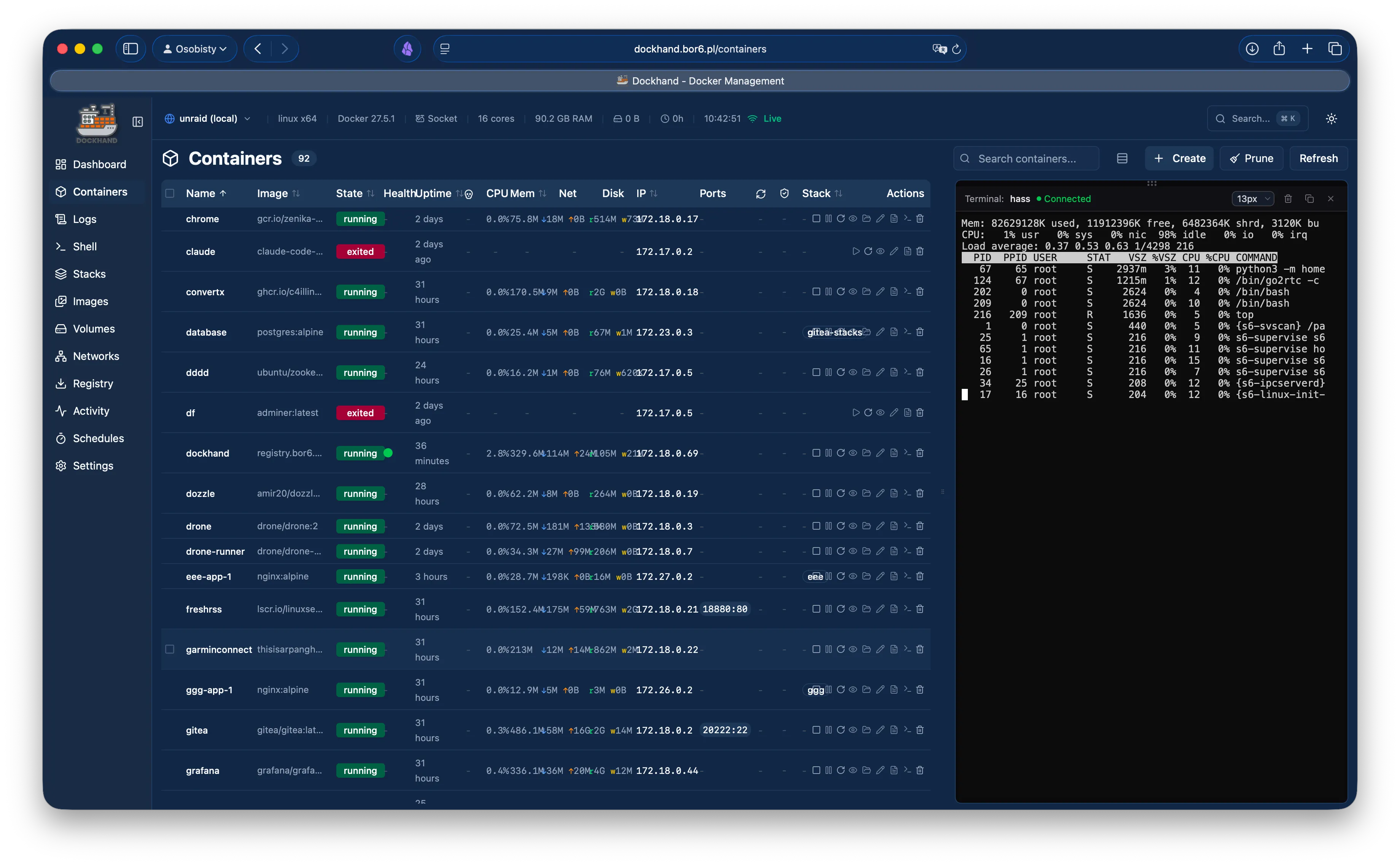
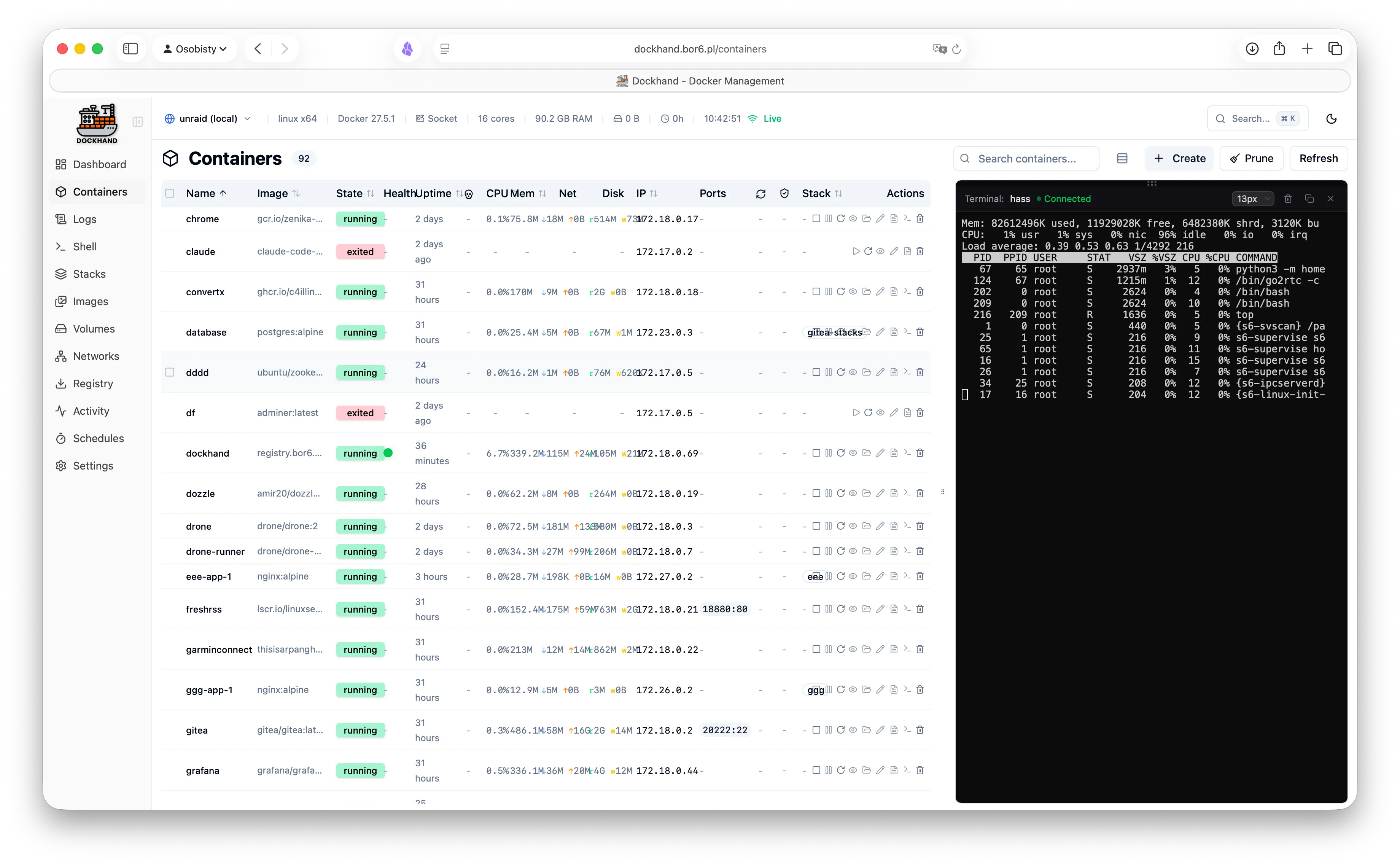
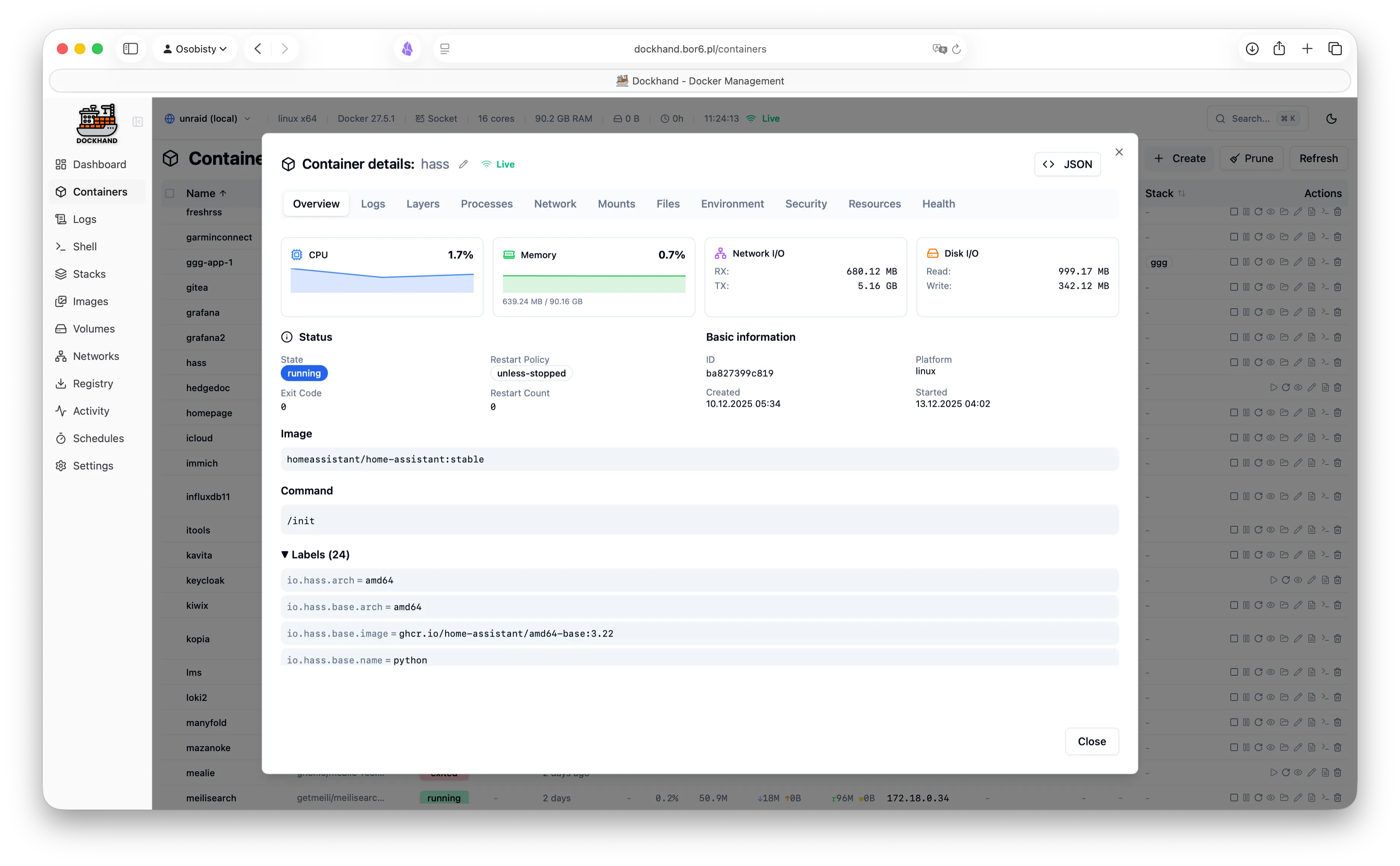
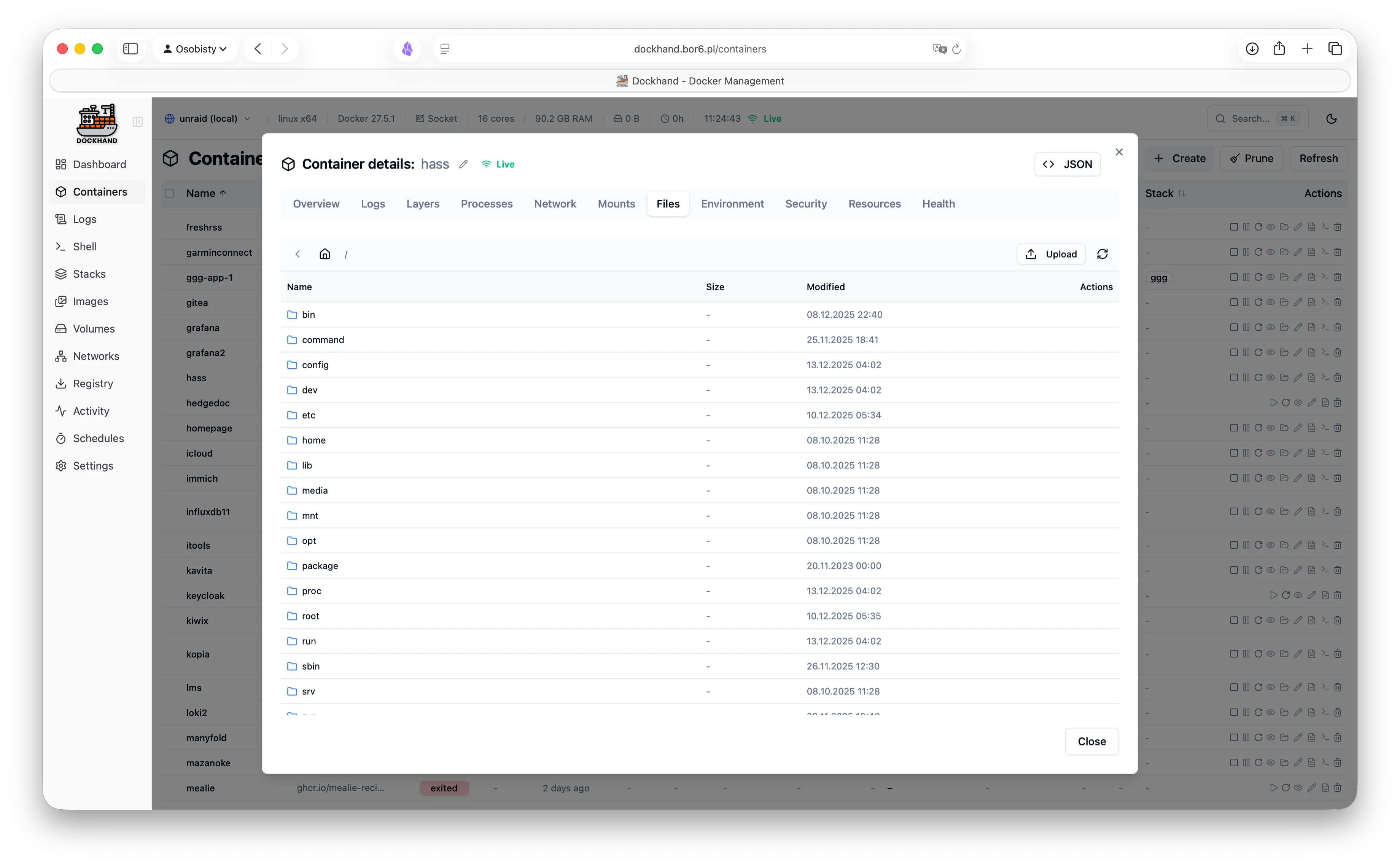
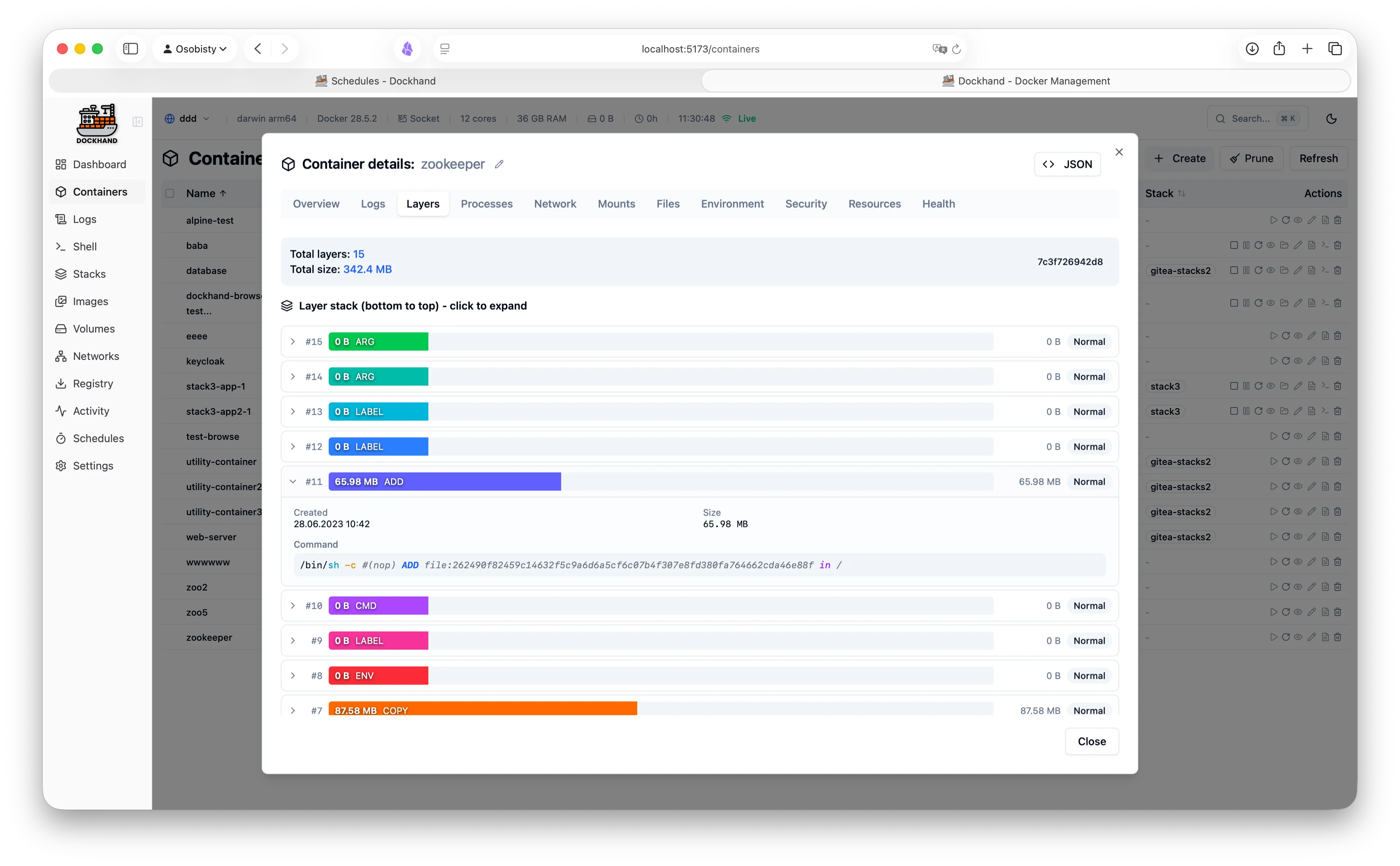
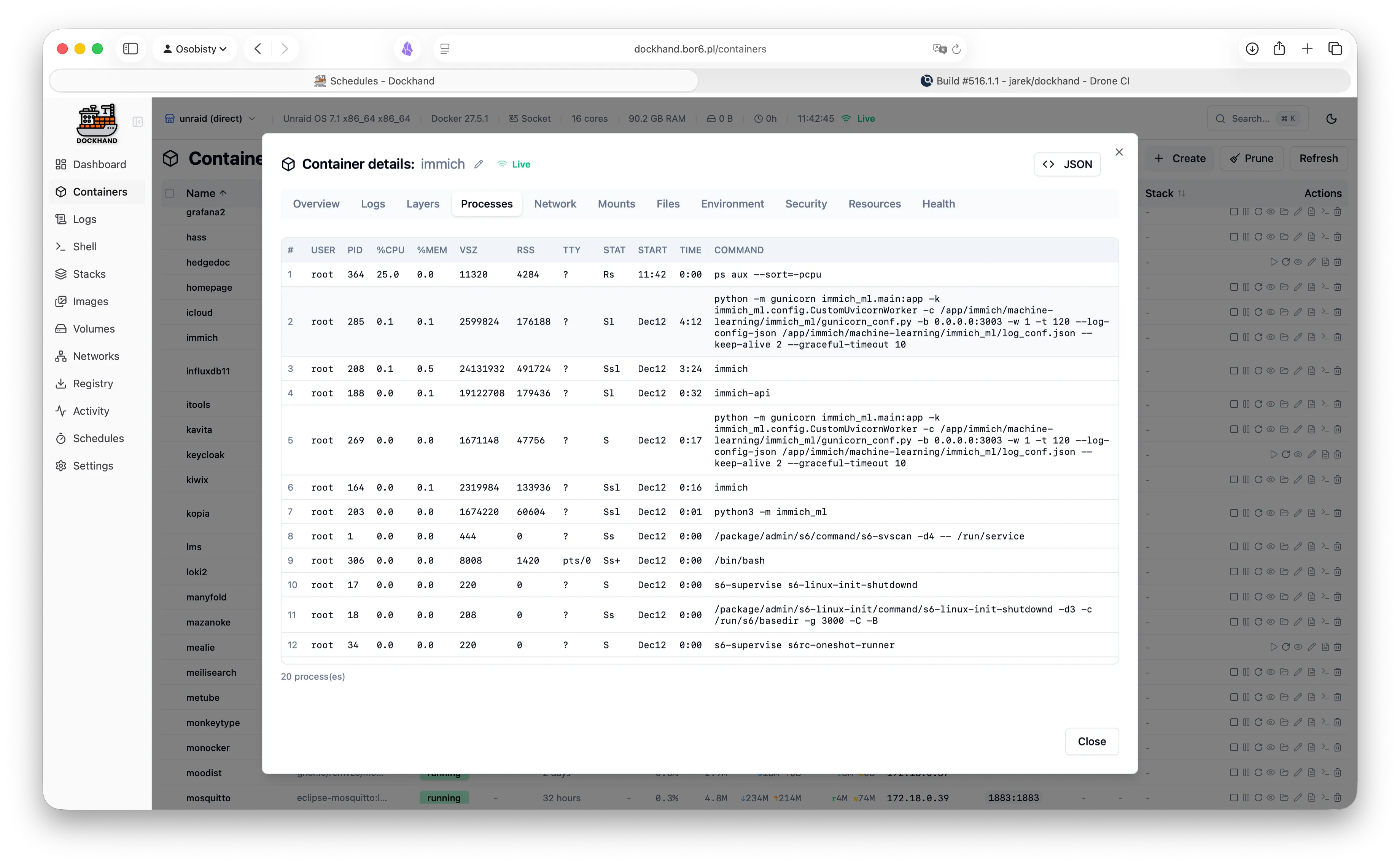
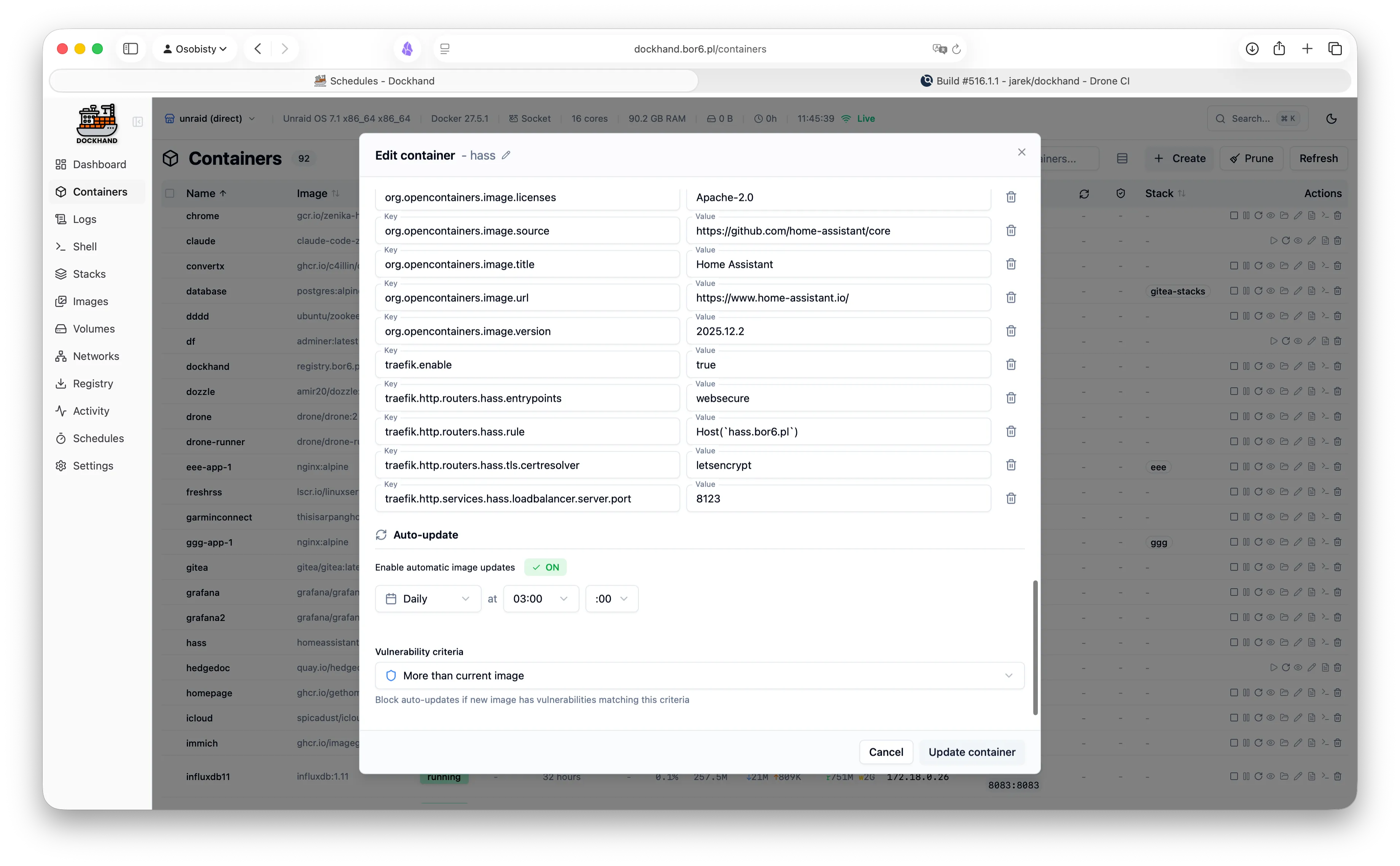
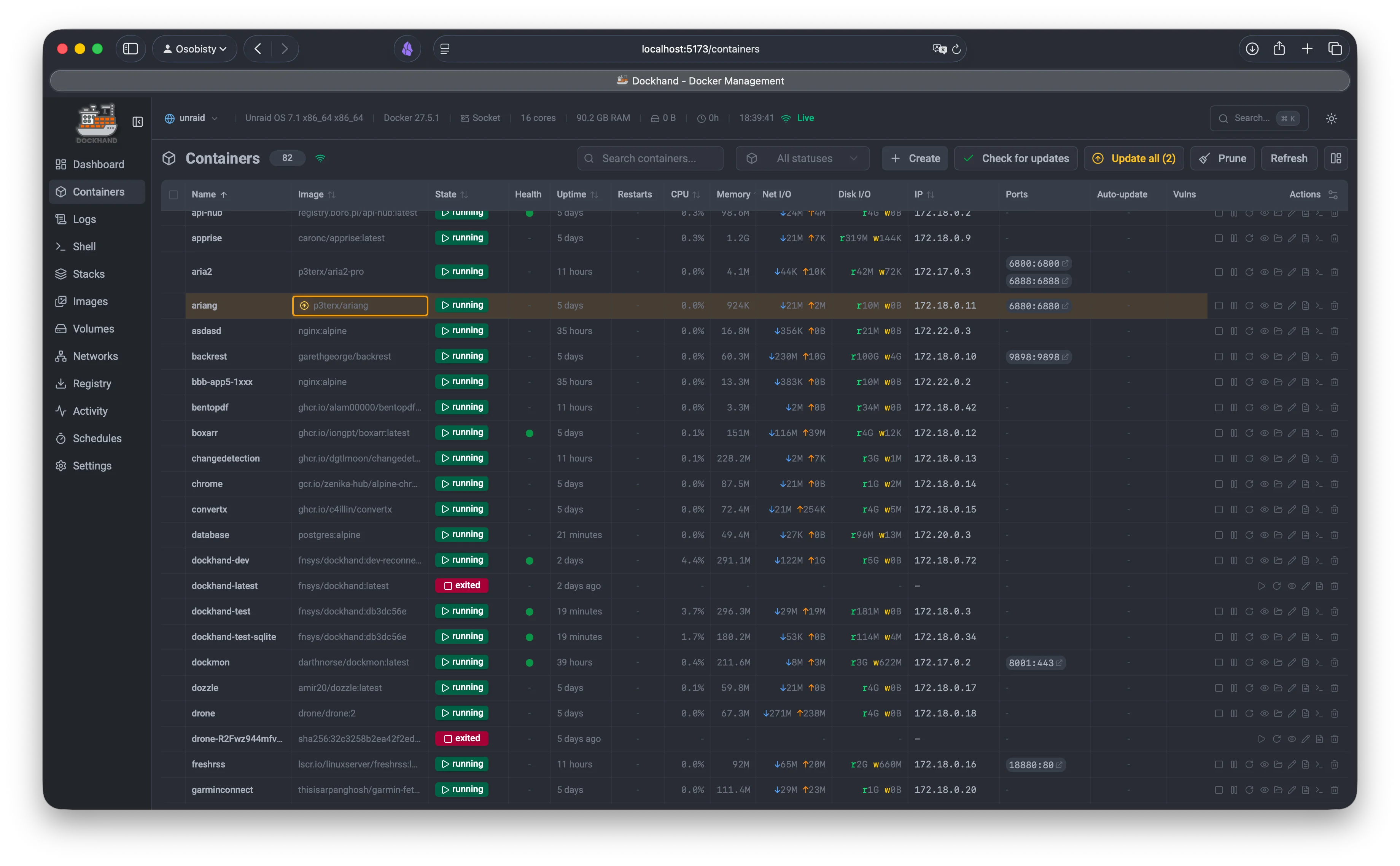
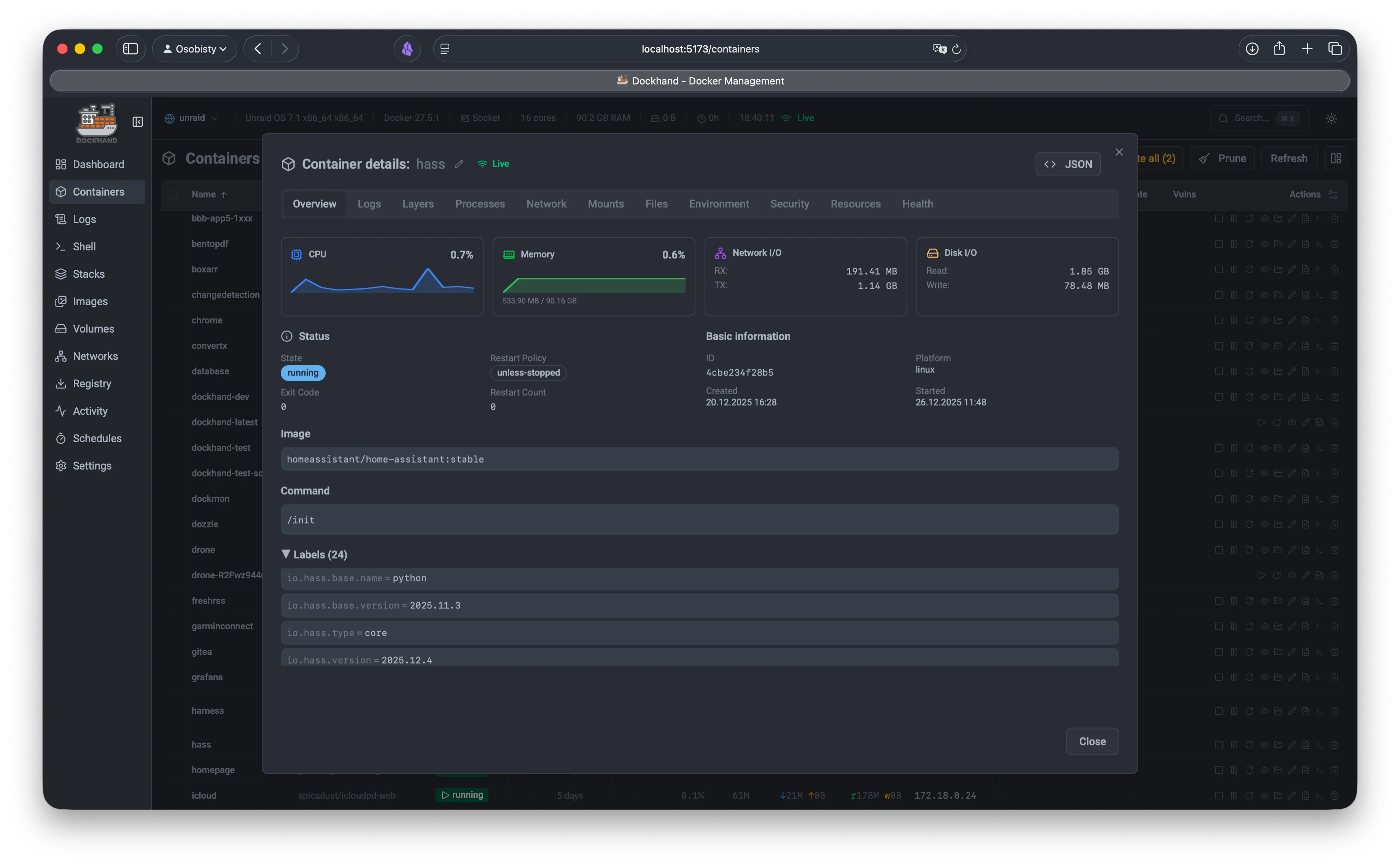
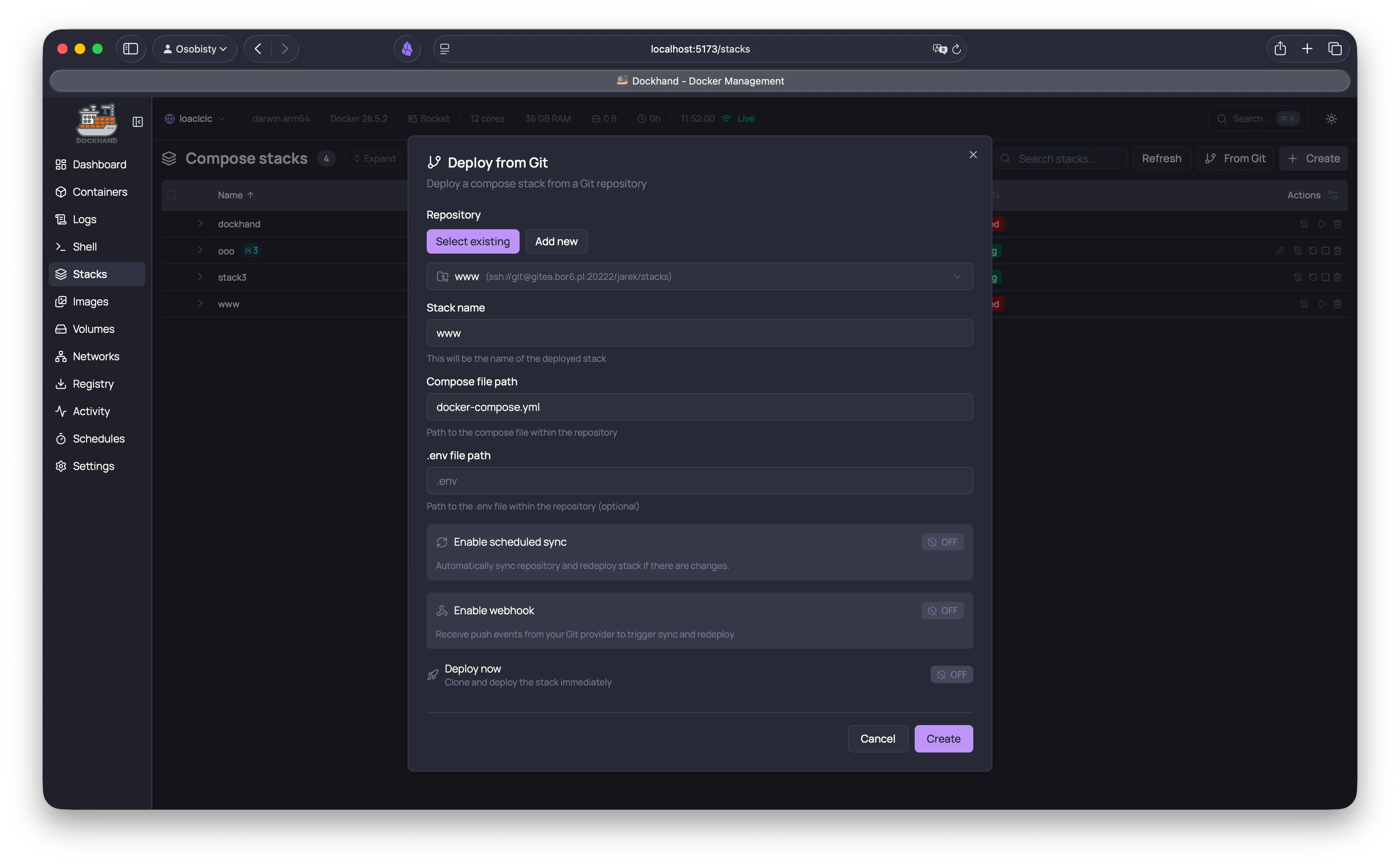
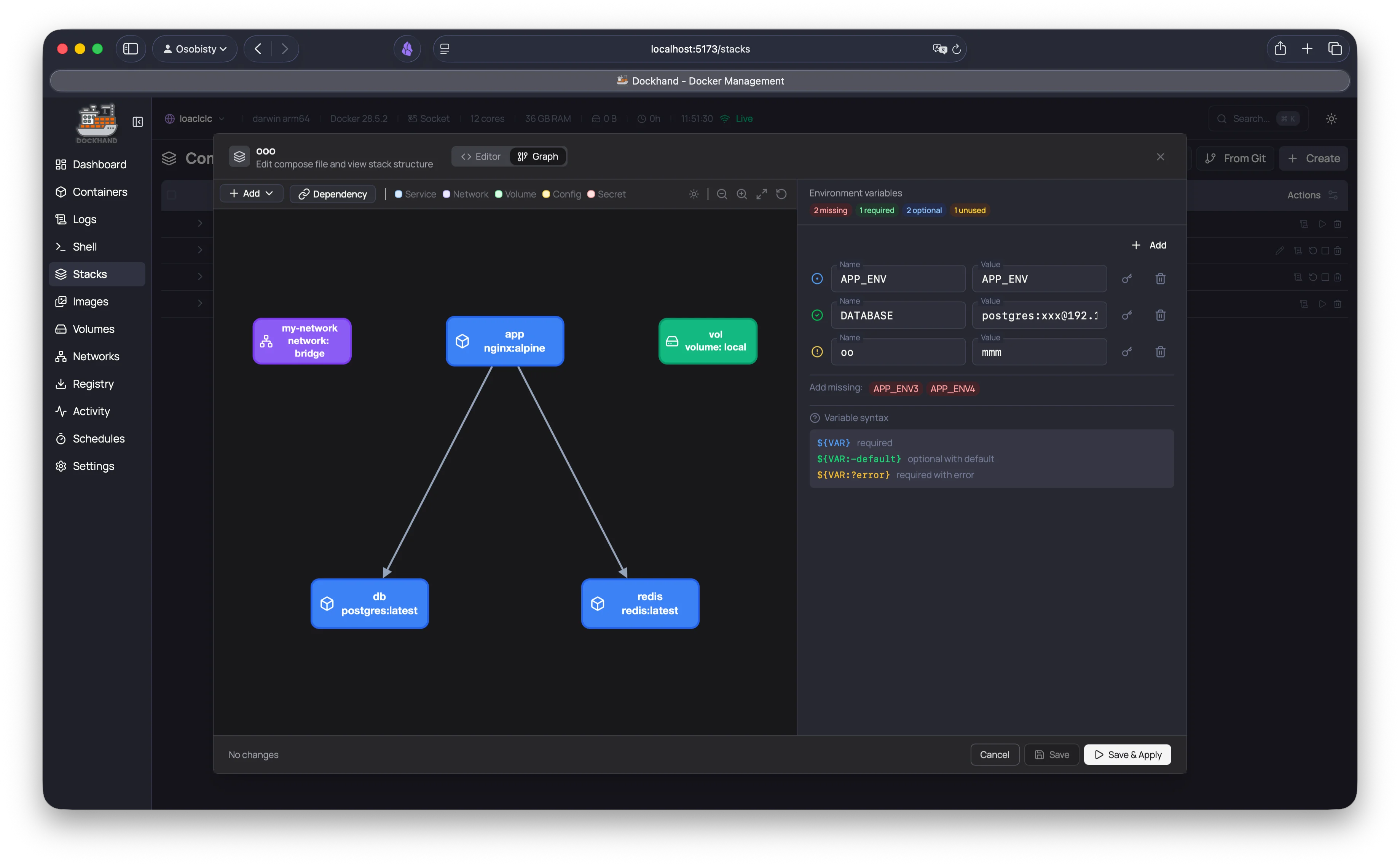
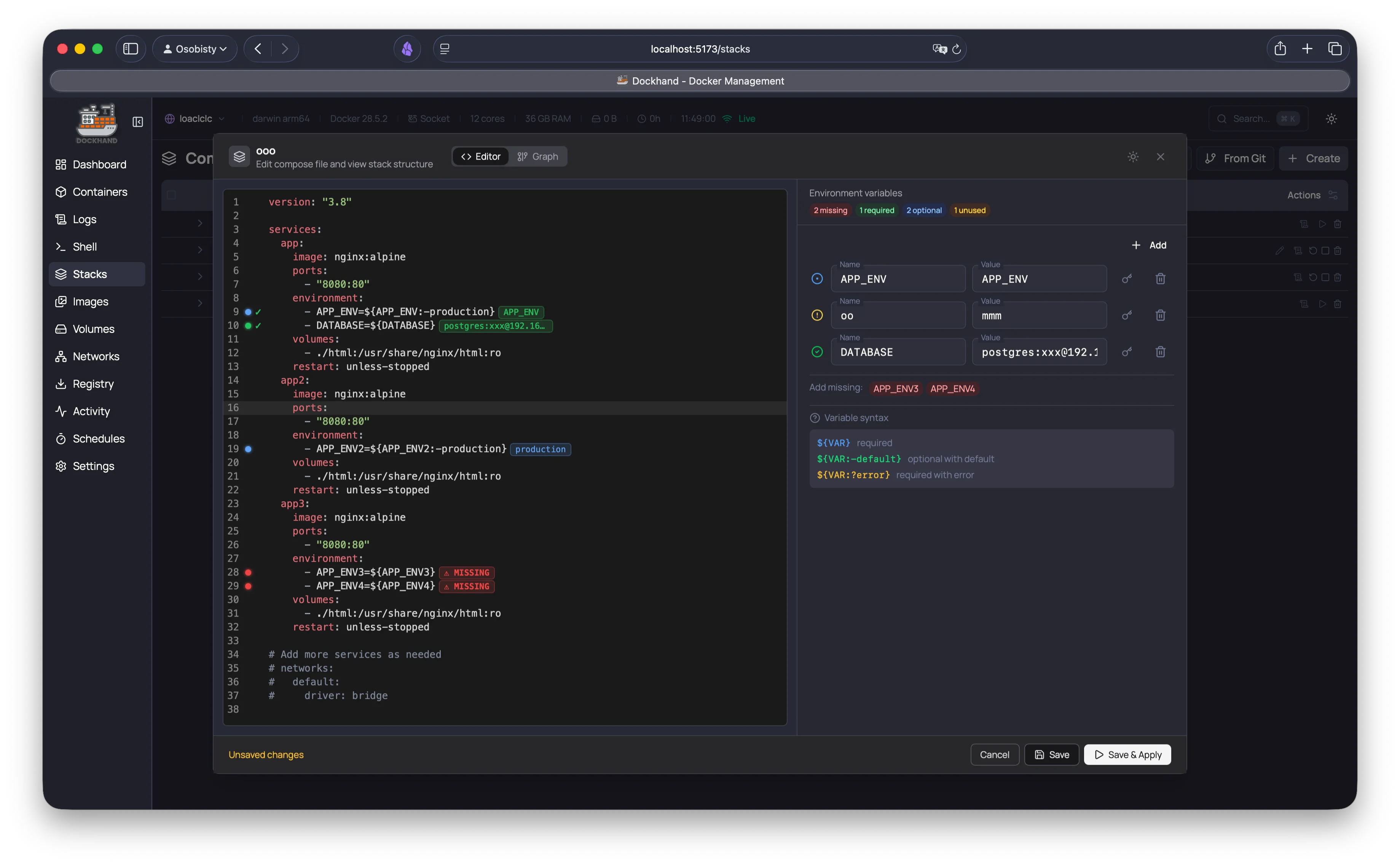
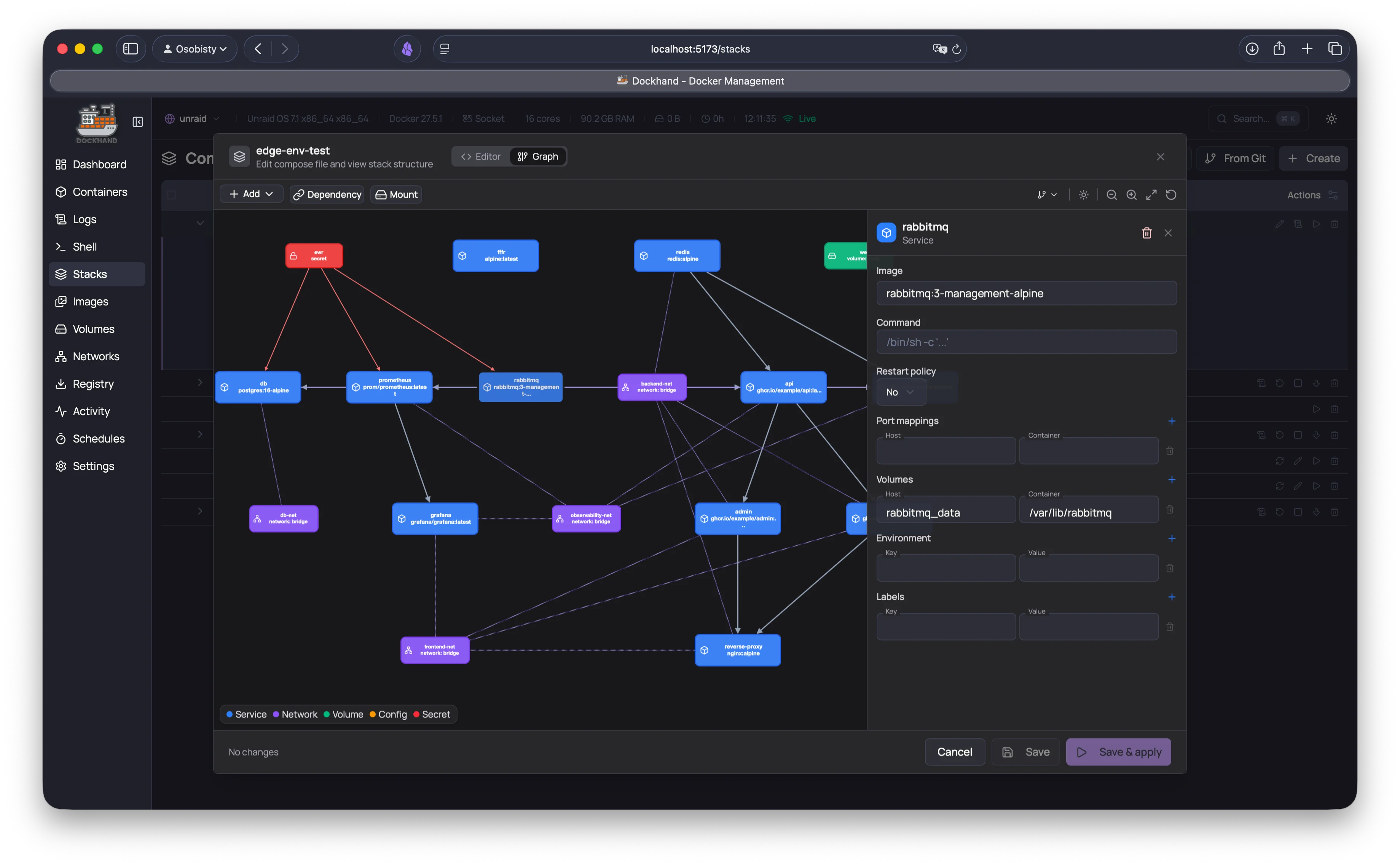
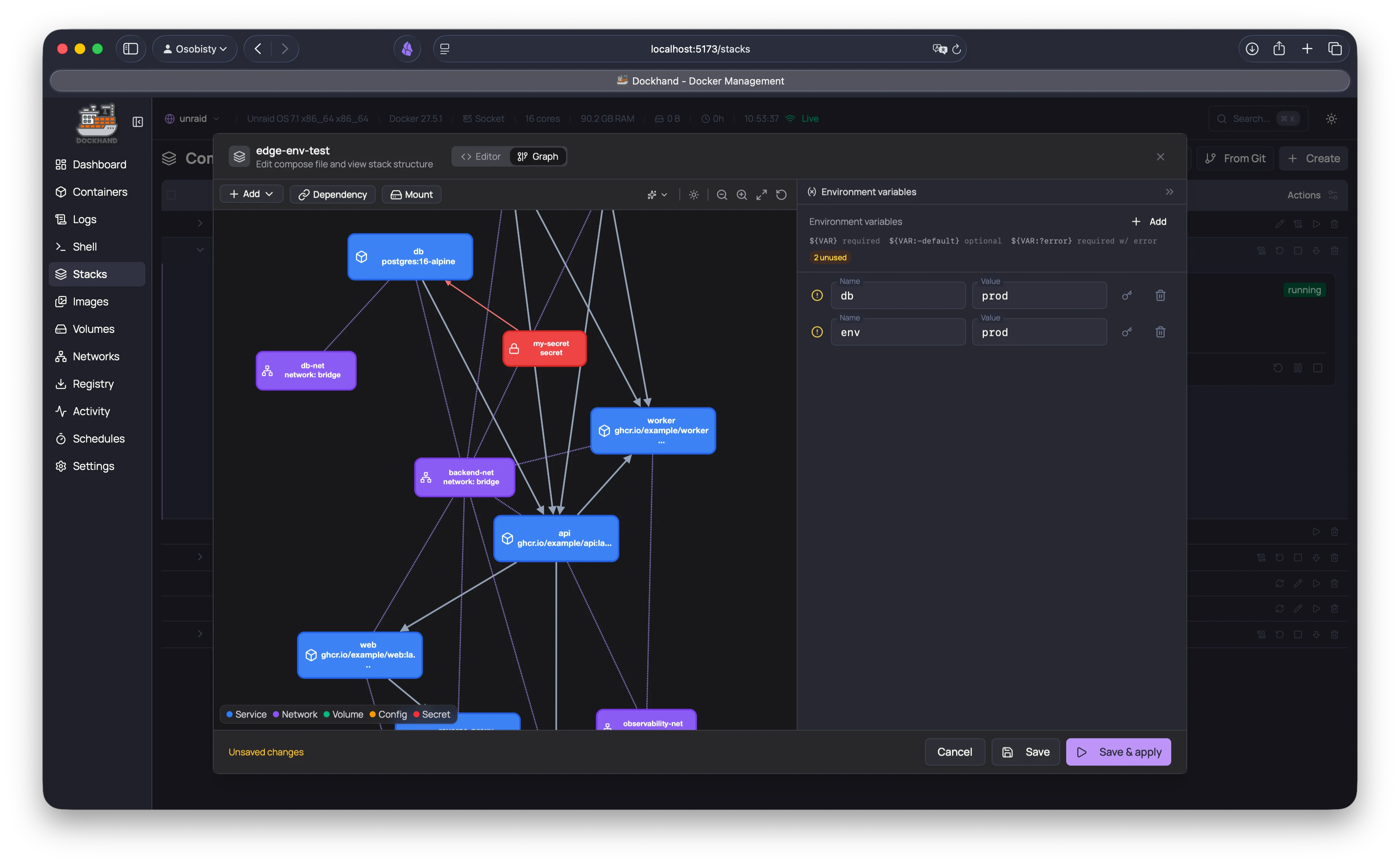
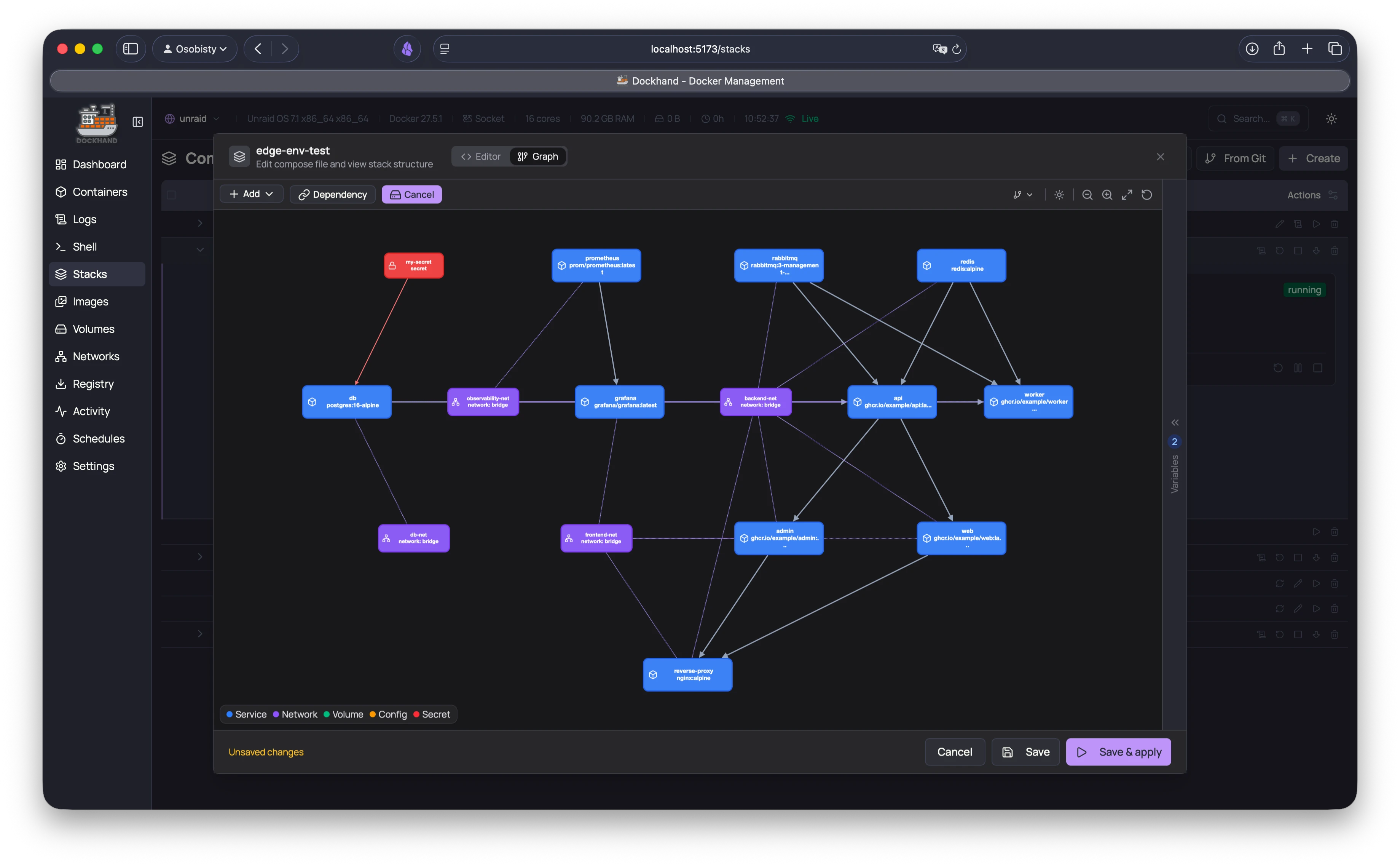
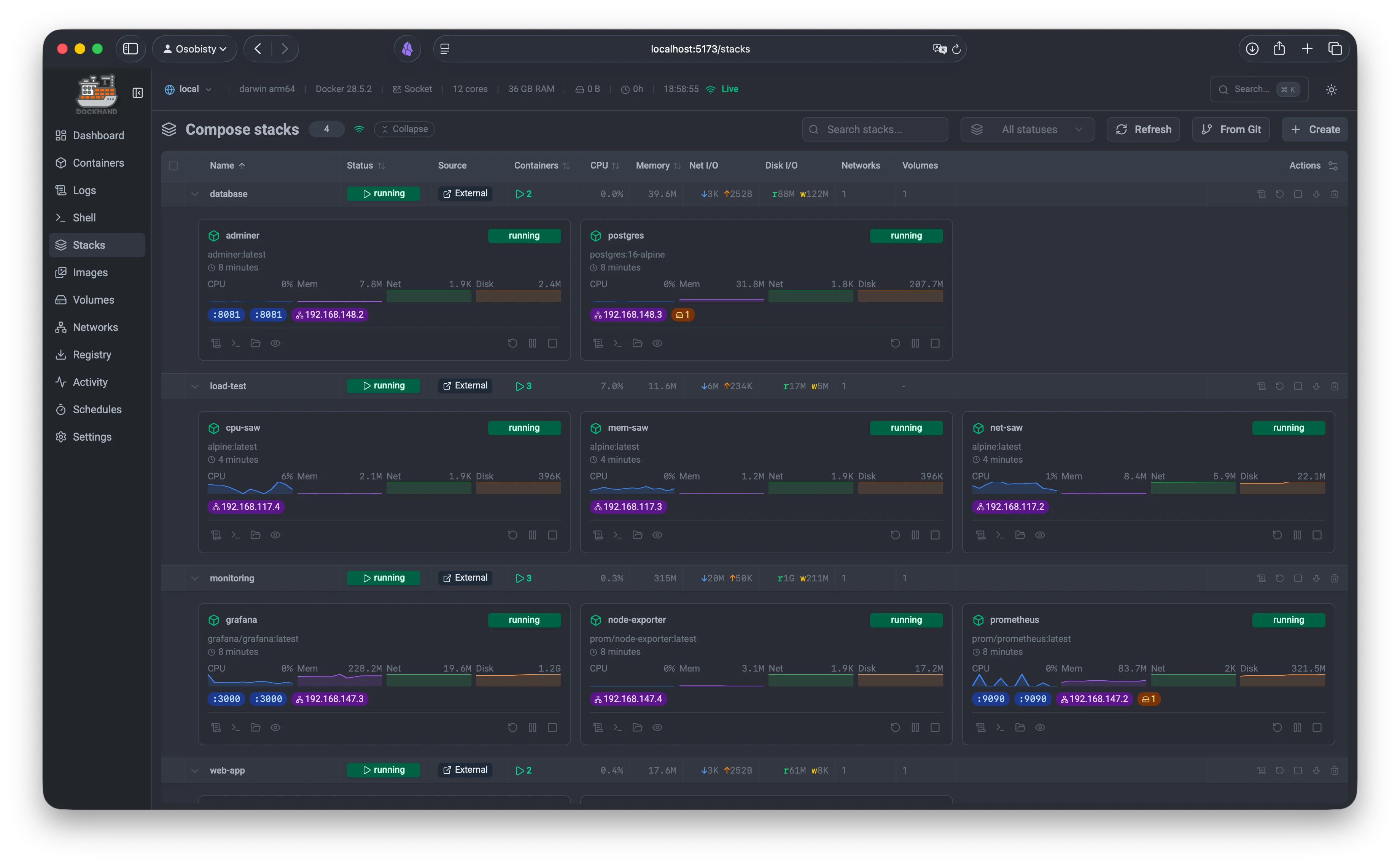
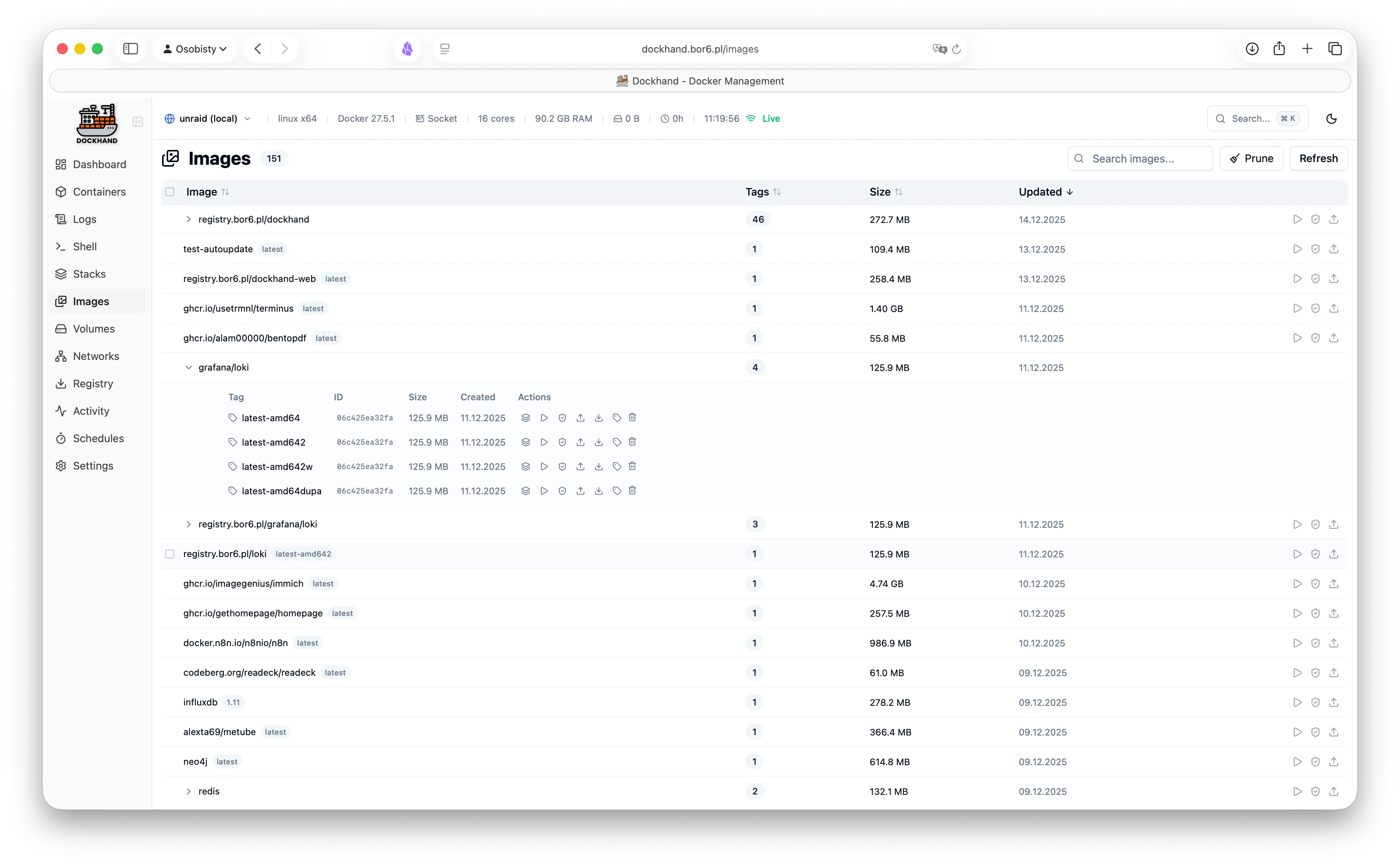
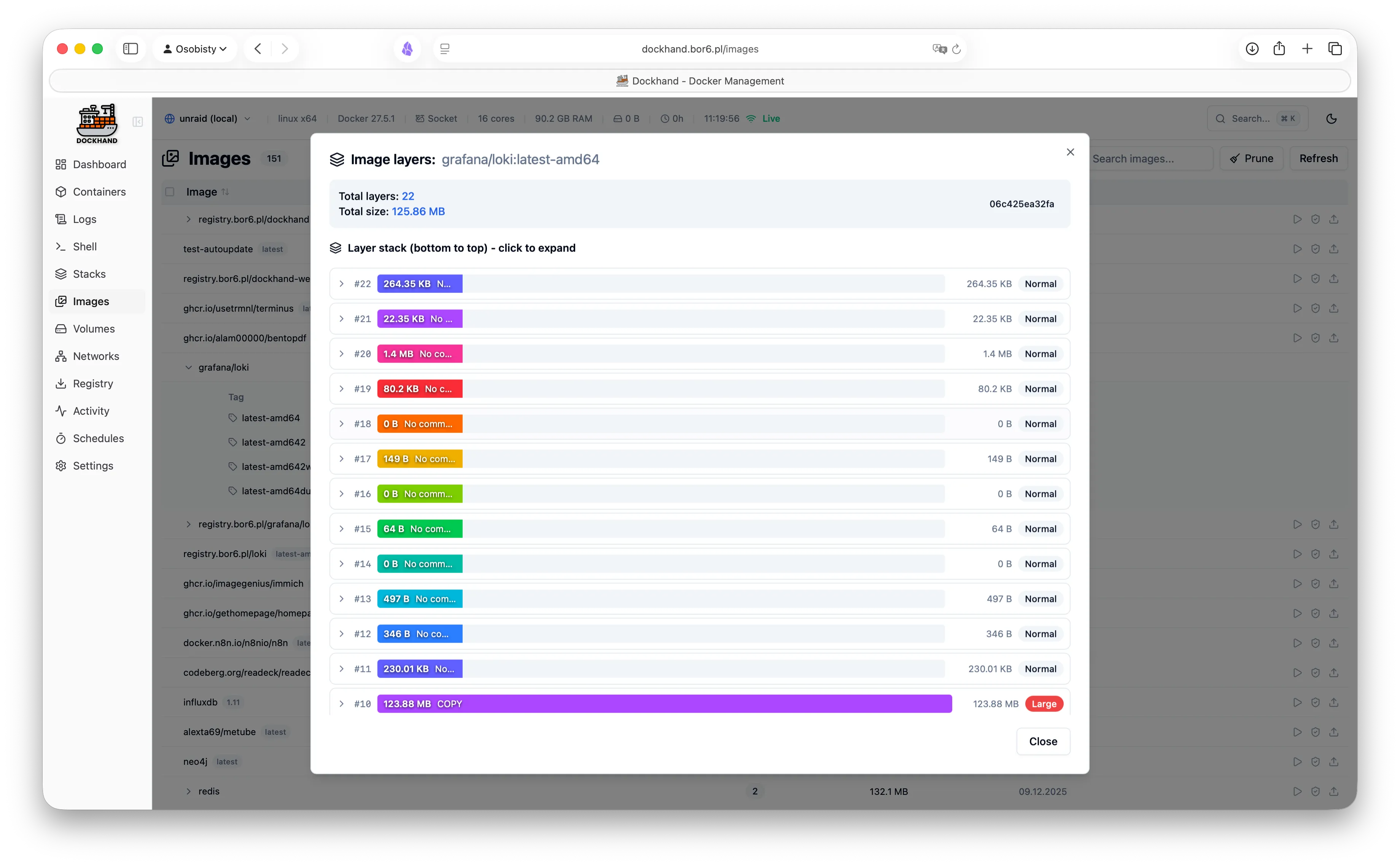
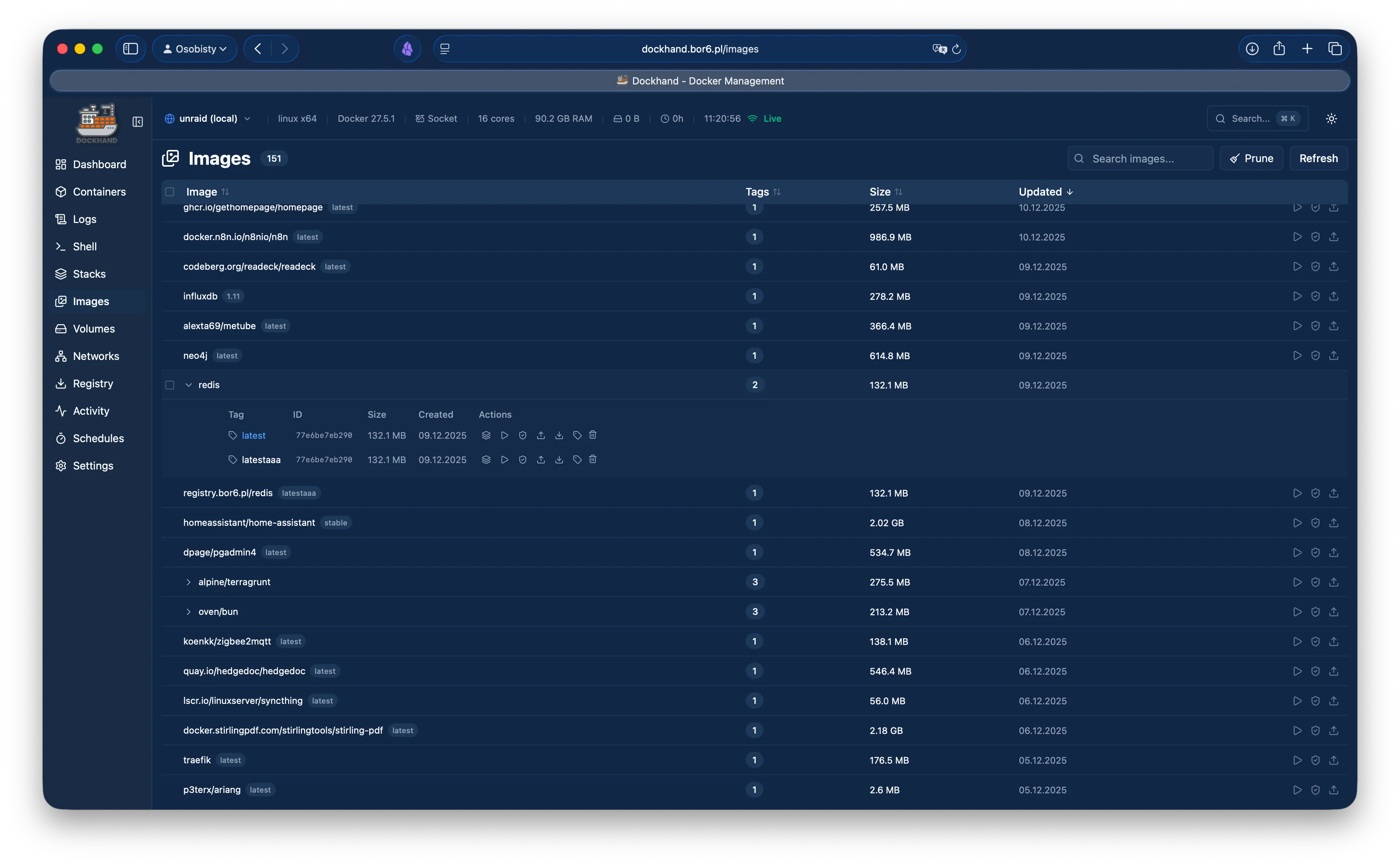
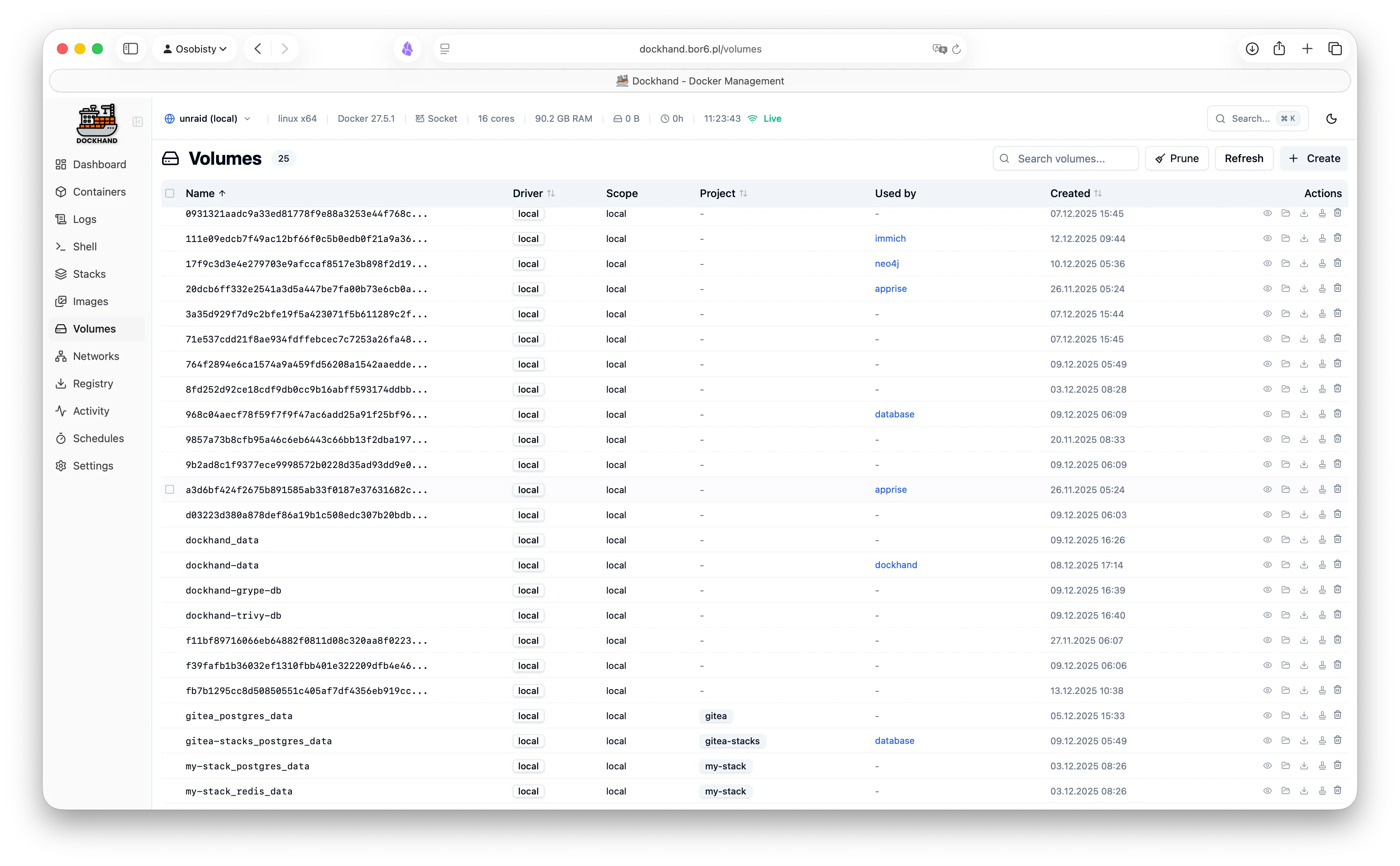
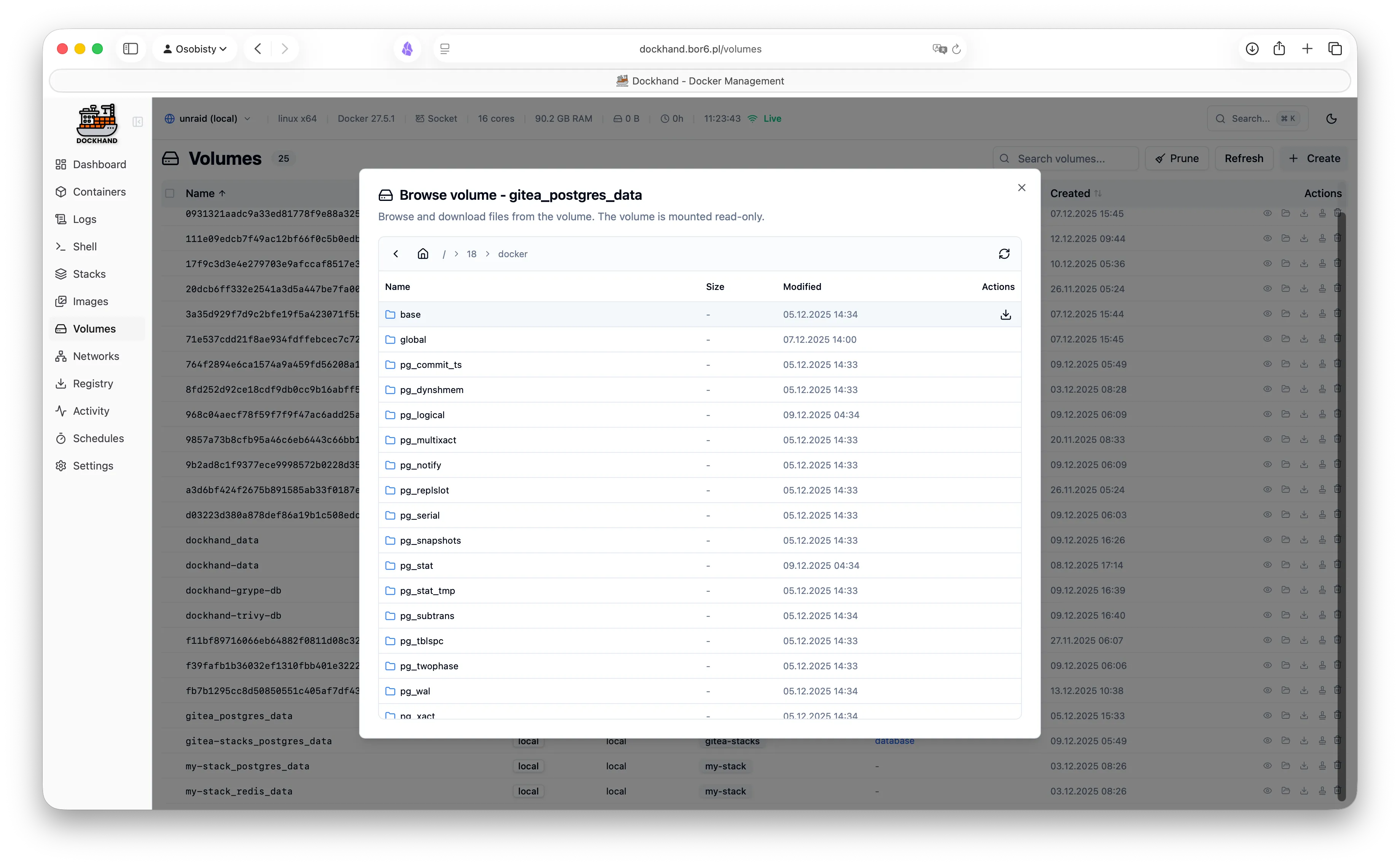
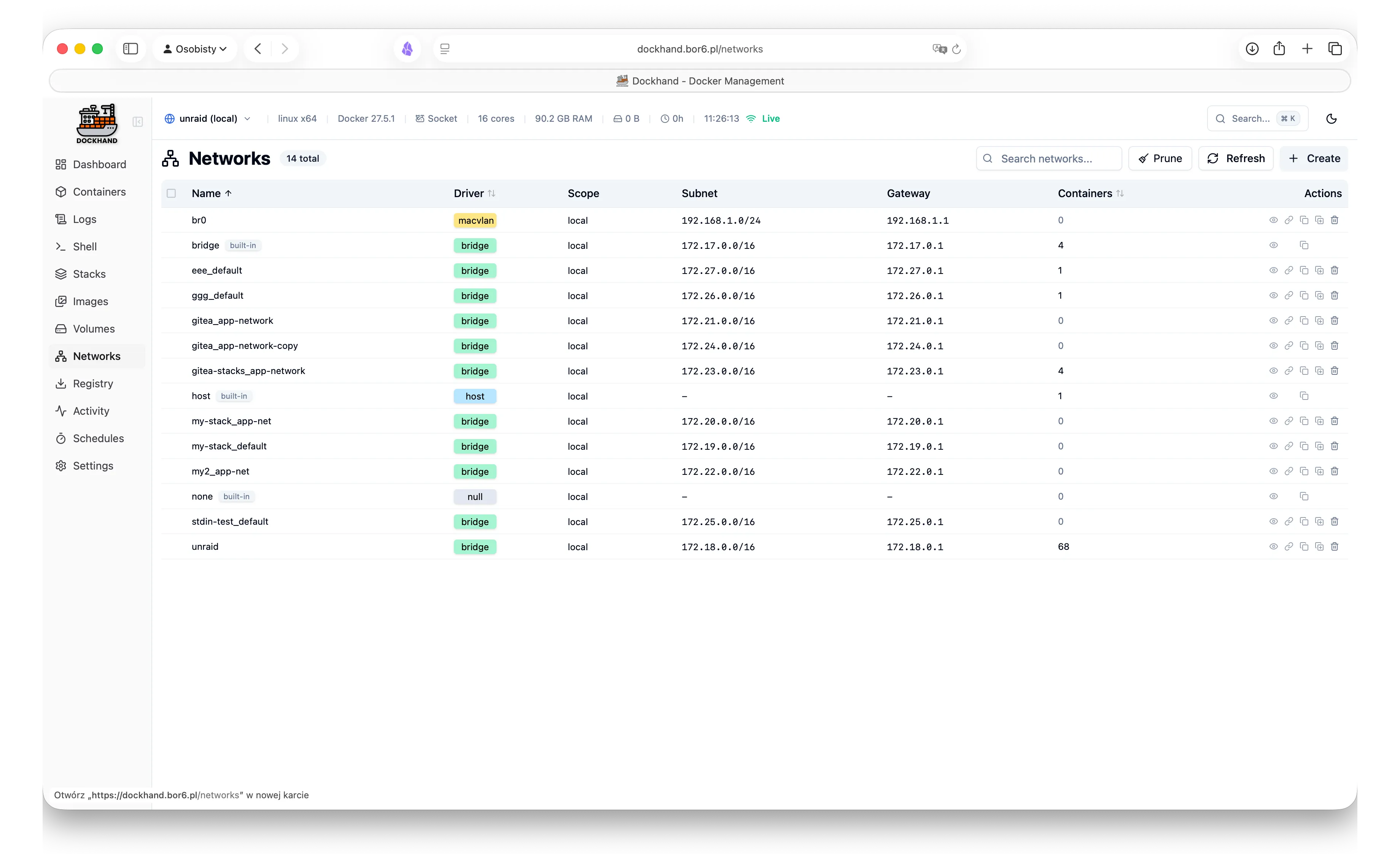
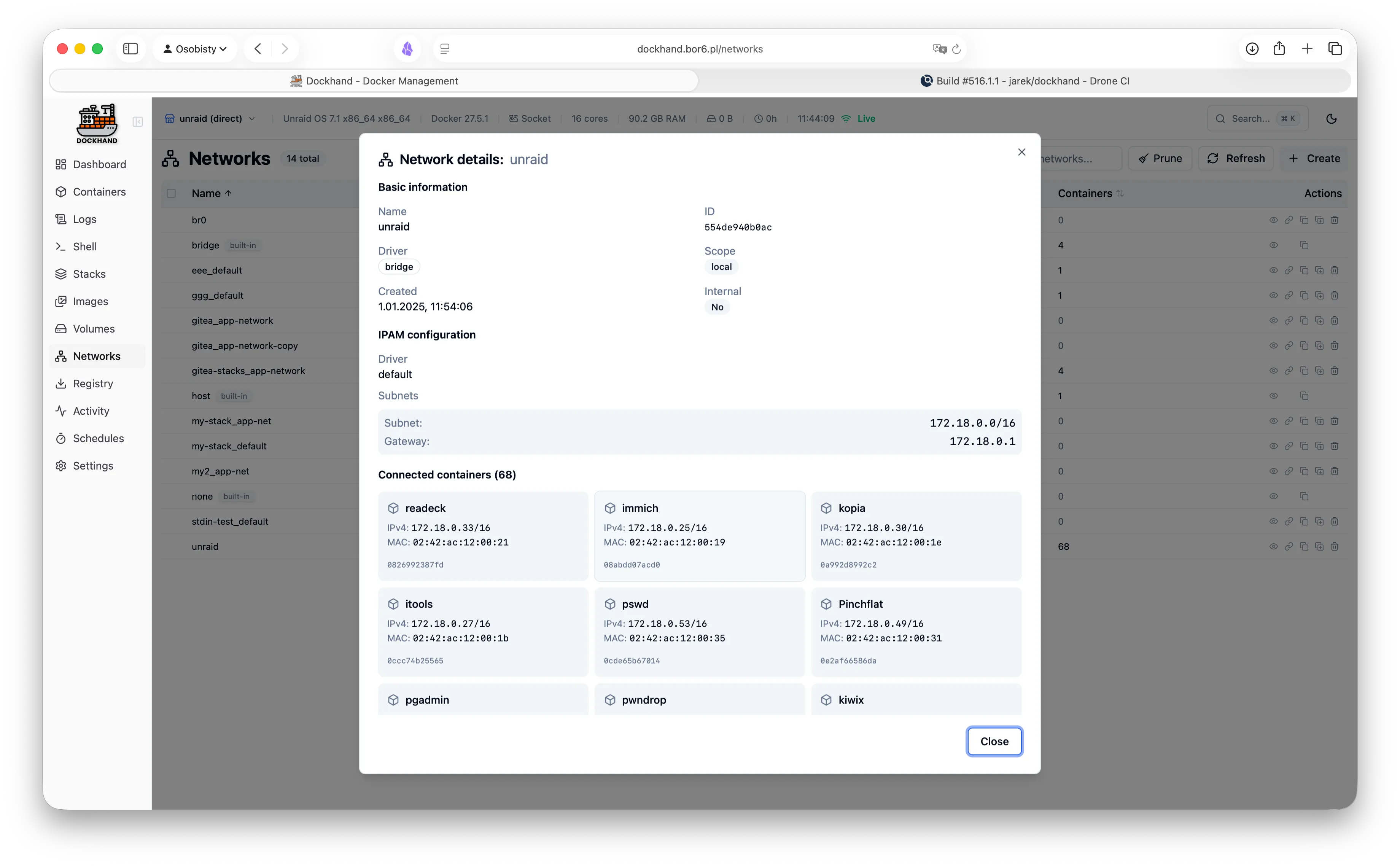
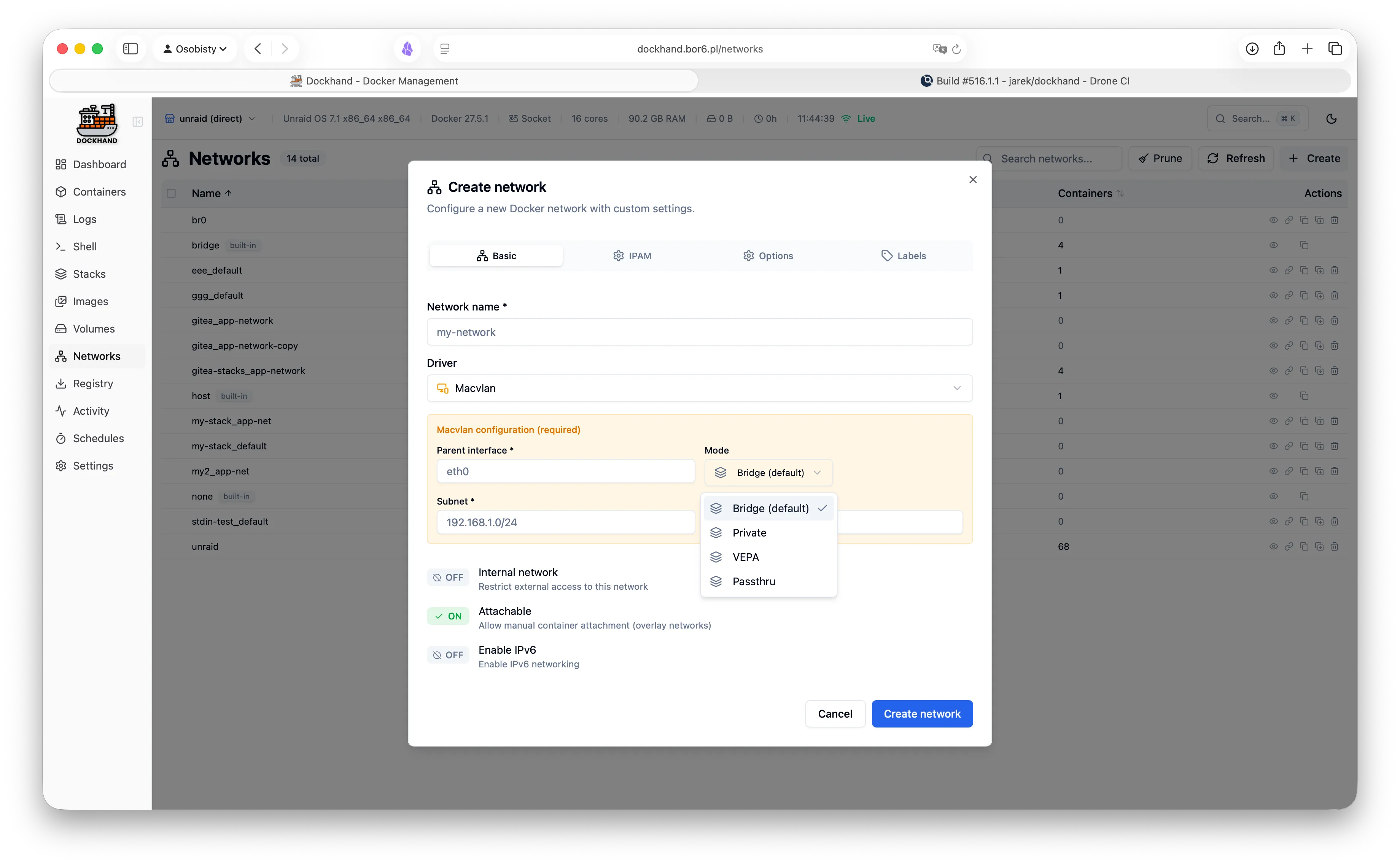
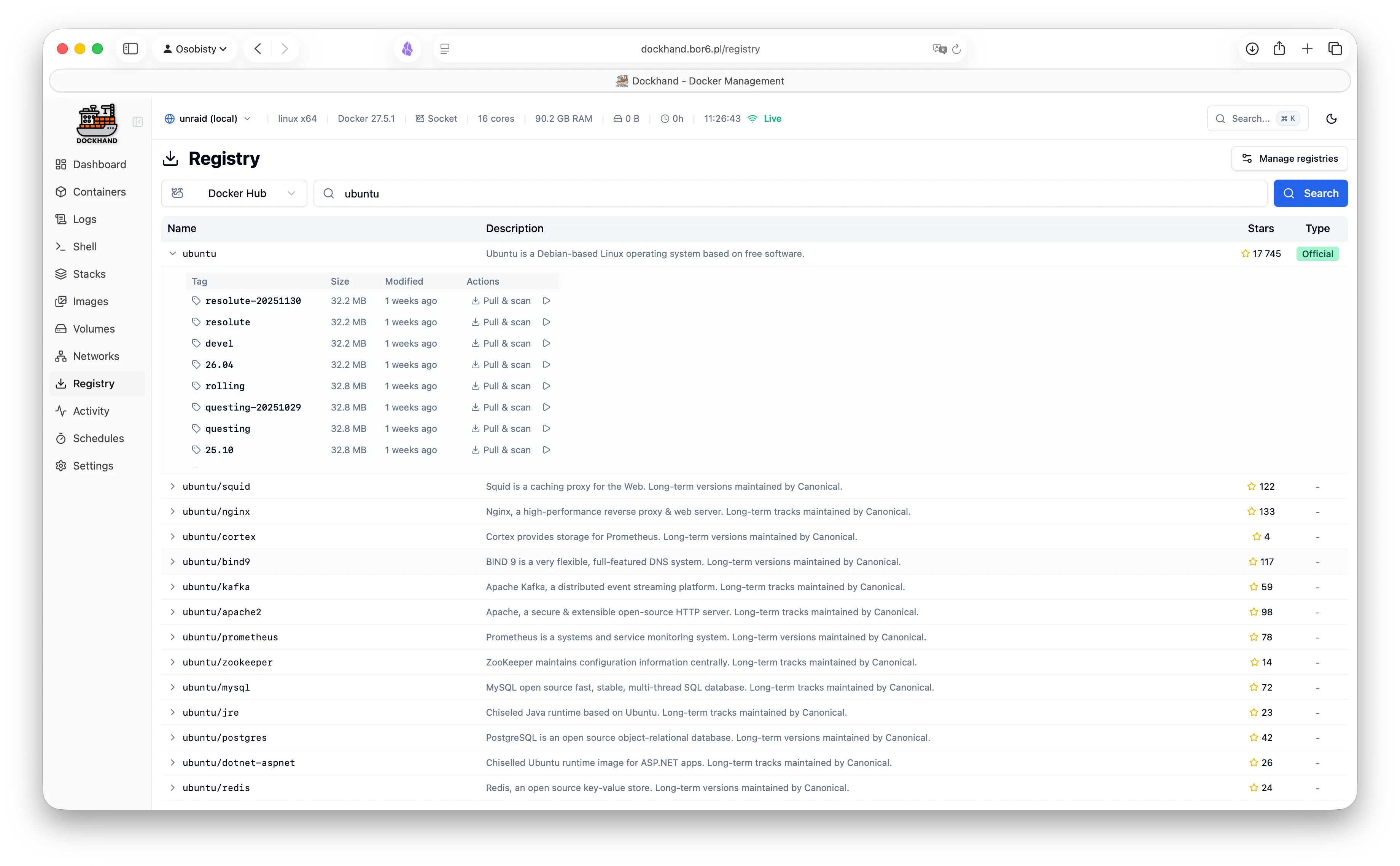
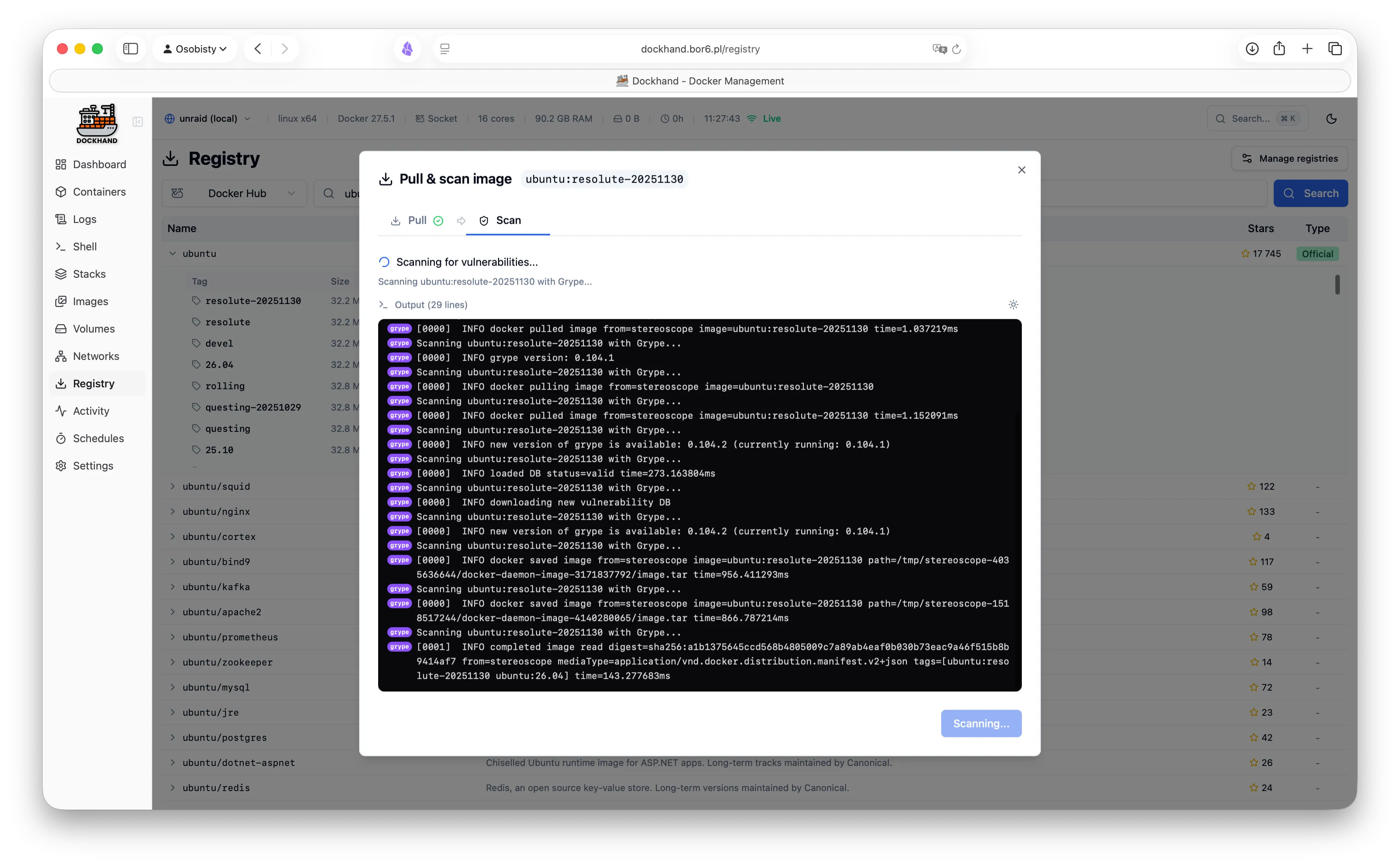
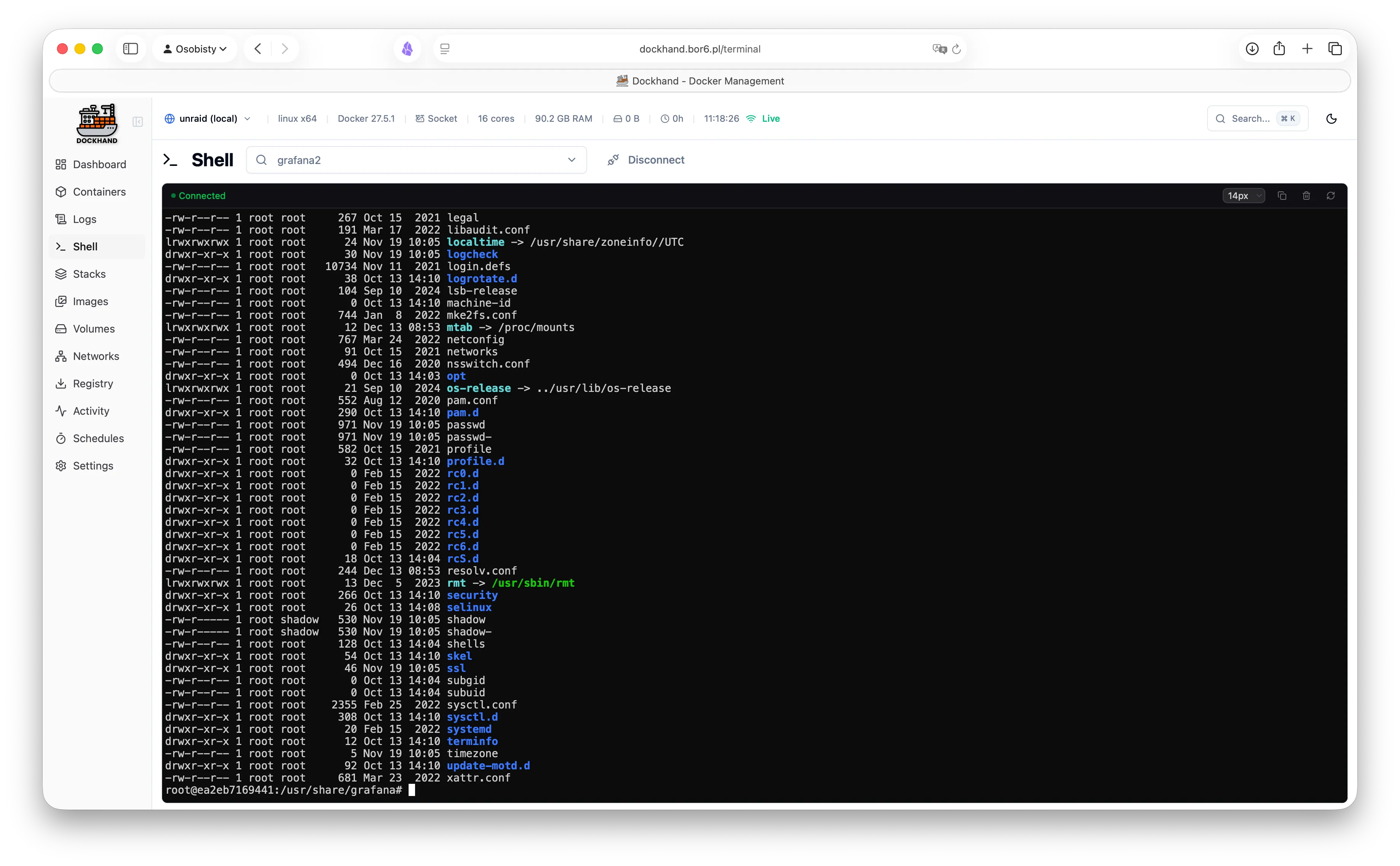
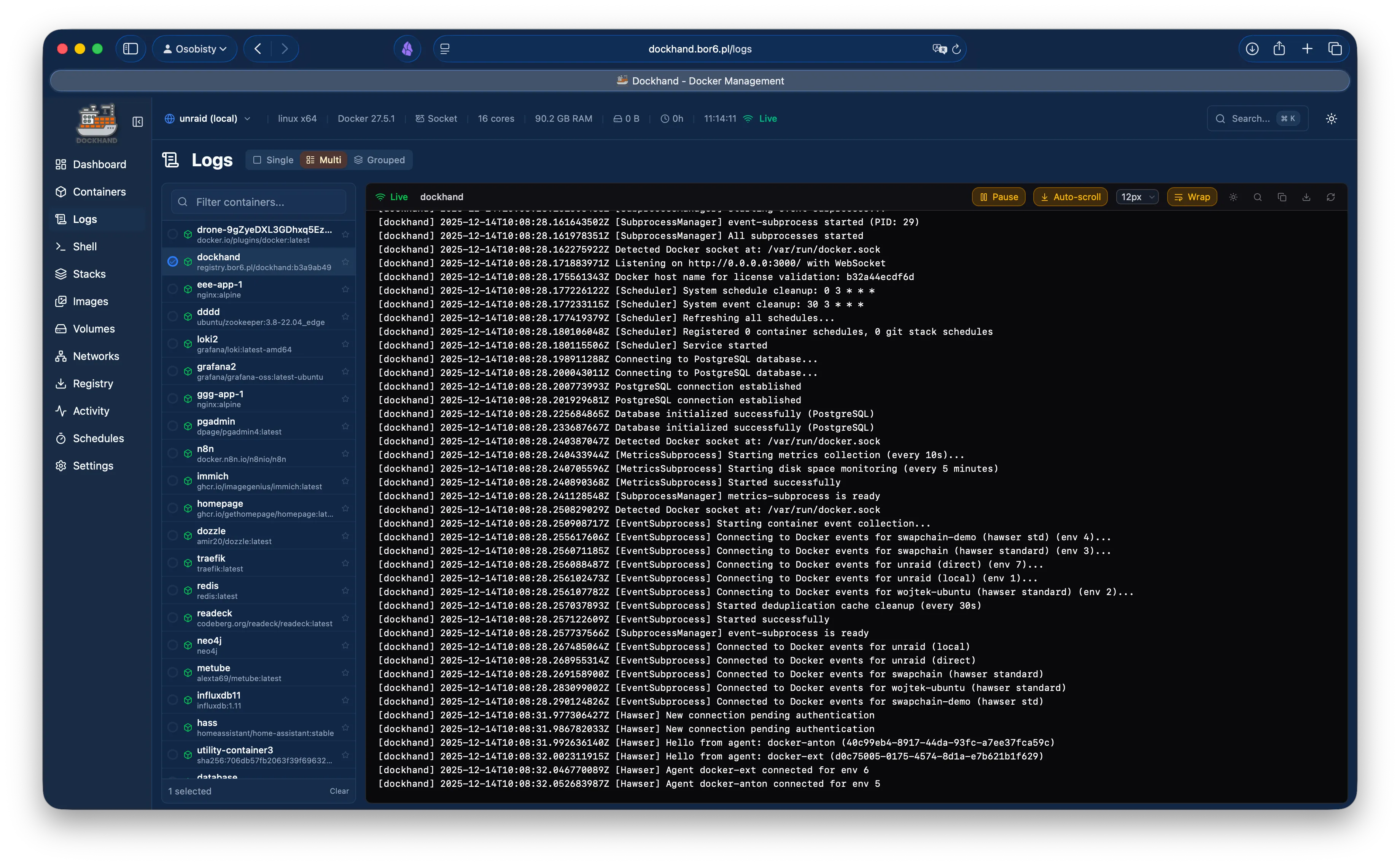
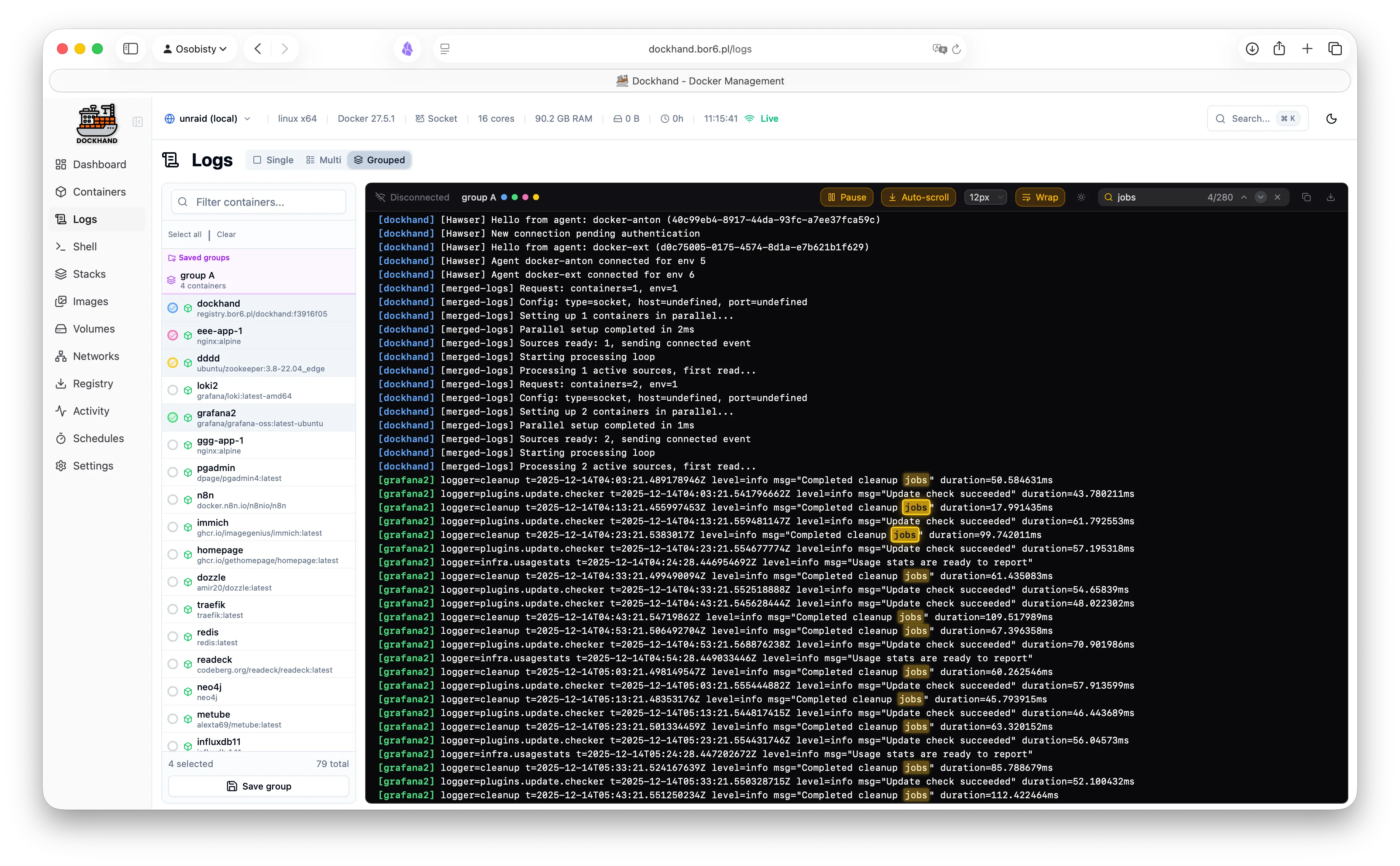
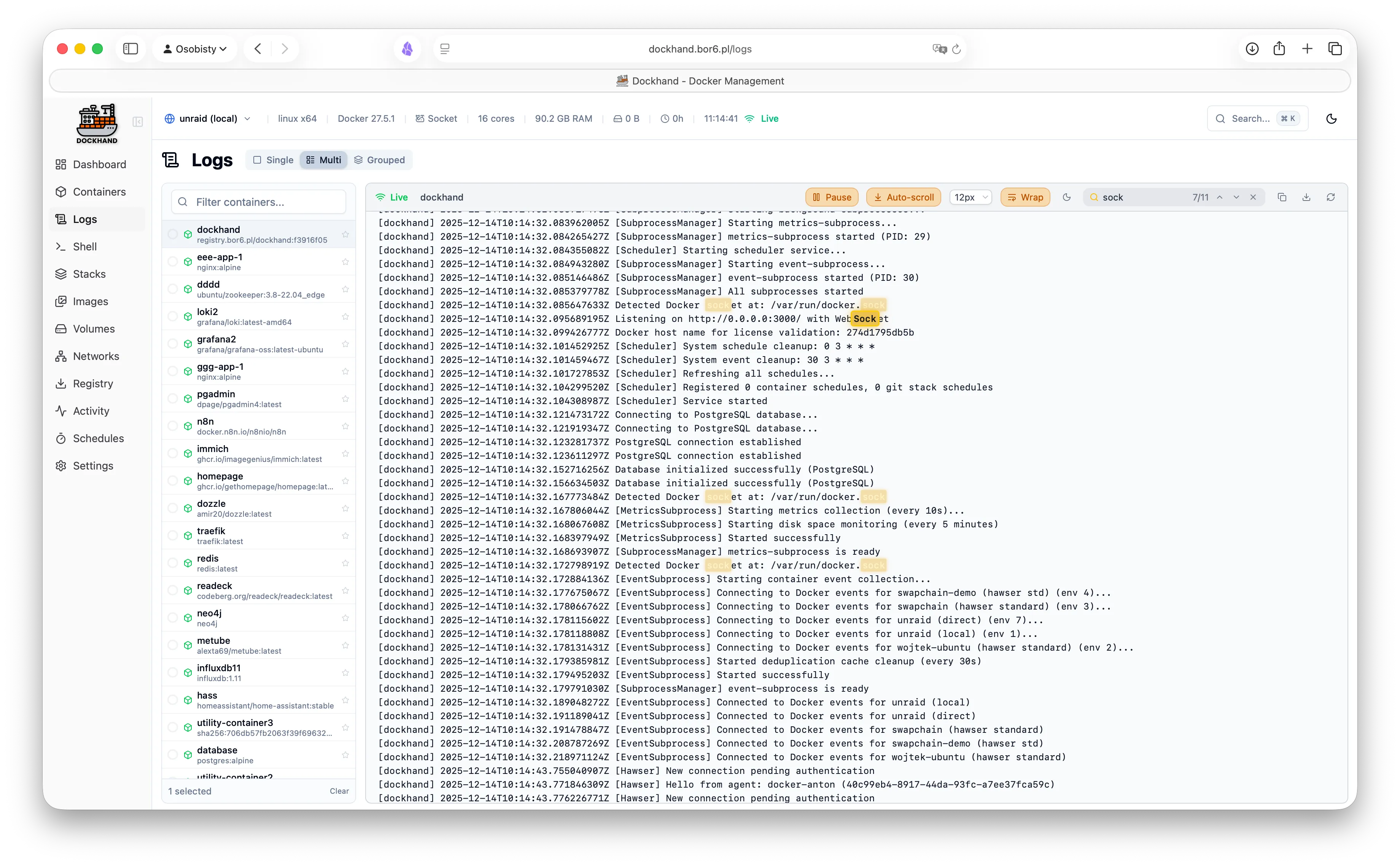
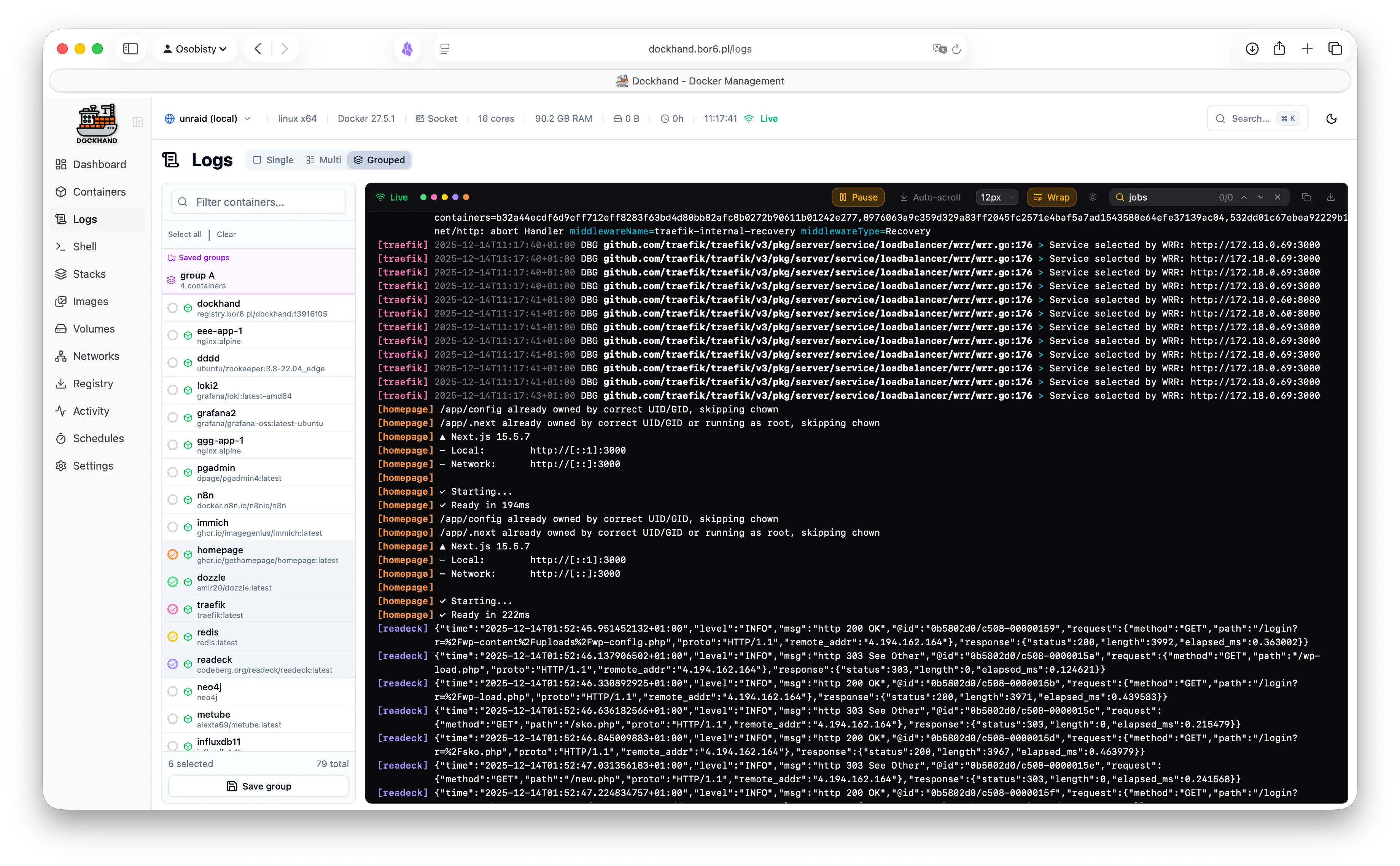
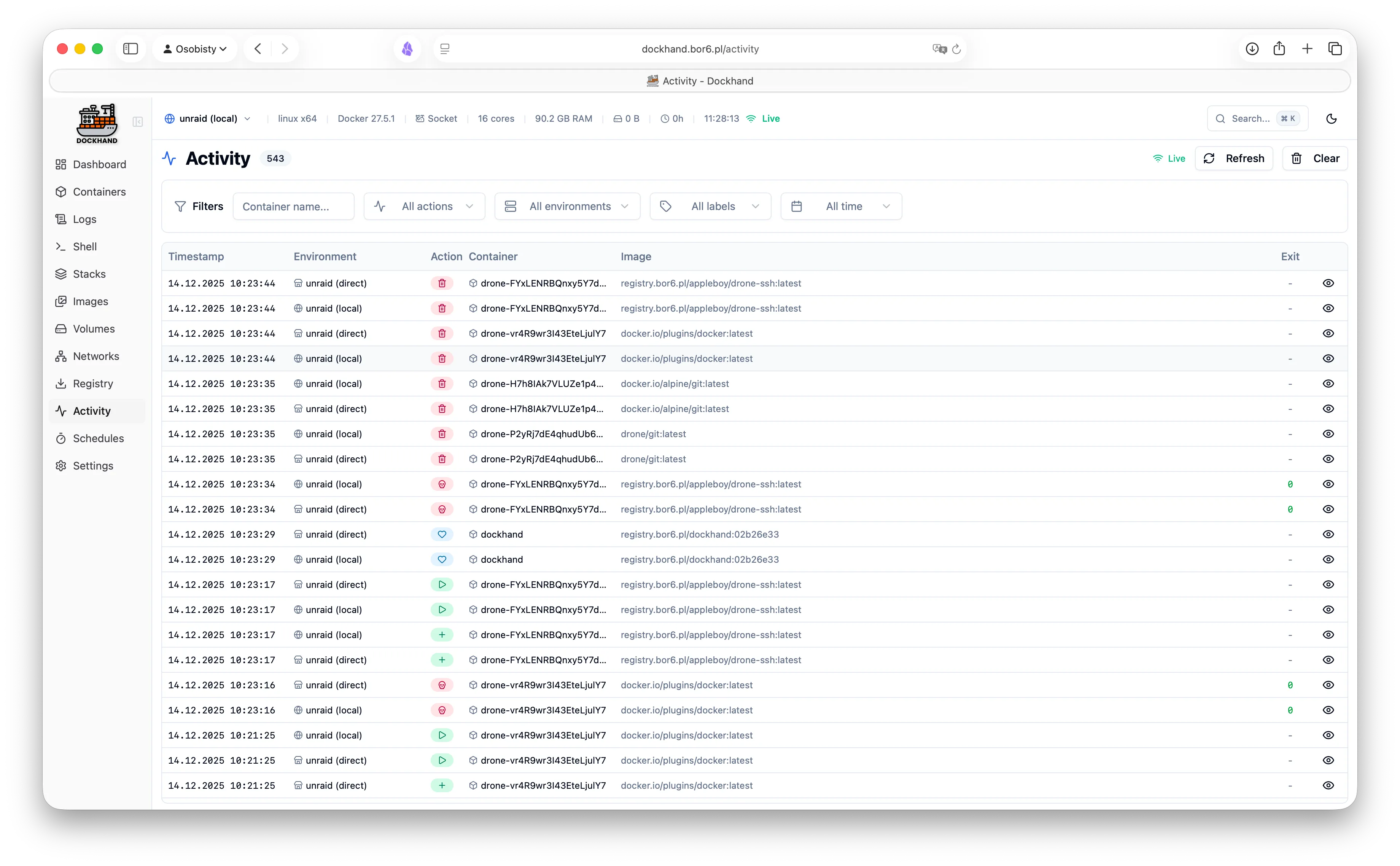
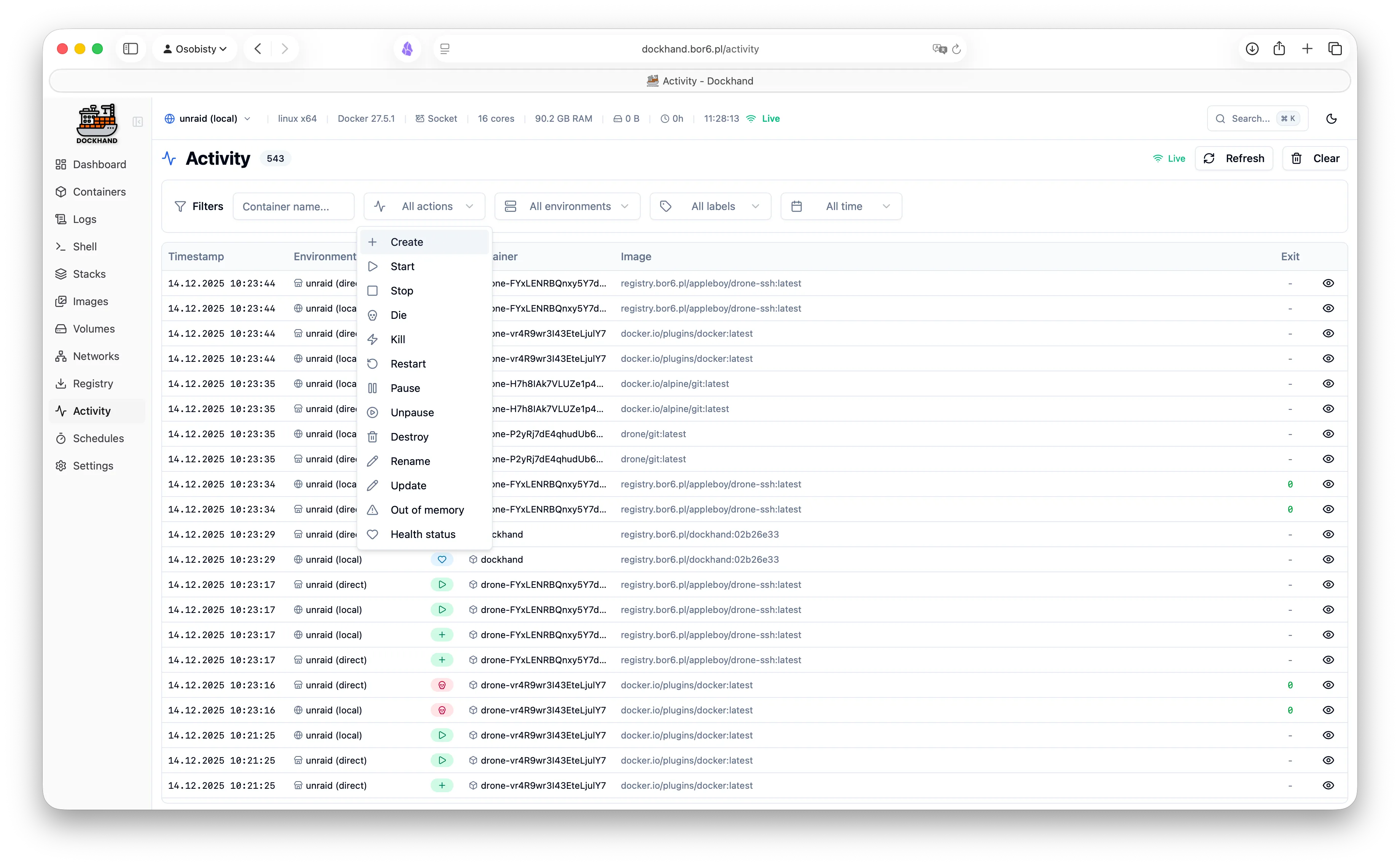
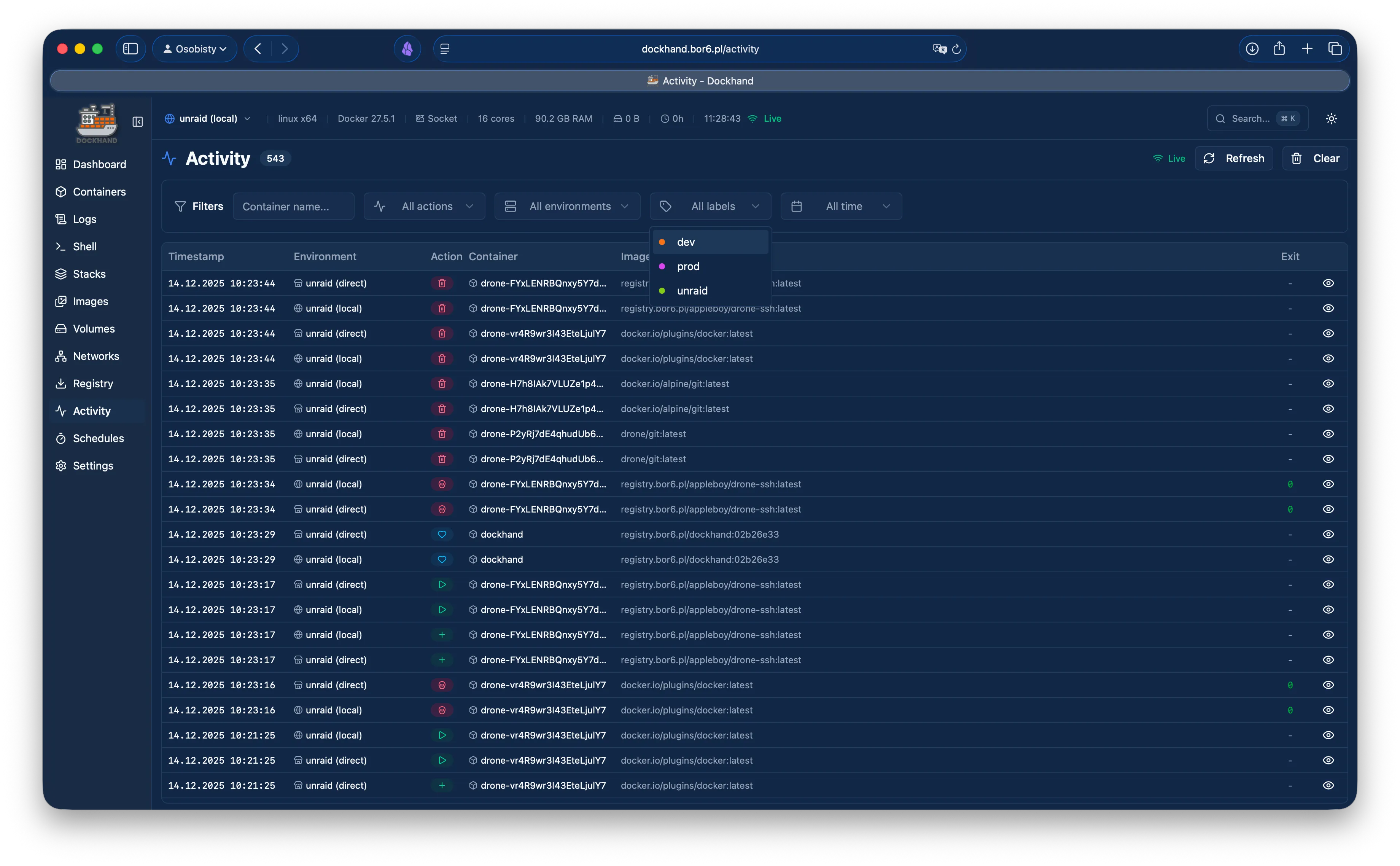
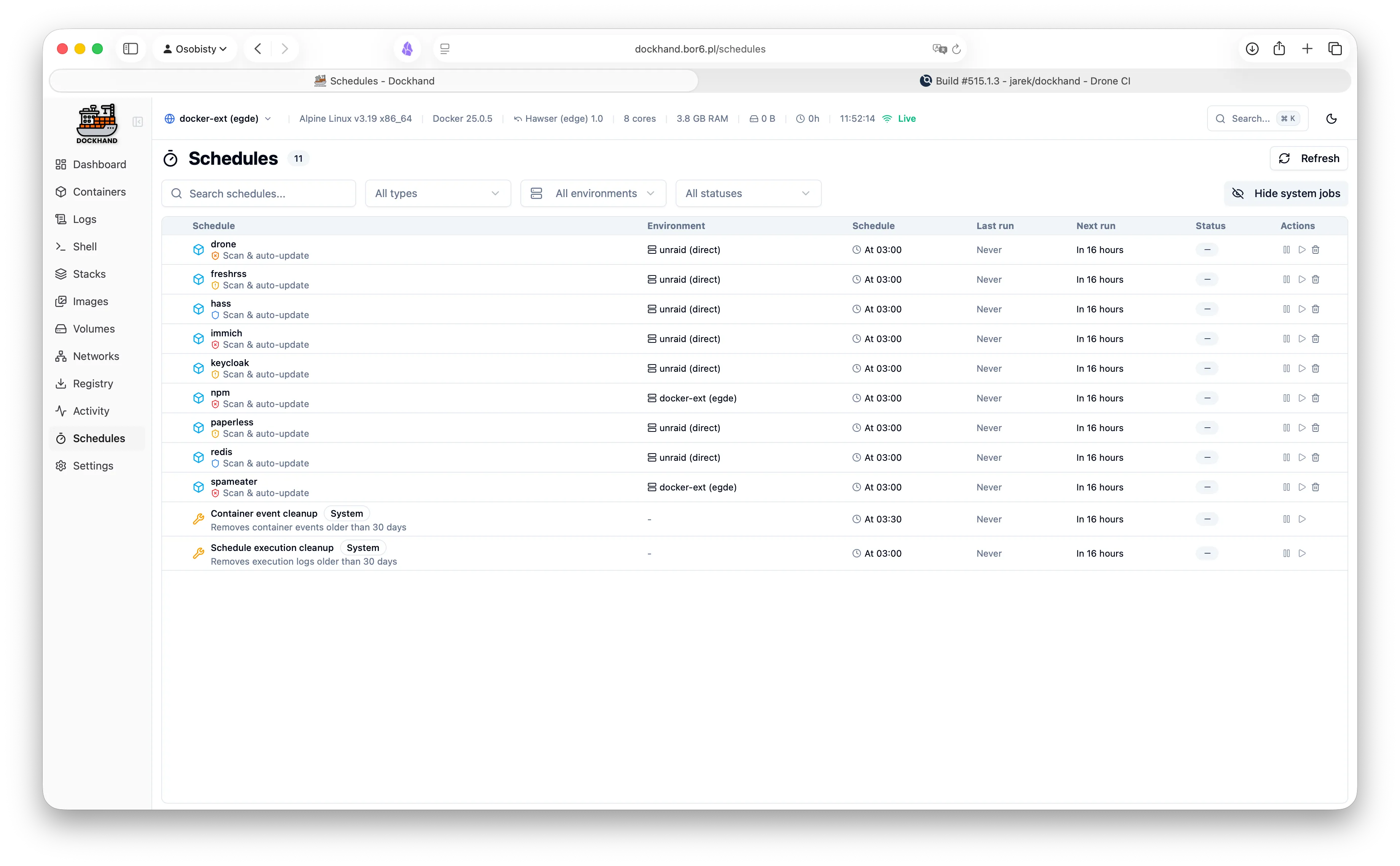
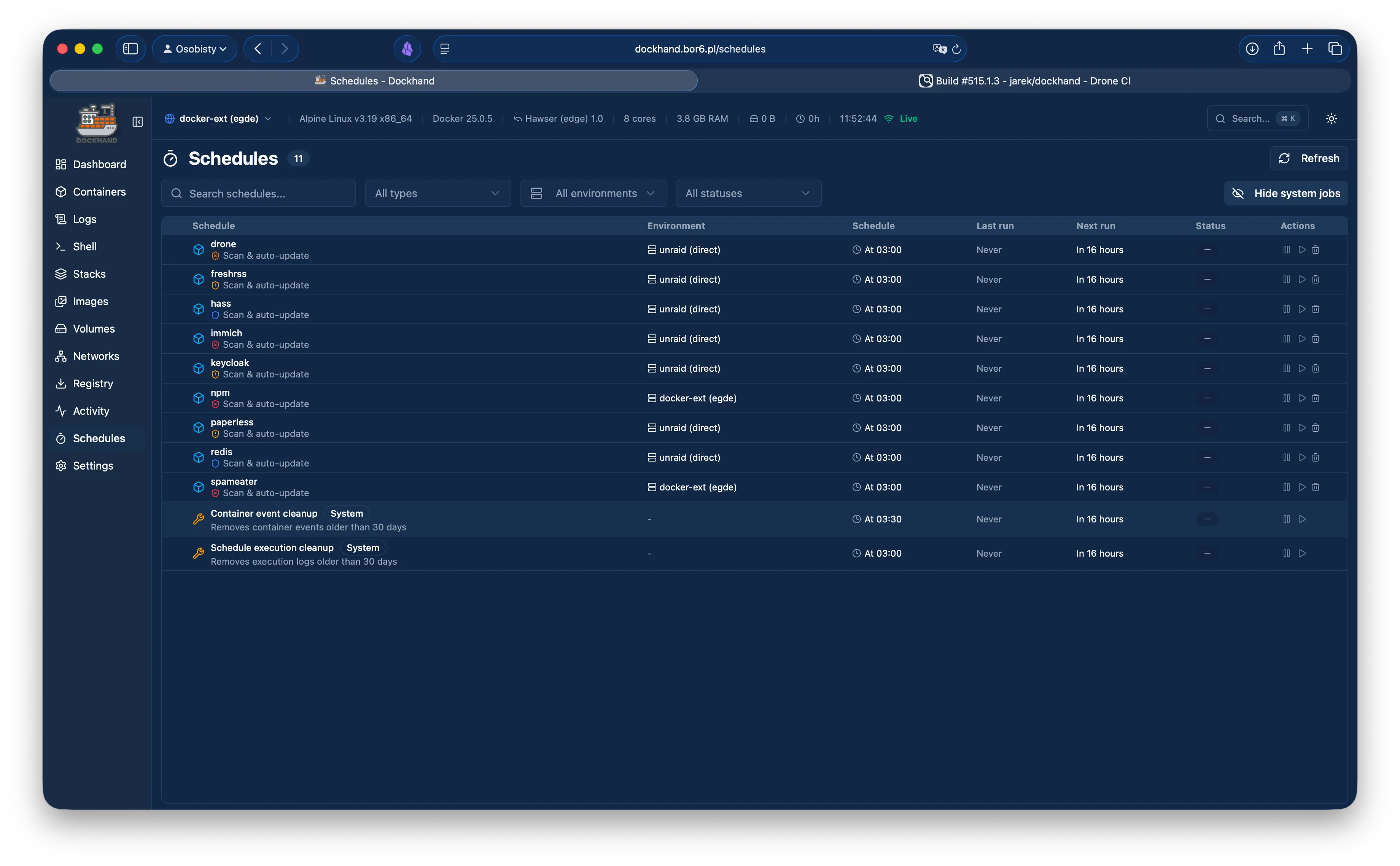
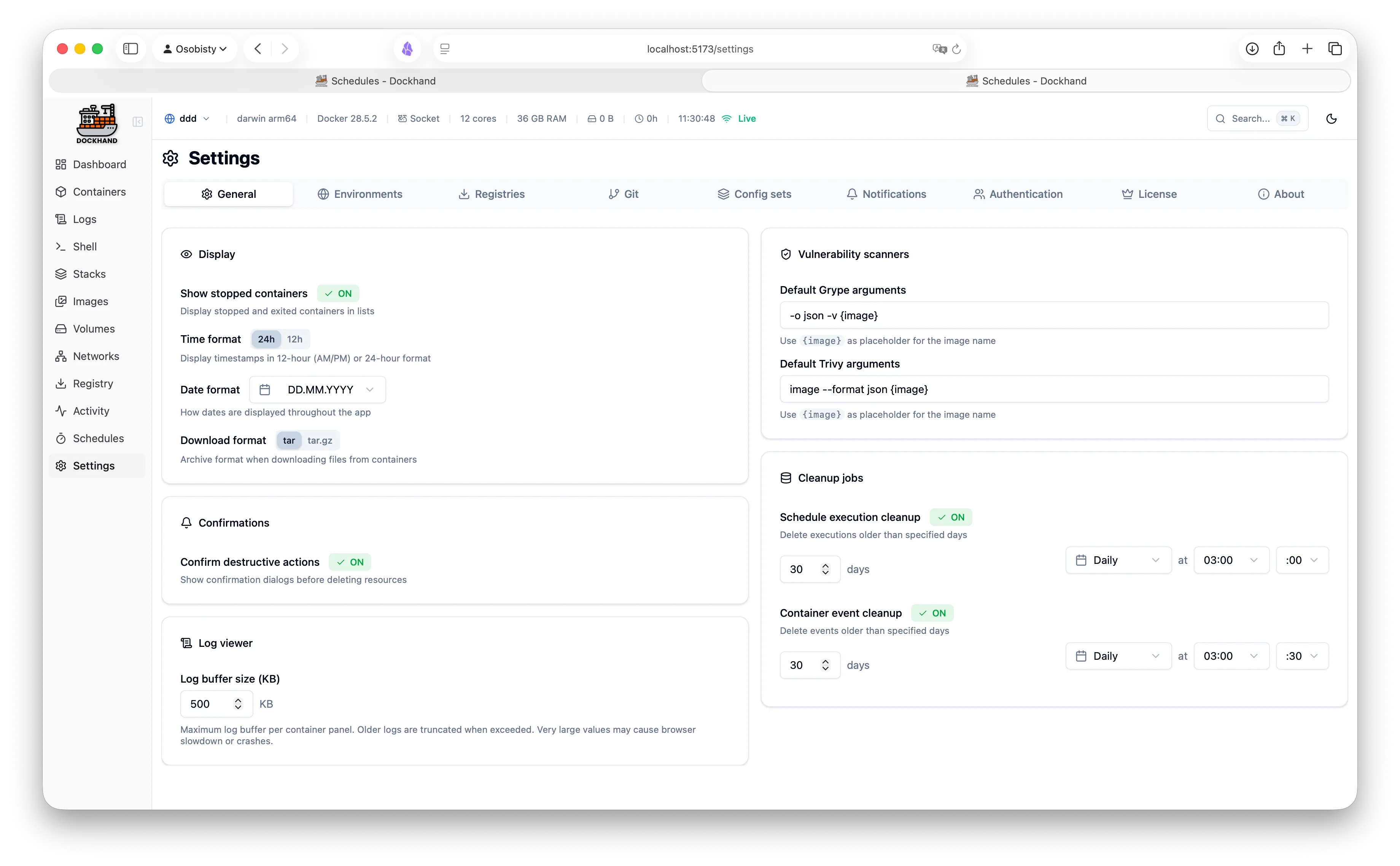
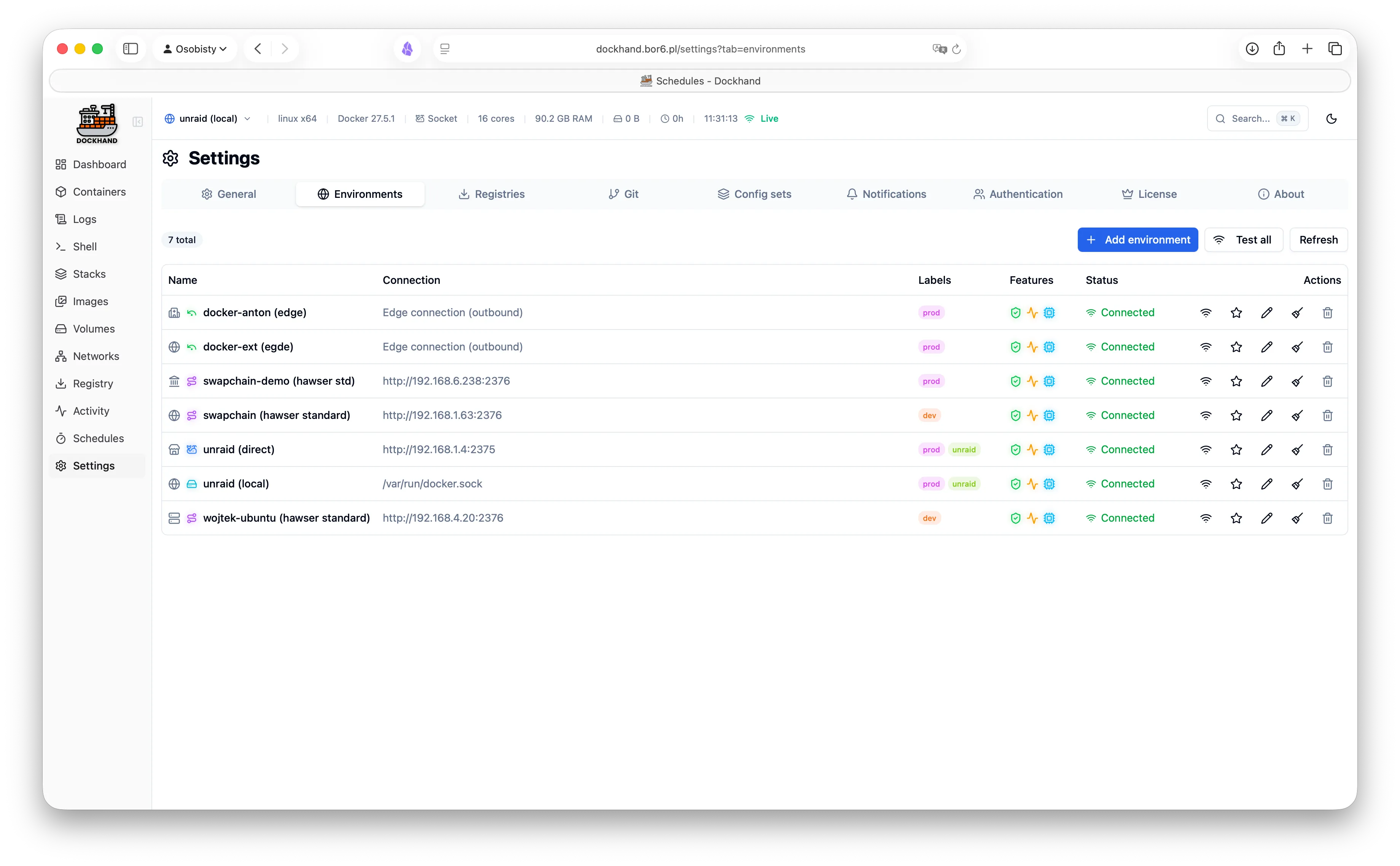
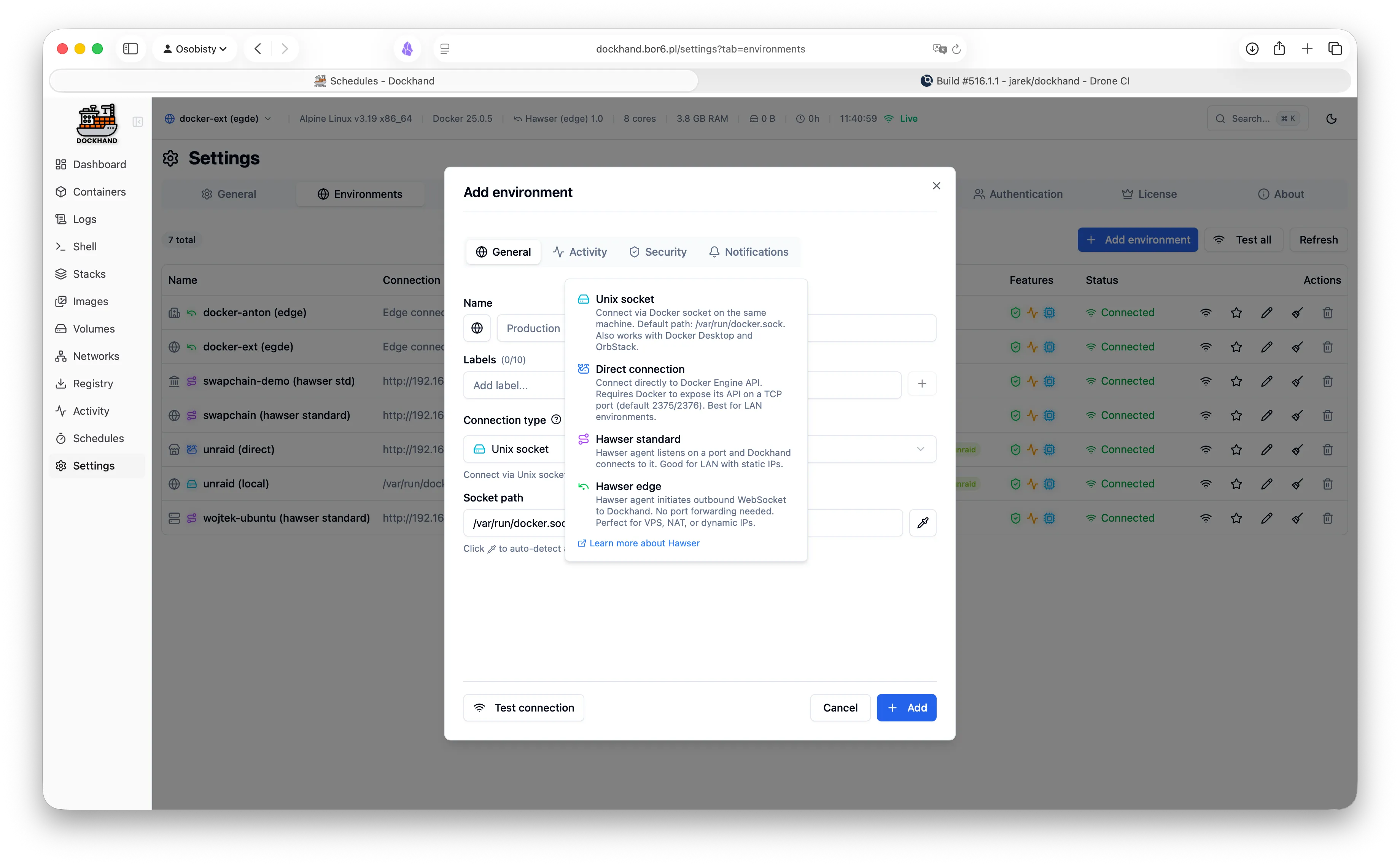
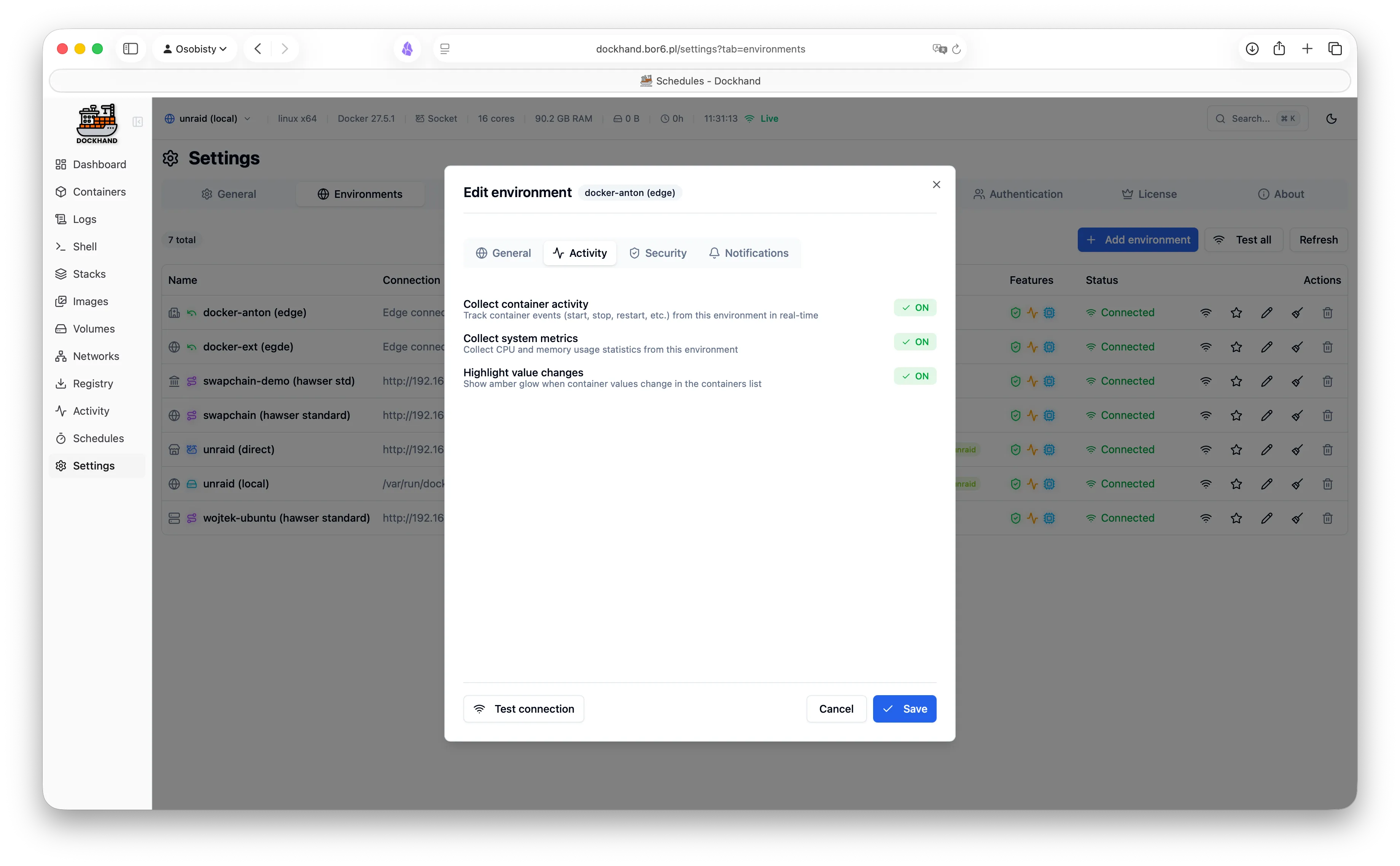
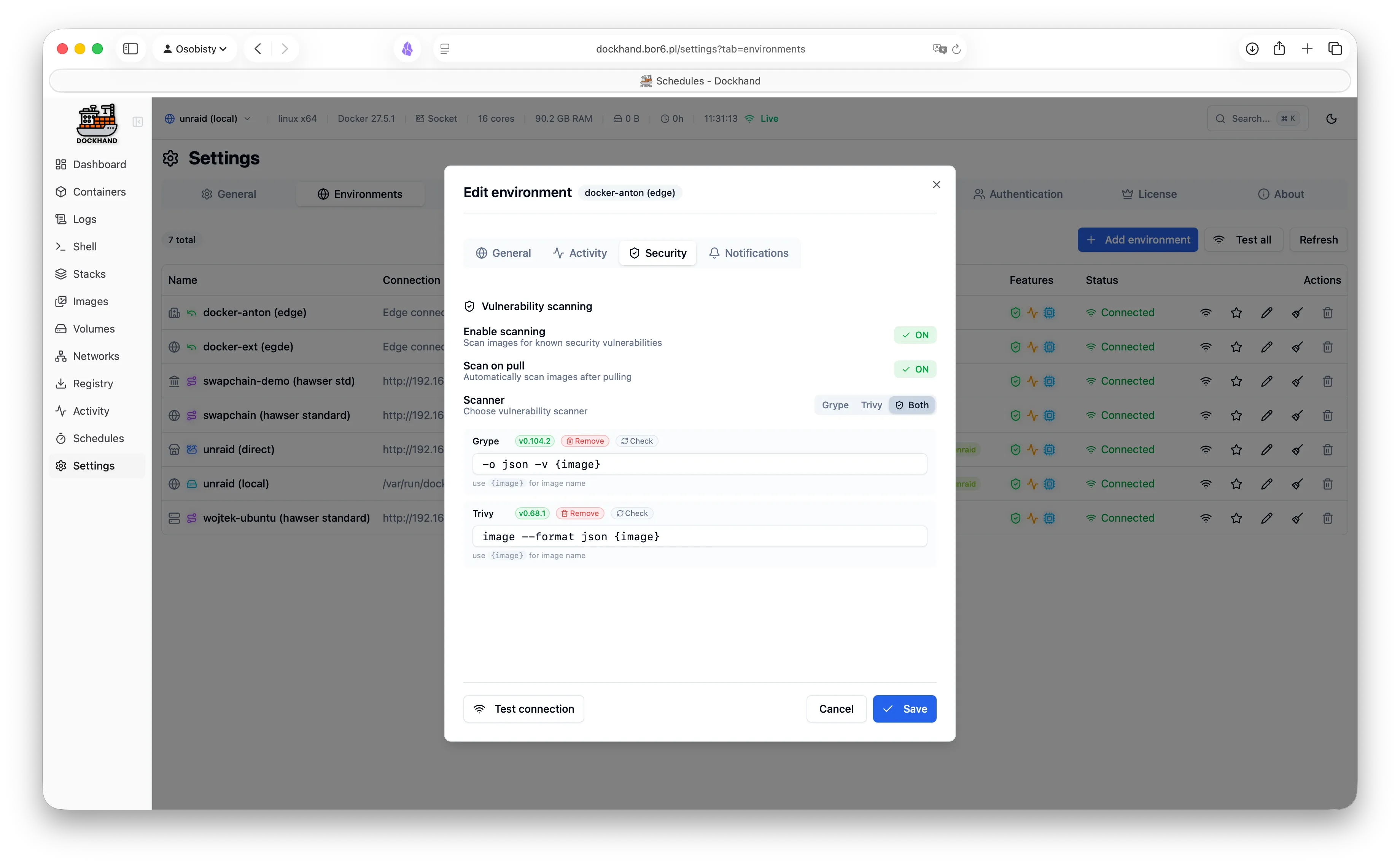
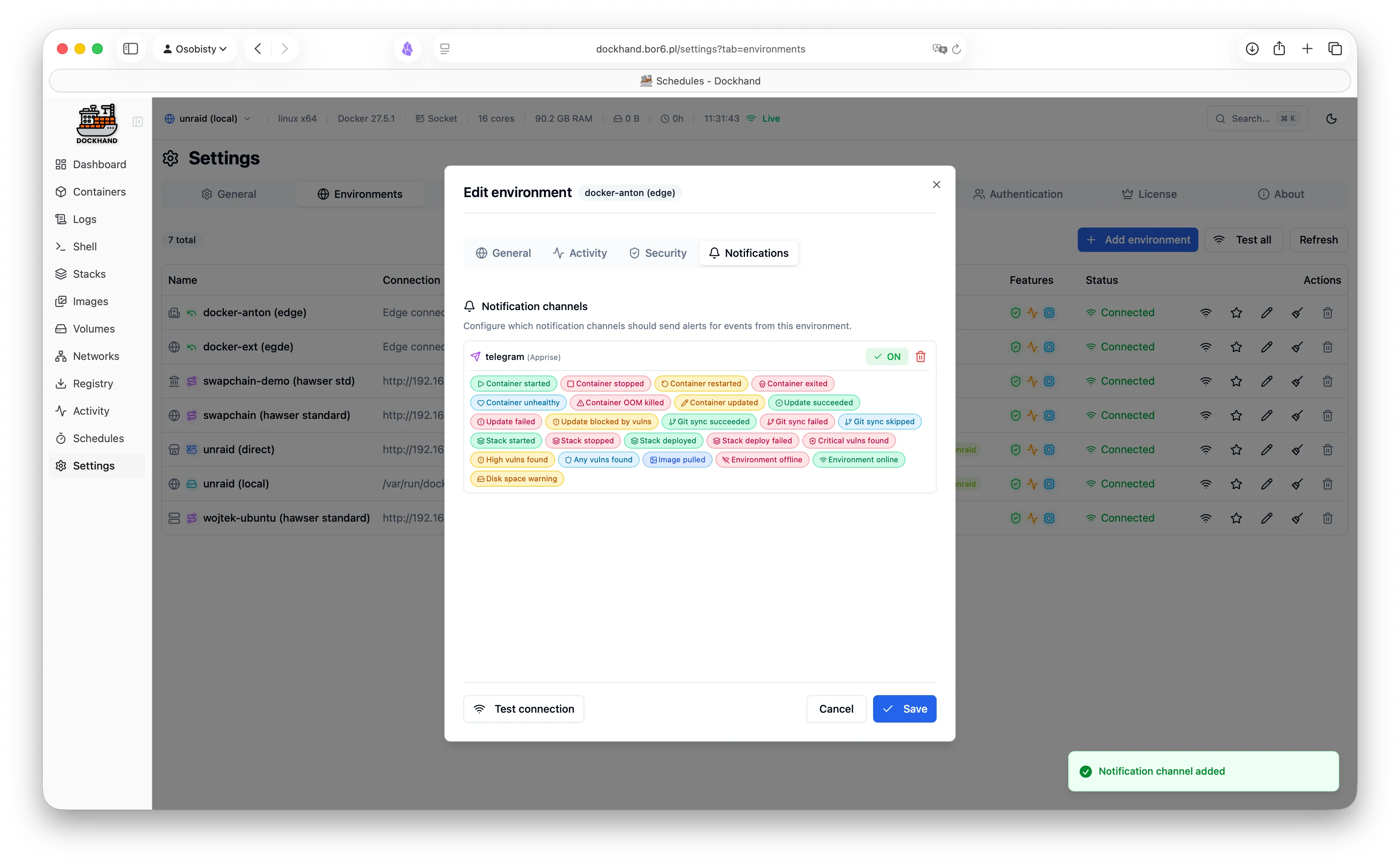
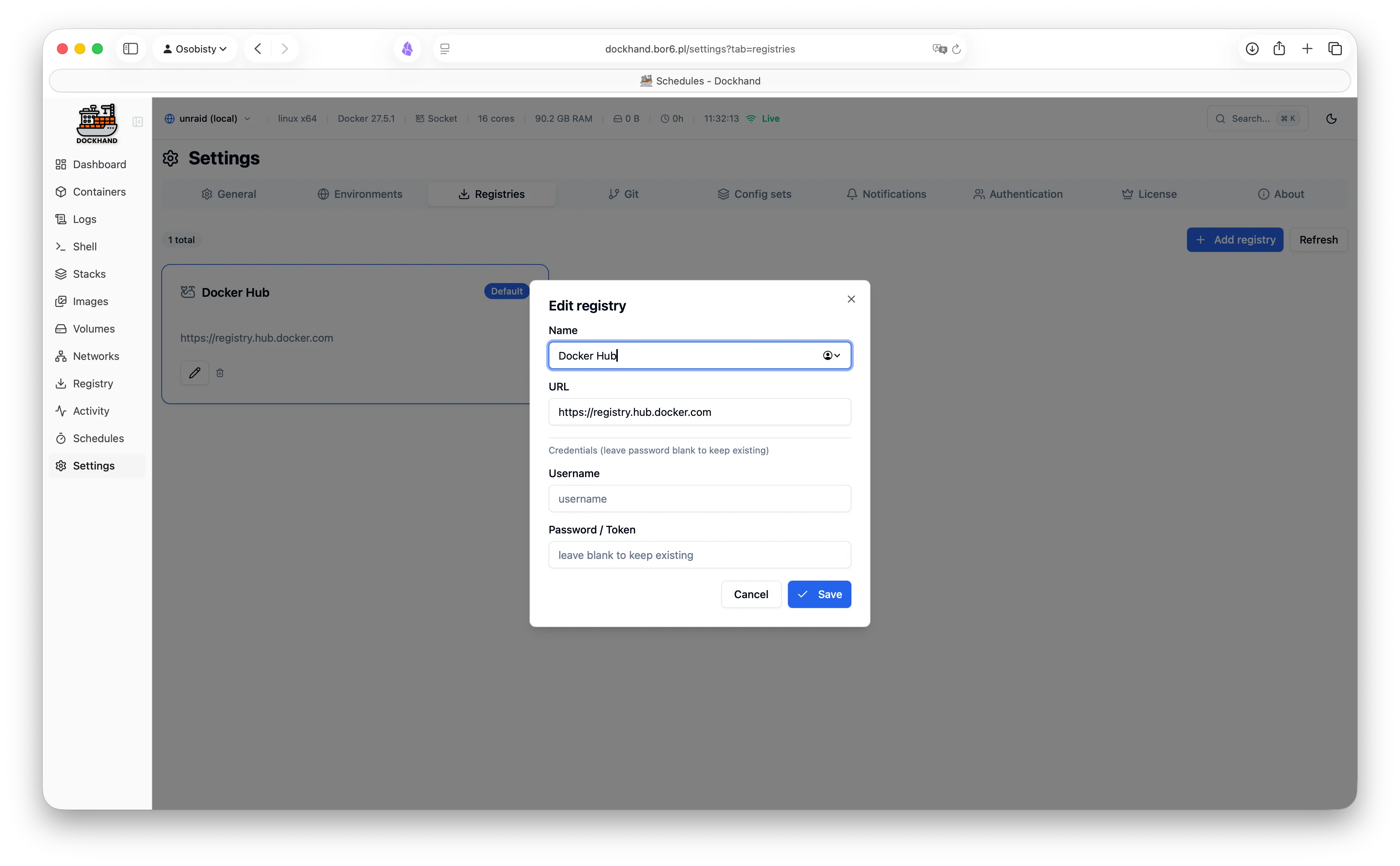
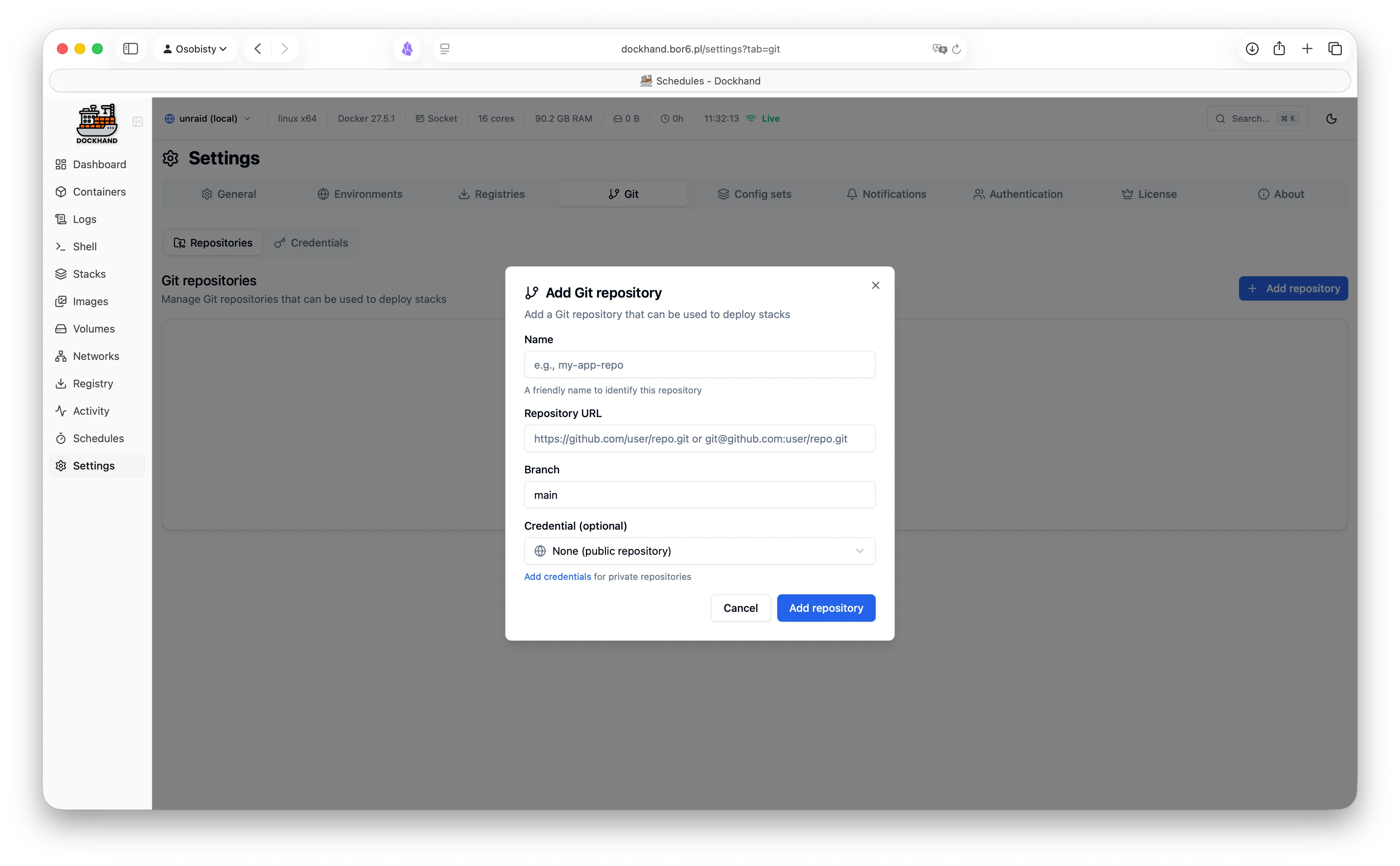
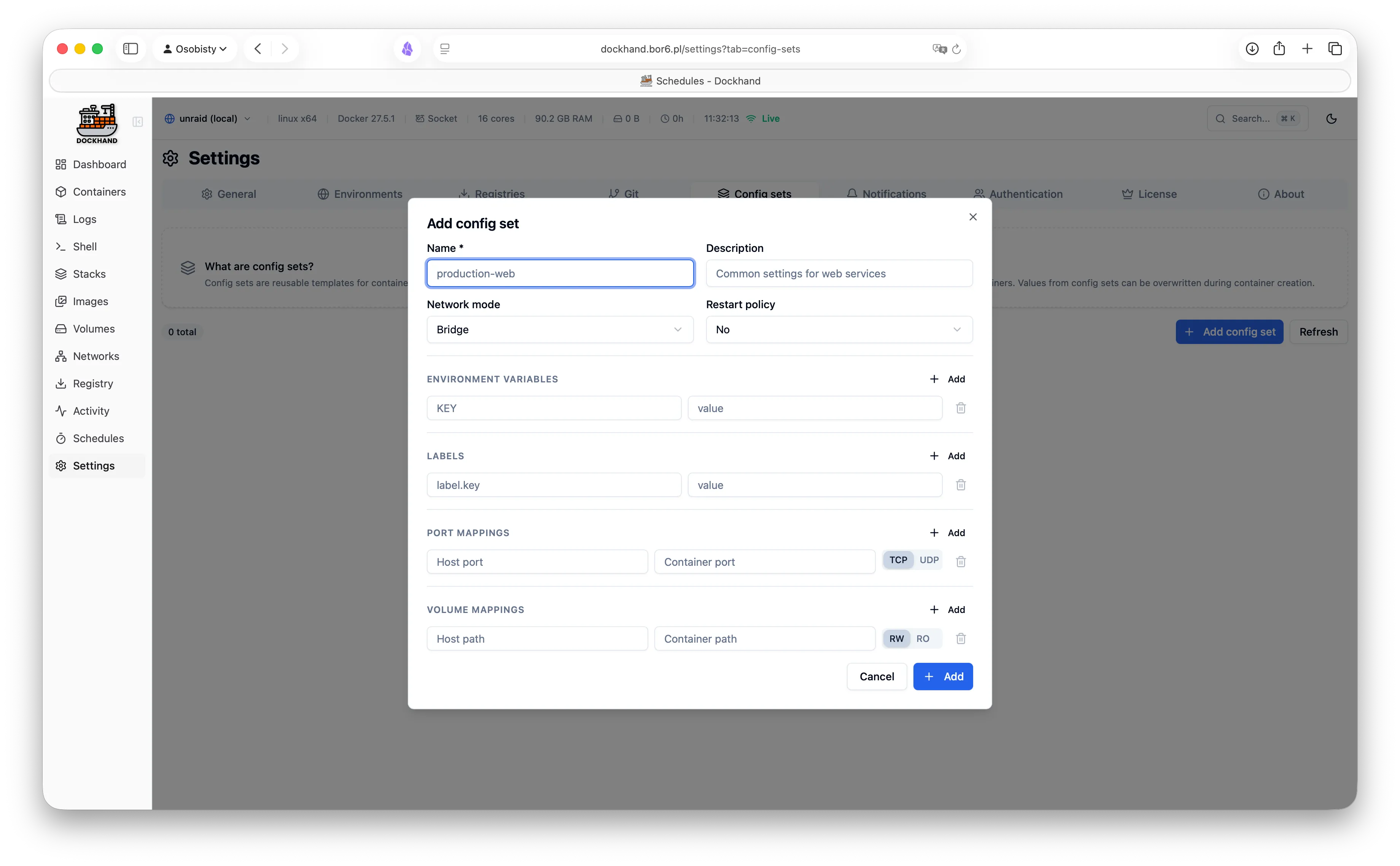
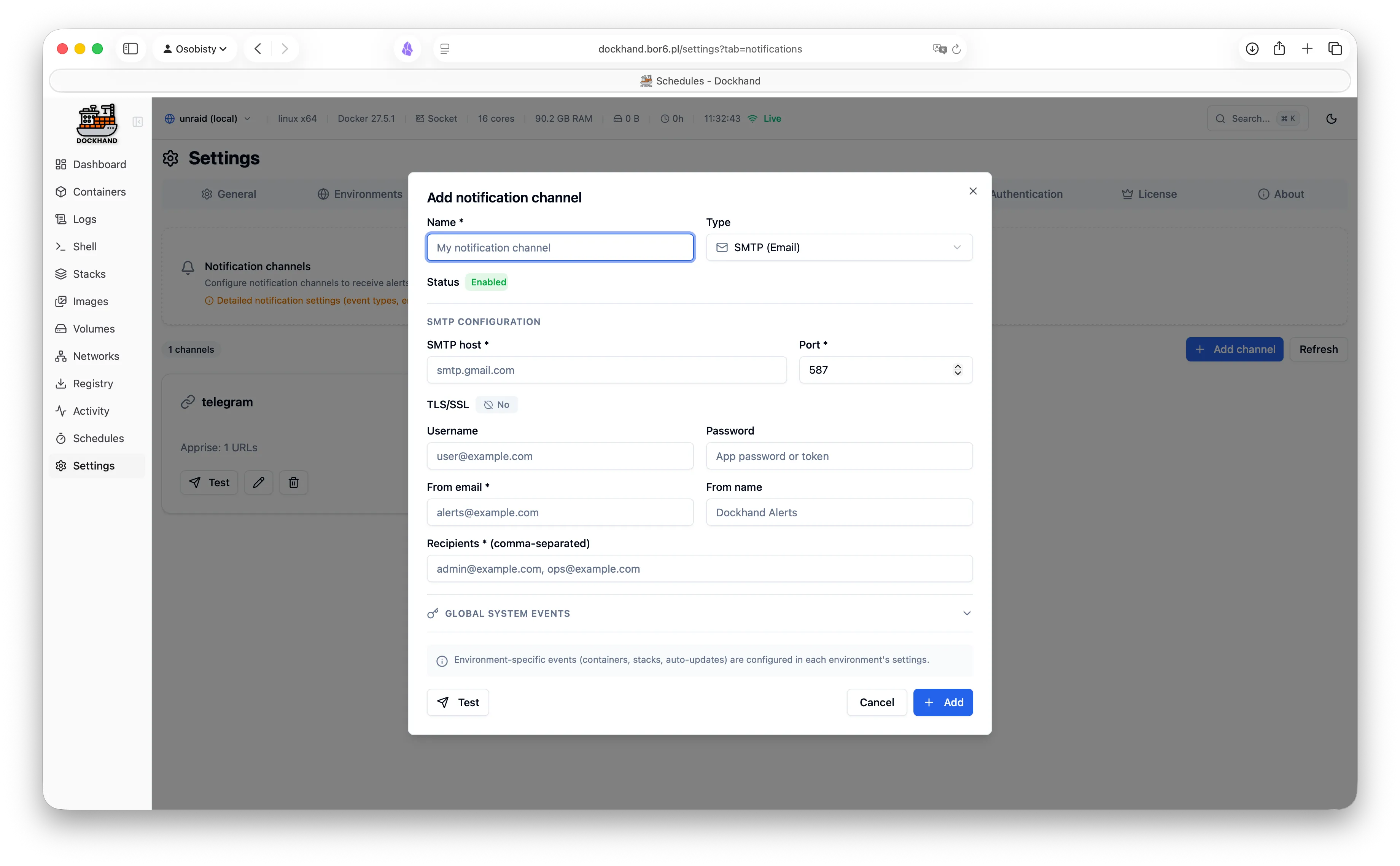
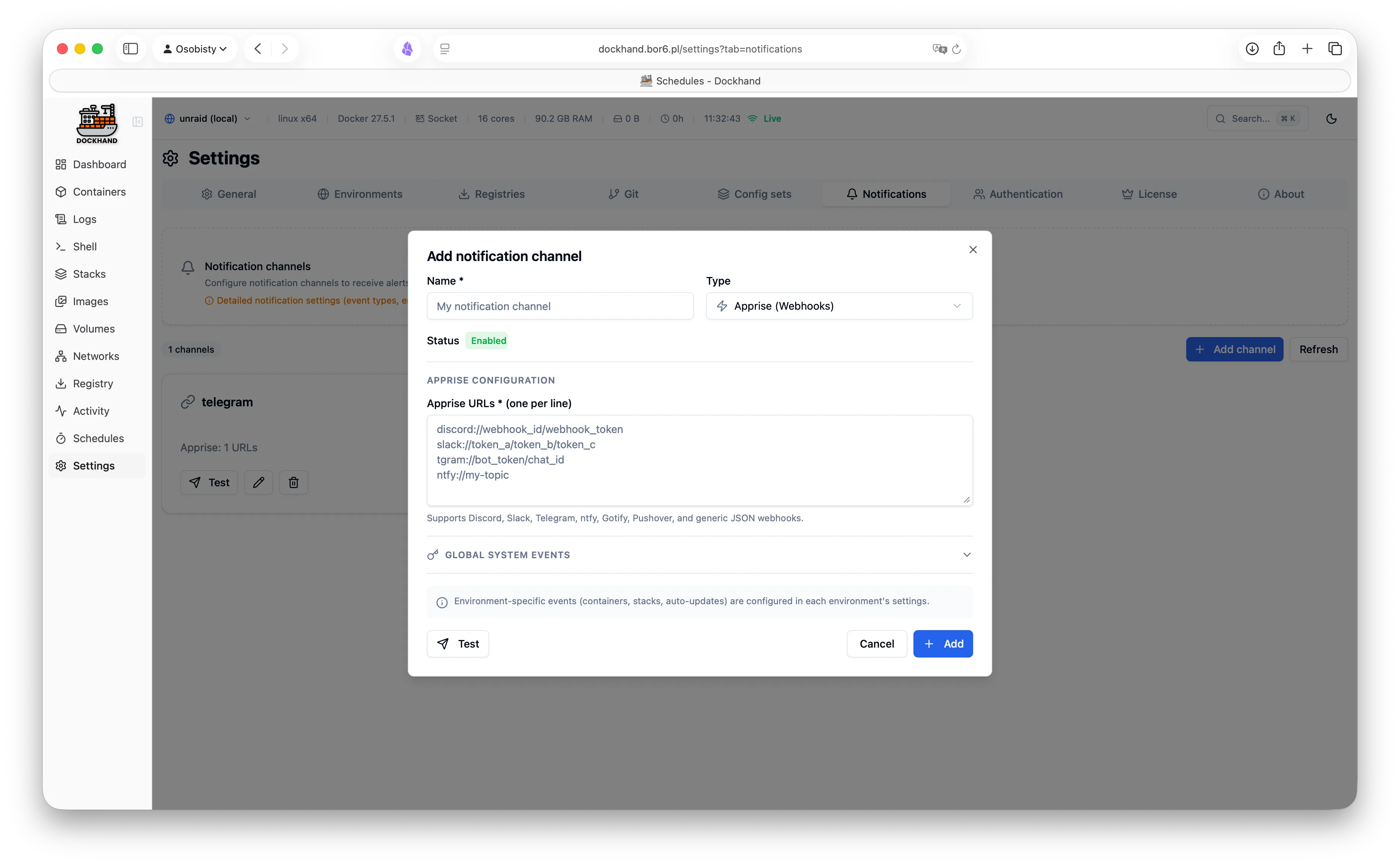
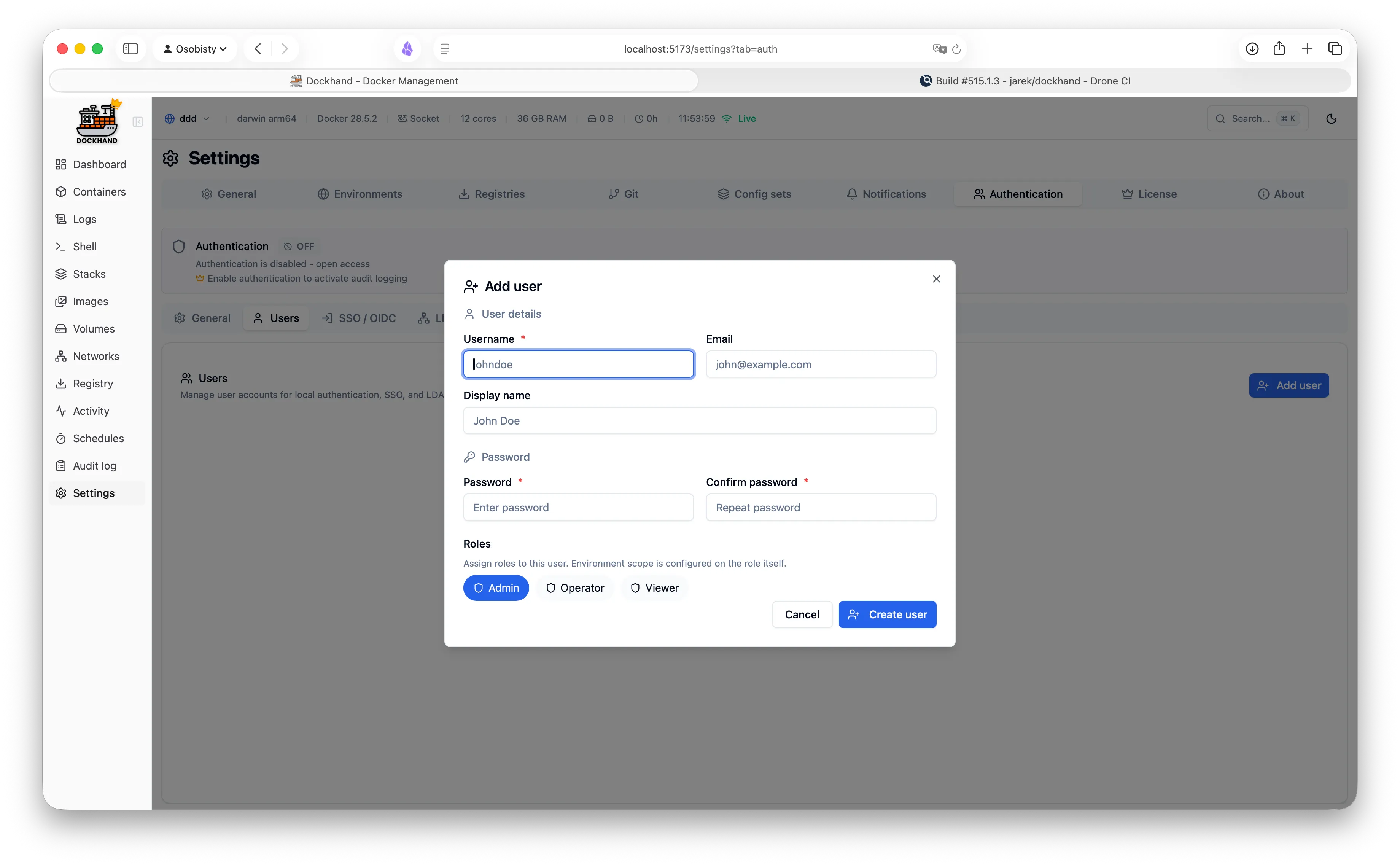
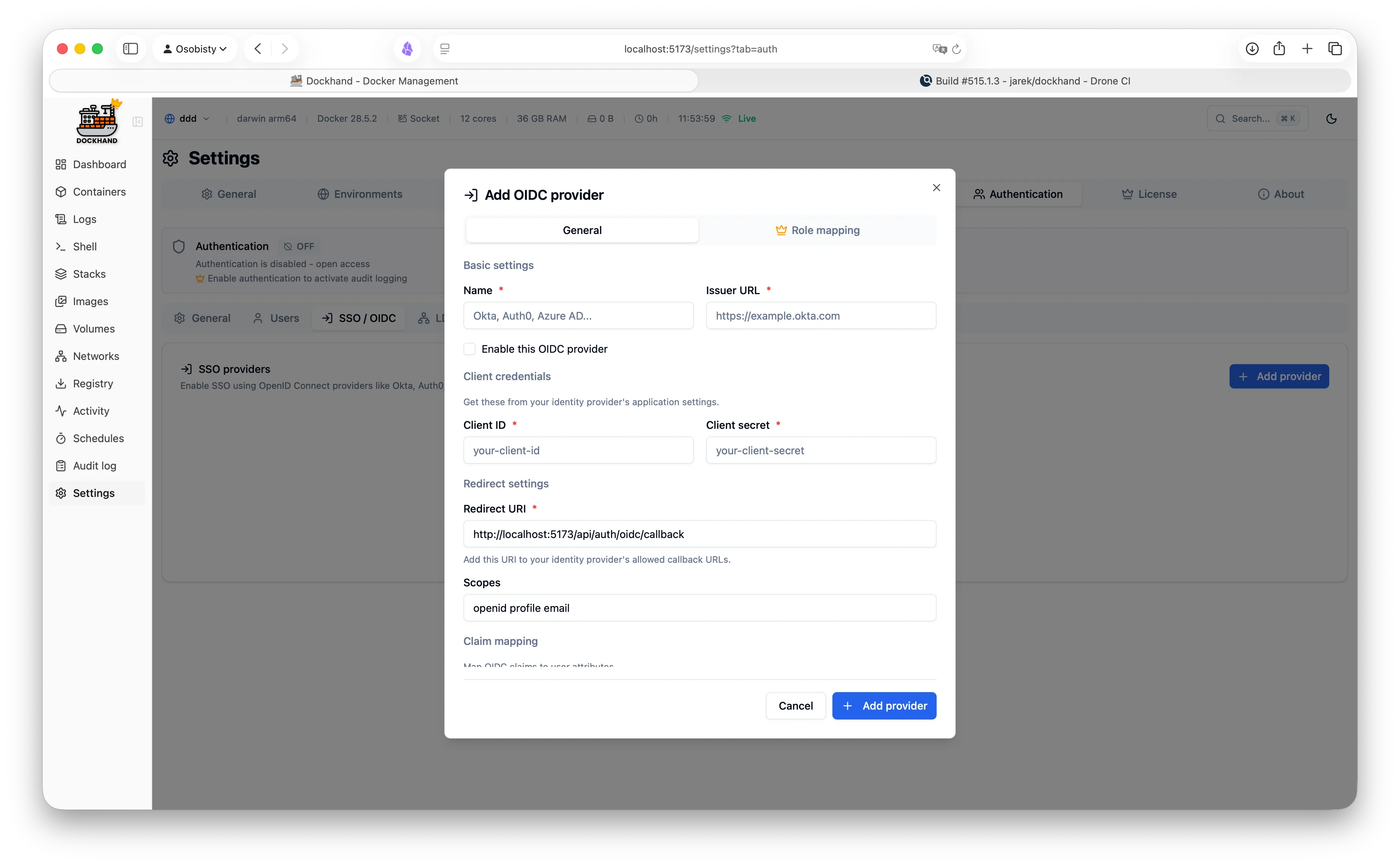
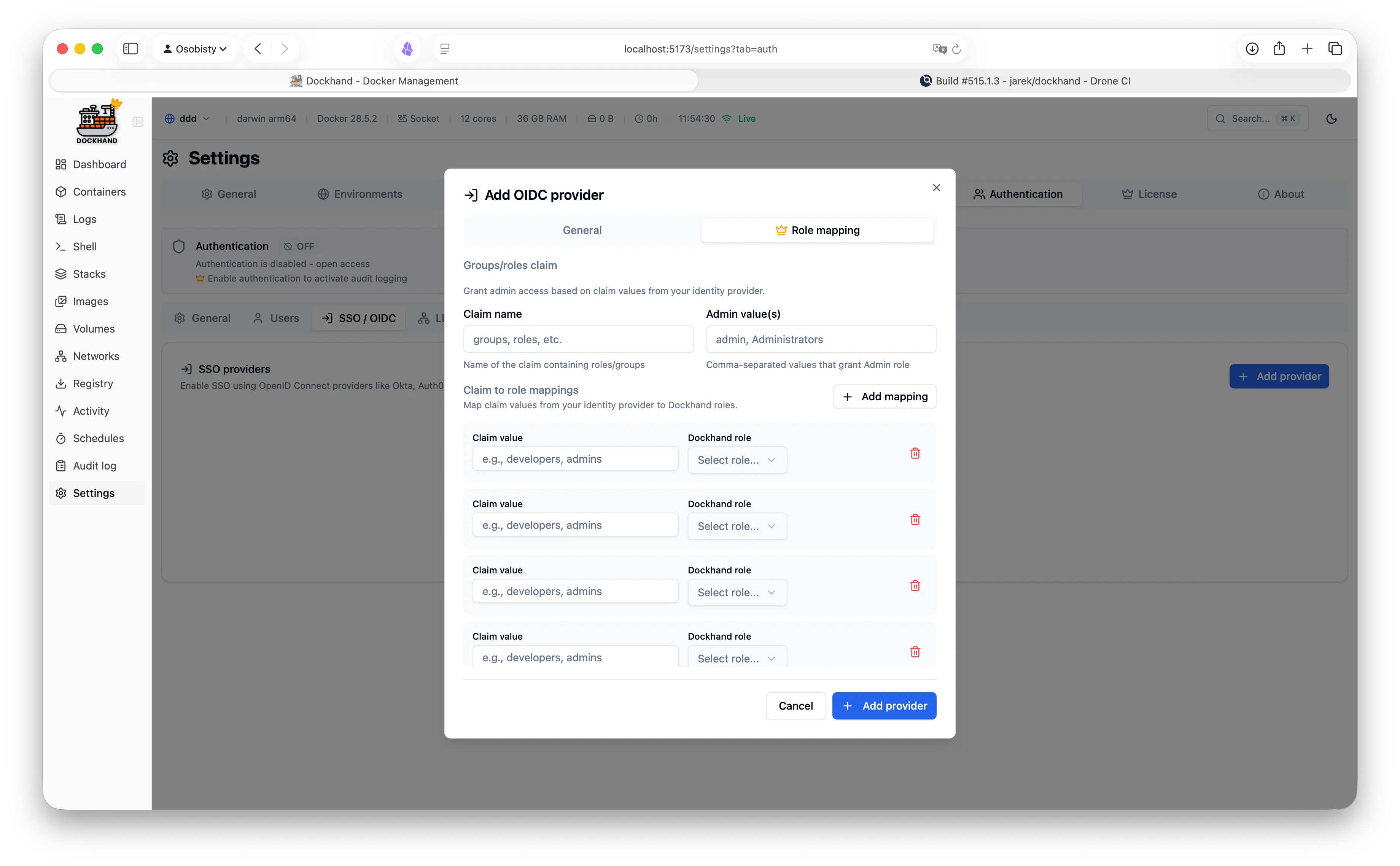
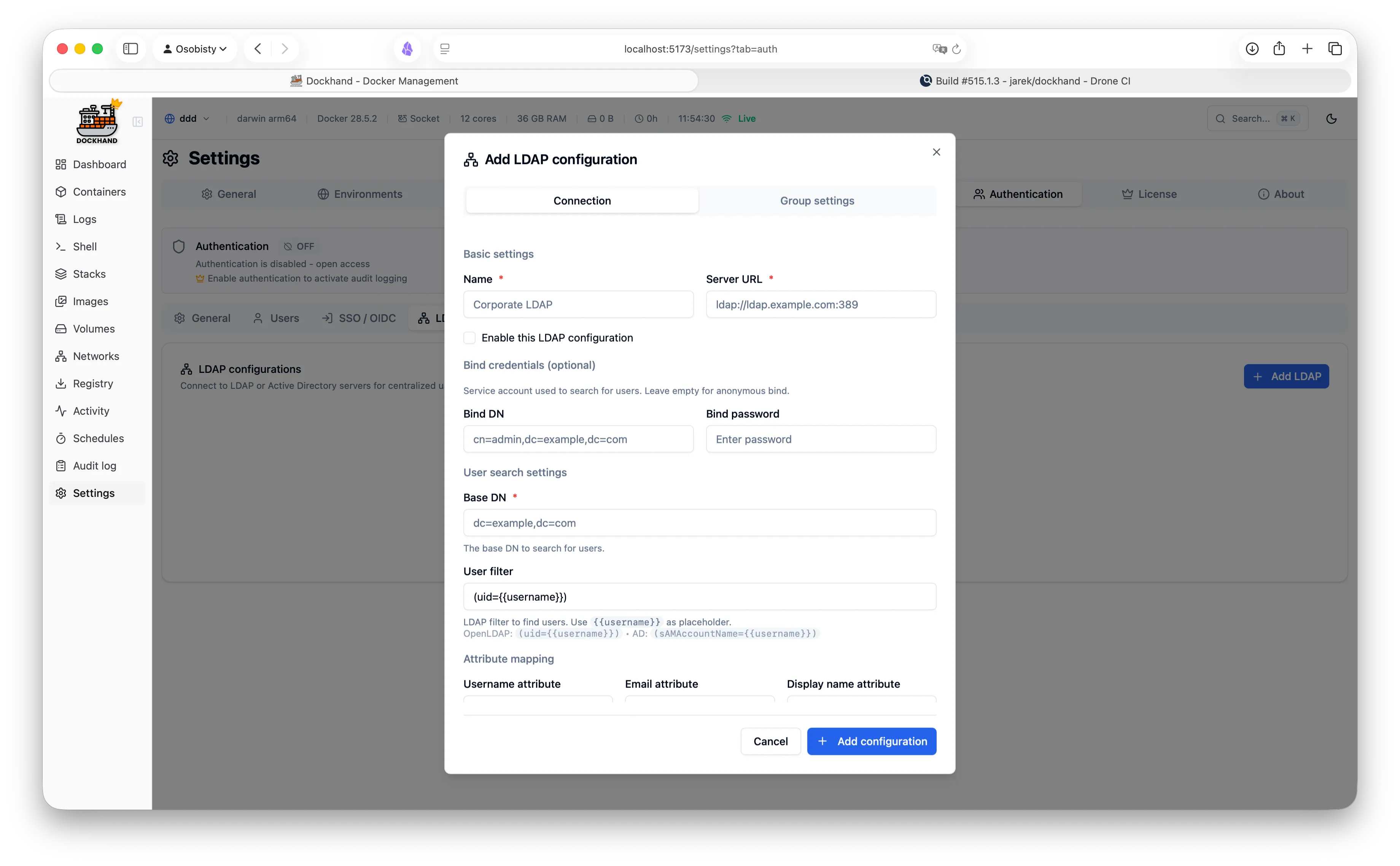
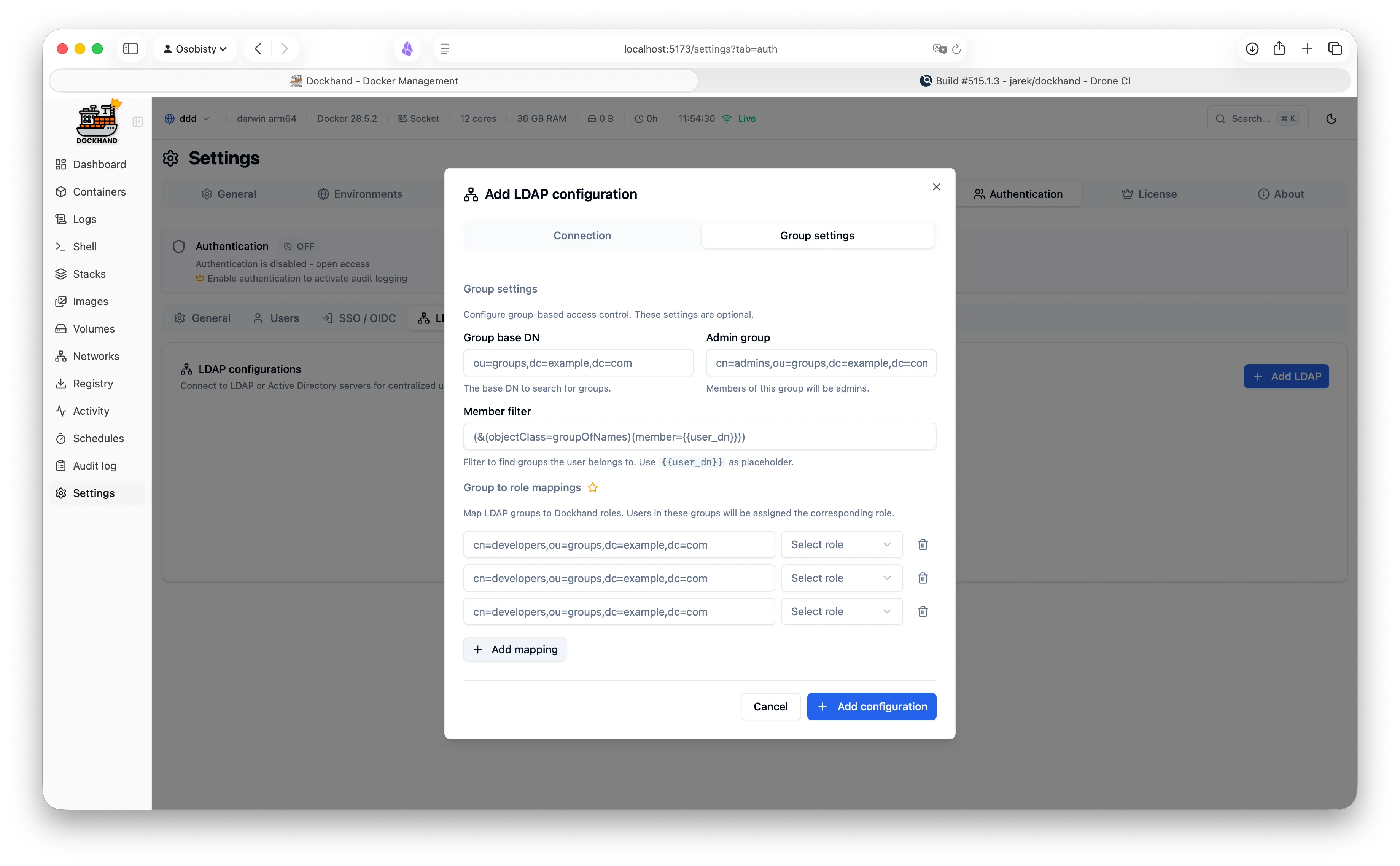
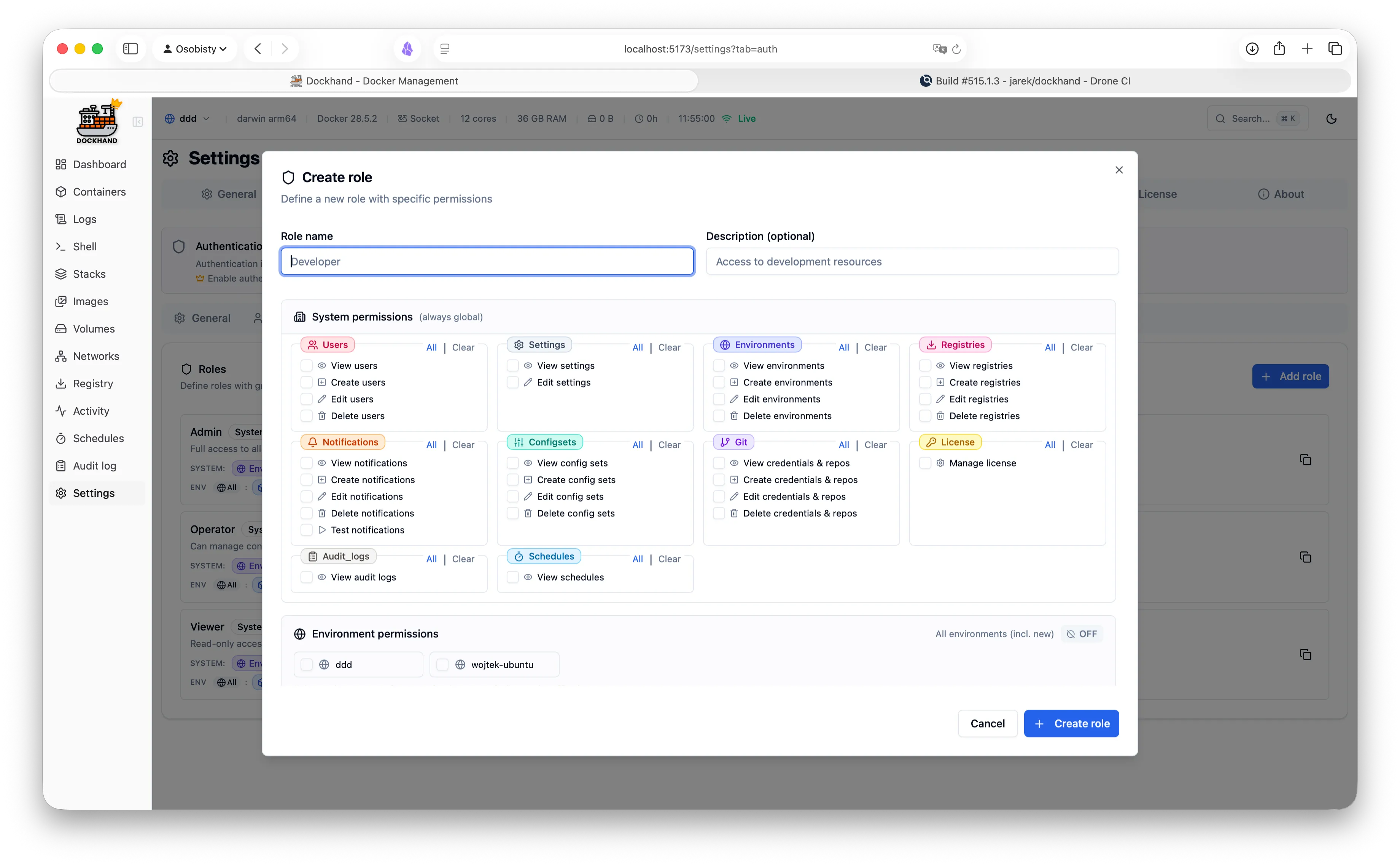
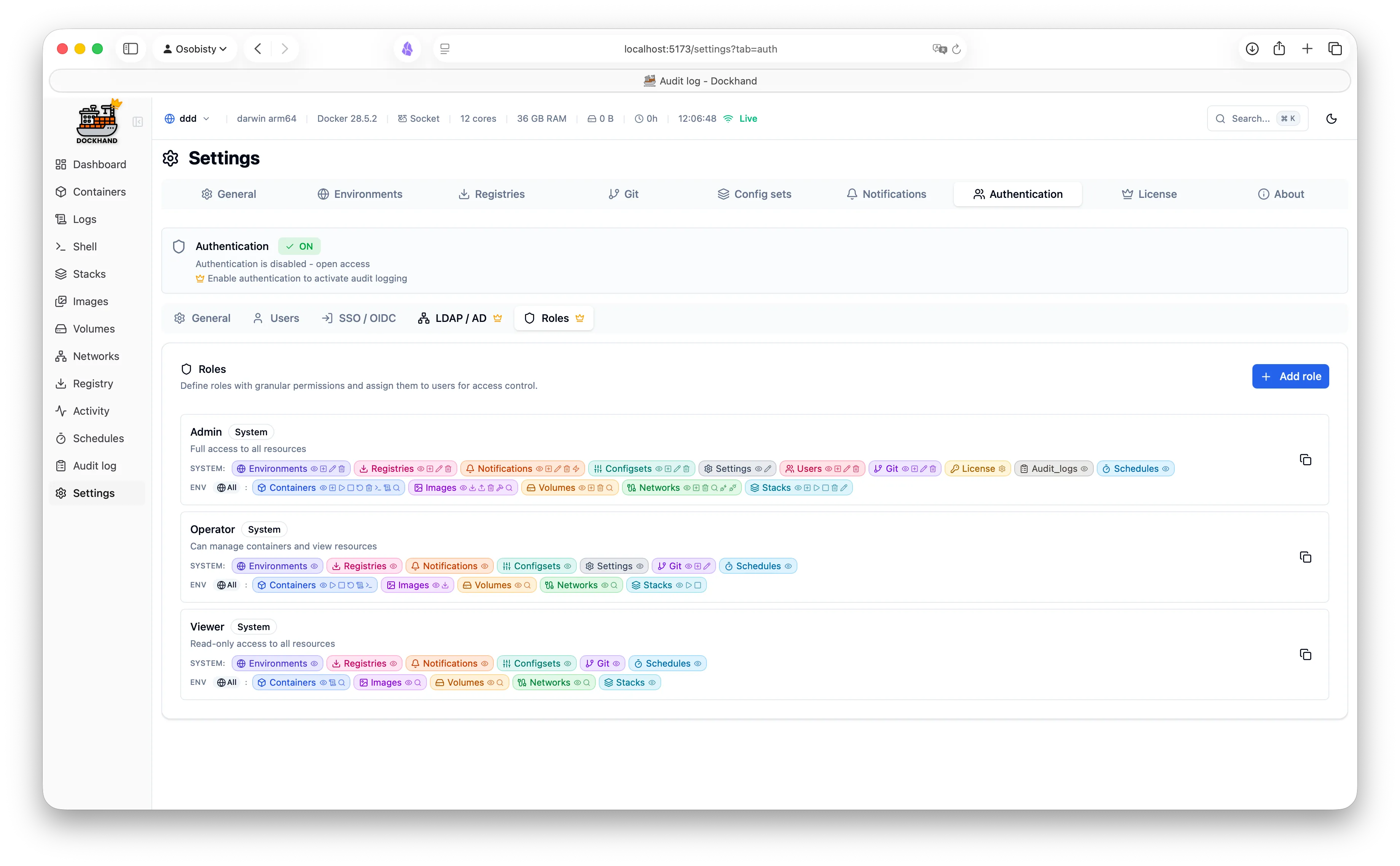
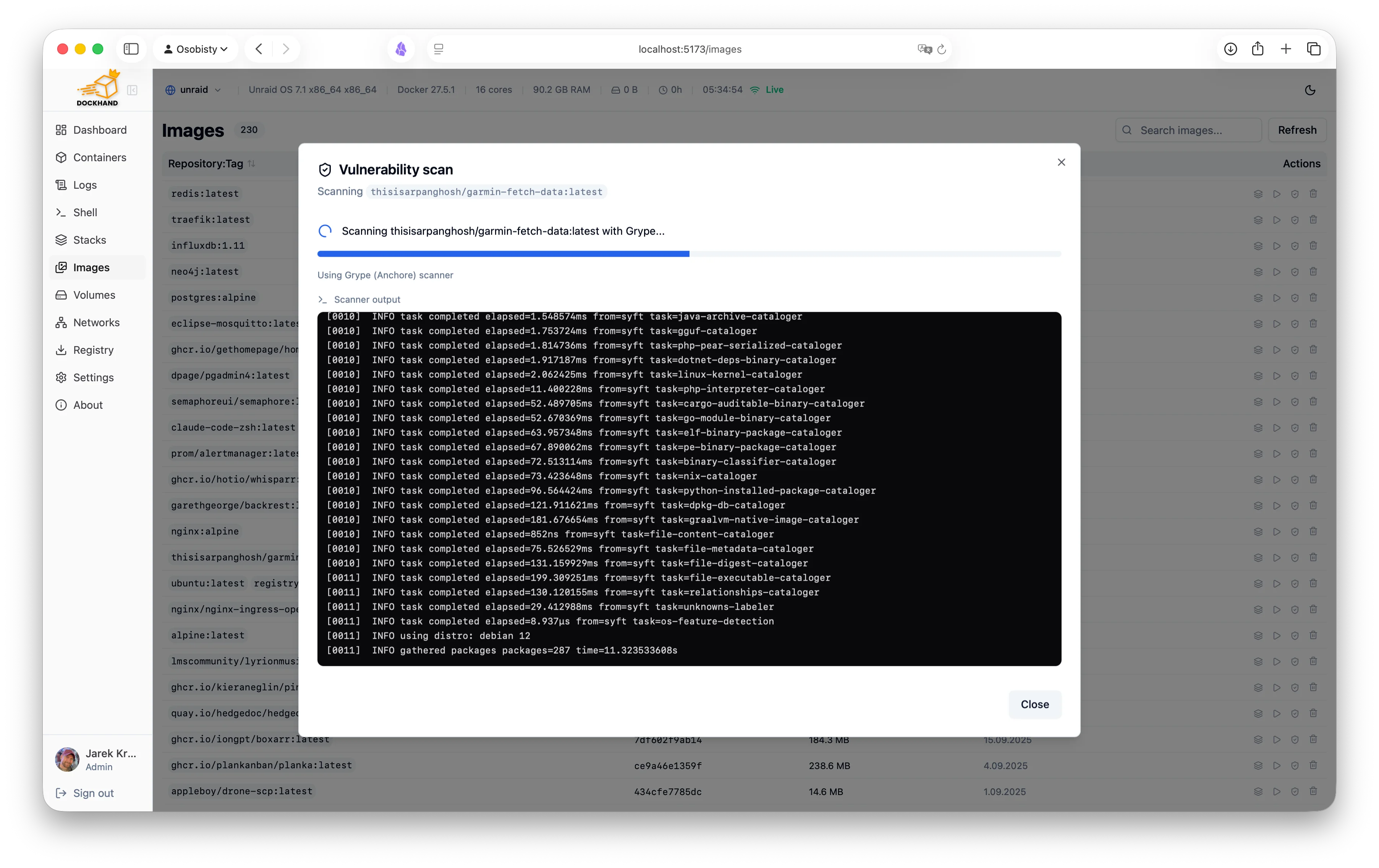
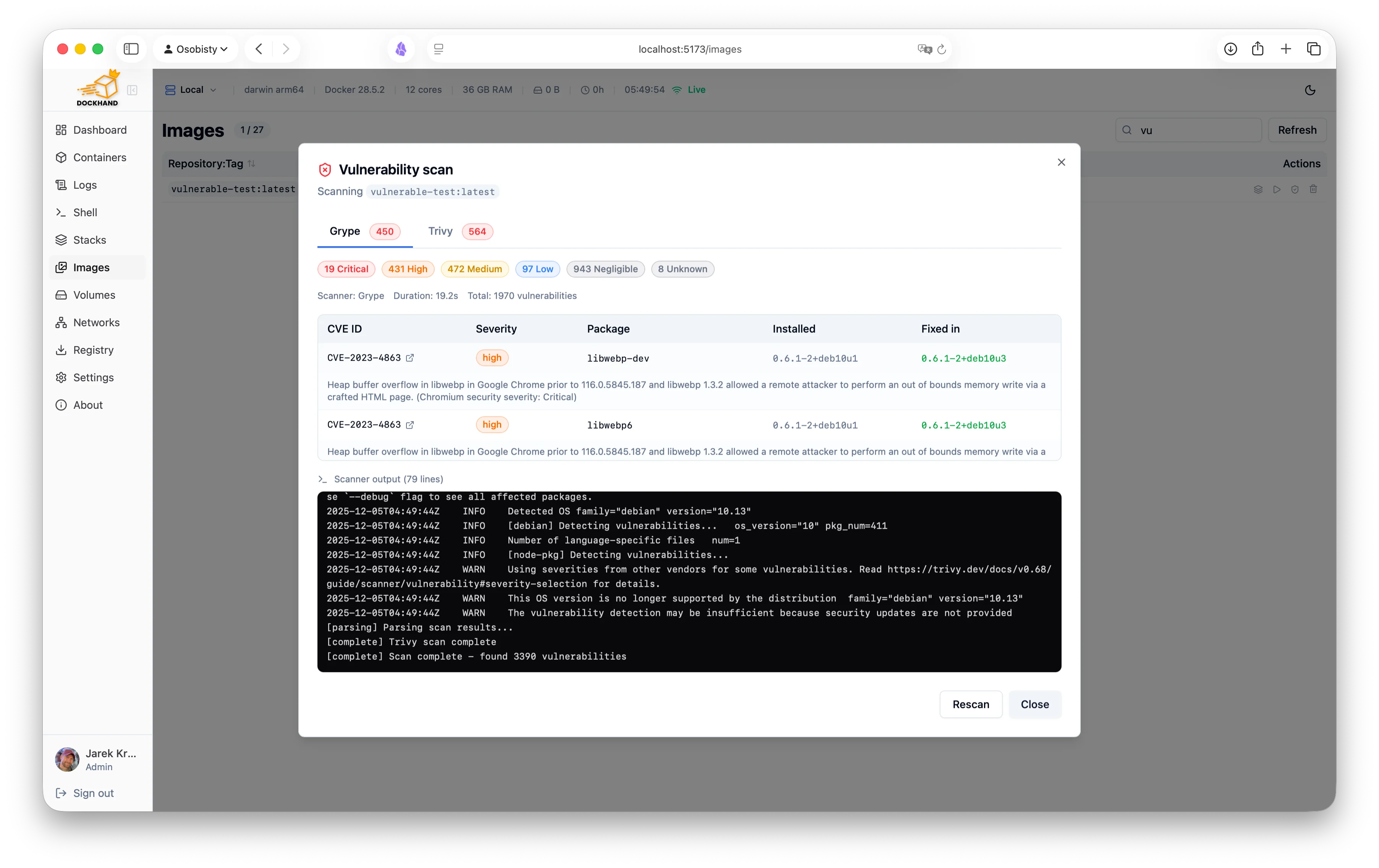
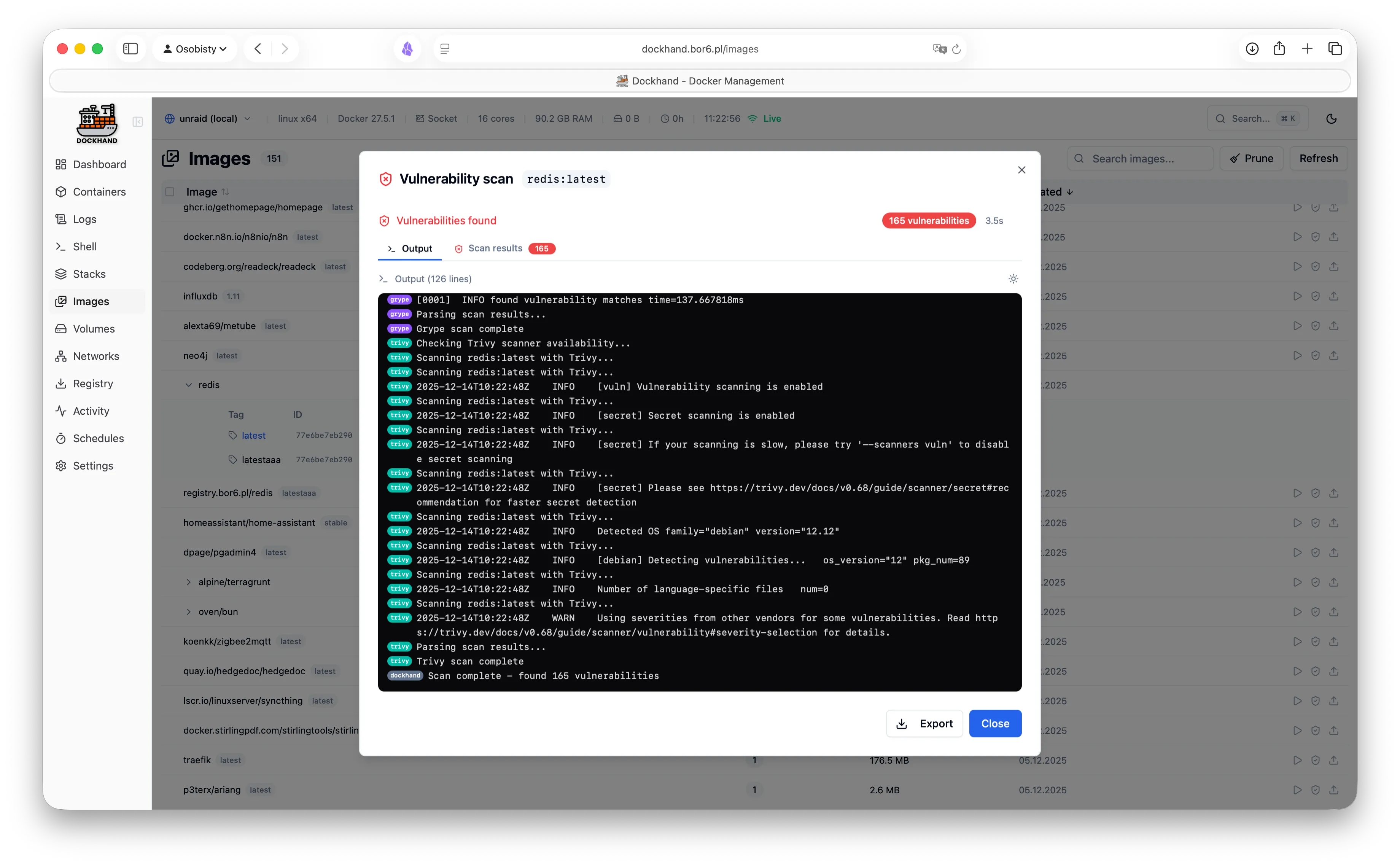
A powerful, intuitive Docker platform. Free for homelabs, ready for enterprise.
We think you'll like it here.
SQLite by default, runs on a Raspberry Pi, zero telemetry, free forever. Self-host everything without the complexity.
OIDC/SSO included free, container activity logging, Git-based deployments, premium support. Everything your team needs without the enterprise price tag.
RBAC, LDAP/AD integration, compliance-grade audit logging, and priority support. Everything you need to satisfy compliance requirements.
One command. No config files. No setup wizards, no 47-page README.
docker run -d \
  --name dockhand \
  --restart unless-stopped \
  -p 3000:3000 \
  -v /var/run/docker.sock:/var/run/docker.sock \
  -v dockhand_data:/app/data \
  fnsys/dockhand:latest
Then open http://localhost:3000. Or put it behind Traefik, Nginx, Caddy, a Kubernetes ingress, three load balancers, and a VPN tunnel. We don't judge.
Prefer Docker Compose?
services:
  dockhand:
    image: fnsys/dockhand:latest
    container_name: dockhand
    restart: unless-stopped
    ports:
      - 3000:3000
    volumes:
      - /var/run/docker.sock:/var/run/docker.sock
      - dockhand_data:/app/data

volumes:
  dockhand_data:
Need PostgreSQL?
services:
  postgres:
    image: postgres:16-alpine
    restart: unless-stopped
    environment:
      POSTGRES_USER: dockhand
      POSTGRES_PASSWORD: changeme
      POSTGRES_DB: dockhand
    volumes:
      - postgres_data:/var/lib/postgresql/data

  dockhand:
    image: fnsys/dockhand:latest
    ports:
      - 3000:3000
    environment:
      DATABASE_URL: postgres://dockhand:changeme@postgres:5432/dockhand
    volumes:
      - /var/run/docker.sock:/var/run/docker.sock
      - dockhand_data:/app/data
    depends_on:
      - postgres
    restart: unless-stopped

volumes:
  postgres_data:
dockhand_data:From simple container operations to complex multi-environment deployments.
Even that one container you forgot about three months ago.
Authentication is free. RBAC is enterprise. No calculator required.
| Feature | Free | SMB | Enterprise |
|---|---|---|---|
| Unlimited environments | ✓ | ✓ | ✓ |
| Container & stack management | ✓ | ✓ | ✓ |
| Git repository integration | ✓ | ✓ | ✓ |
| Vulnerability scanning | ✓ | ✓ | ✓ |
| Local user accounts | ✓ | ✓ | ✓ |
| OIDC/SSO | ✓ | ✓ | ✓ |
| Multi-factor authentication | ✓ | ✓ | ✓ |
| Container activity log | ✓ | ✓ | ✓ |
| Commercial usage license | — | ✓ | ✓ |
| Premium support | — | ✓ | ✓ |
| Priority bug fixes | — | ✓ | ✓ |
| LDAP/Active Directory | — | — | ✓ |
| Role-based access control | — | — | ✓ |
| Environment-scoped permissions | — | — | ✓ |
| Audit logging (compliance) | — | — | ✓ |
| Price | $0 forever | $499/host/year | $1,499/host/year |
| Buy me a coffee |
Host = one machine running Dockhand. Volume discounts available for 5+ hosts.
No cloud dependencies, no telemetry, no data leaving your network. Solid base.
Paranoid? We prefer "security-conscious."
Dockhand runs entirely on your infrastructure. No SaaS, no cloud dependency, no vendor lock-in. Your data never touches our servers.
We don't phone home. No usage tracking, no analytics, no mysterious background connections. Your Docker environment stays private.
SQLite by default, optional PostgreSQL for HA. No Redis, no message queues. Simple deployment, minimal attack surface.
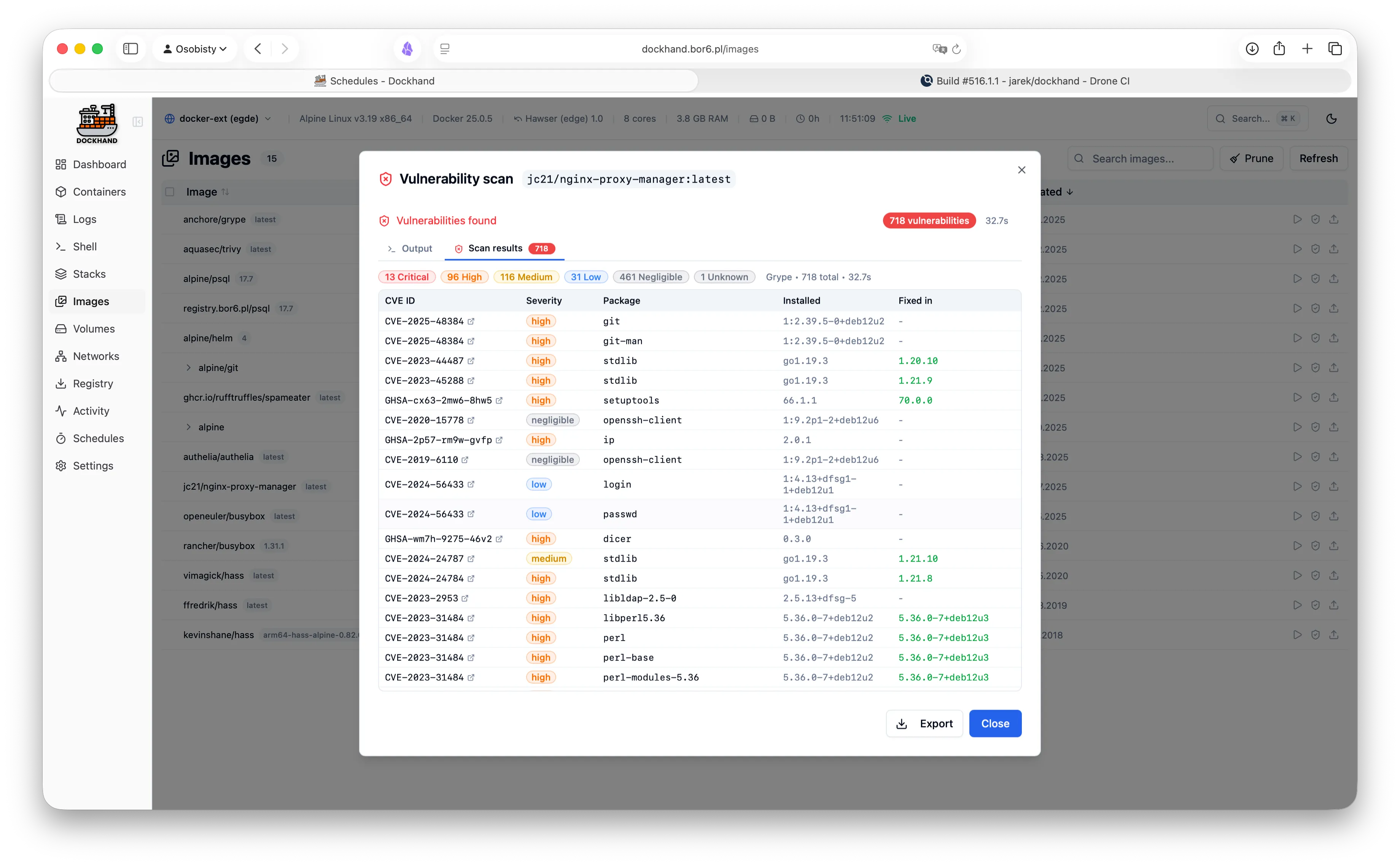
Scan your images for CVEs using Grype and Trivy. Identify security risks before deployment.
Safe-pull protection: During auto-updates, new images are pulled to a temporary tag and scanned before touching your running containers. If vulnerabilities exceed your criteria, the temp image is deleted and your container keeps running safely.
We don't trust pre-built base images. Dockhand builds its own OS layer from scratch using Wolfi packages via apko. Every package is explicitly declared in our Dockerfile - full transparency, zero mystery meat.
While others ship Alpine with 10+ CVEs, we obsess over our own image security. Because a Docker management tool with vulnerabilities is like a locksmith with a broken door. We scan ourselves too.
Our open-source Go agent lets you manage Docker hosts behind NAT, firewalls, or dynamic IPs. The agent initiates outbound connections to Dockhand - no exposed ports, no inbound firewall rules needed.
A modern, intuitive interface designed for productivity.
Warning: May cause sudden urges to containerize everything.
See what our users are saying.
"After trying Dockhand in my lab and comparing features toe to toe with other tools I am currently using, I can honestly say it is one of the best that I have used. It is extremely easy to use, intuitive, and it puts docker management tool security in focus where it should be."
"Perfect for my homelab. It's lightweight, actively maintained, and has all the features I need. Love the terminal access and real-time log streaming!"
"The LDAP integration was a game-changer for our team. Set it up in 10 minutes and now all our developers have proper access control."
"Dockhand wants to be a Portainer replacement, and it might already be there."
"Dockhand is bursting onto the scene with impressive force, bringing a breath of truly fresh air to a world that, let's be honest, had started to feel a bit stagnant."
"Dockhand is incredibly handy to have around."
"The easiest way I've found to manage and update Docker containers."
Free forever. No, really. No bait-and-switch.
Like it? Fuel the dev with caffeine.
For commercial use. Growing teams, happy CFOs.
When compliance asks "is it enterprise-ready?" and you want to say yes.
In the vast landscape of popular culture, few franchises have woven a web as intricate and immersive as the German Netflix series Dark (2017–2020). Within its complex narrative of time travel, philosophical determinism, and intergenerational trauma, the show introduces a pivotal, albeit fictional, artifact: a manuscript titled A Journey Through Time by the enigmatic clockmaker H.G. Tannhaus. For fans of the series, the search for a PDF of this work represents a desire to bridge the gap between fiction and reality. However, the quest for a "free download" of Tannhaus’s book serves as a fascinating case study in modern media consumption, fictional mythology, and the legal realities of intellectual property.
Although the full text never appears on screen, the series offers glimpses of its table of contents, marginal notes, and quotations. From these fragments we can infer the following architecture:
Prolegomena: The Philosophy of Temporal Existence
Mechanics of the Chronometer
Paradoxes and Their Resolution
Ethics of Temporal Intervention
Narratives of the Knot
Appendix: Theoretical Applications
These sections collectively illustrate Tannhaus’s ambition: to create a scientific theology that legitimizes the human desire to rewrite personal tragedy while simultaneously warning of the cosmic cost.
This is a grey area. Since H.G. Tannhaus is a fictional character and Netflix owns the Dark IP, any PDF claiming to be the actual book is technically derivative fan fiction. Distributing a PDF of the prop book verbatim would violate Netflix’s copyright on the script.
However, no law enforcement agency is hunting down fans who share theoretical physics essays written in the style of a clockmaker. Most "free downloads" available on Reddit, Tumblr, and Discord are original fan works presented as "in-universe documents."
Warning: Be wary of sites offering an A Journey Through Time H.G. Tannhaus PDF free download that require you to disable your antivirus or fill out a survey. These are often phishing scams. Because the search term is popular, malicious actors use it as bait.
If a user were to find a link claiming to offer a PDF of A Journey Through Time by H.G. Tannhaus, they would encounter one of three scenarios, each carrying significant implications:
From a copyright perspective, H.G. Tannhaus and all his works, including the fictional manuscript, are the intellectual property of the creators of Dark (Baran bo Odar and Jantje Friese) and the production company. There is no authorized publication of the full text. Therefore, any "official" PDF download is technically a violation of copyright, though the material itself (a full book) was never physically produced.
Why are we so obsessed with a book that isn't real? The search for A Journey Through Time H.G. Tannhaus PDF free download speaks to a deeper human need.
In Dark, the book is a "closed loop." Tannhaus only writes it because he reads it in the future. Jonas only brings it to him because he found it in the past. The book exists without an origin.
By searching for the PDF, we are trying to break the fourth wall. We want to hold the key to the universe in our hands. We want to believe that if we just read the right paragraphs, time will make sense. The search is an act of love for the show—a desire to stay in Winden a little longer.
Some graphic designers have recreated the prop book visually. These PDFs feature the same red cover, weathered pages, and diagrams of the tunnel system connecting 1953, 1986, and 2019.
From a psychological standpoint, the “journey” motif can be read as an allegory for grief processing. Tannhaus’s obsession with rebuilding his family mirrors a therapeutic narrative: confronting the past, re‑authoring the story, and ultimately accepting the irrevocability of loss. The endless loops in the series illustrate how unprocessed trauma can trap individuals in repetitive cycles, whereas the eventual “break” in the knot (the sacrifice of the origin world) symbolizes catharsis.
Tannhaus’s multiversal branching proposal attempts to rescue free will from a strictly deterministic universe. However, the series demonstrates a paradoxical tension: the same characters recur across branches, suggesting an underlying pattern—an “eternal recurrence” reminiscent of Nietzsche’s philosophy. The essay thus argues that Tannhaus’s theory, while mathematically elegant, fails to fully reconcile the experiential reality of agency.
Get started in 30 seconds. No credit card required.
Finally, a UI that sparks joy.
In the vast landscape of popular culture, few franchises have woven a web as intricate and immersive as the German Netflix series Dark (2017–2020). Within its complex narrative of time travel, philosophical determinism, and intergenerational trauma, the show introduces a pivotal, albeit fictional, artifact: a manuscript titled A Journey Through Time by the enigmatic clockmaker H.G. Tannhaus. For fans of the series, the search for a PDF of this work represents a desire to bridge the gap between fiction and reality. However, the quest for a "free download" of Tannhaus’s book serves as a fascinating case study in modern media consumption, fictional mythology, and the legal realities of intellectual property.
Although the full text never appears on screen, the series offers glimpses of its table of contents, marginal notes, and quotations. From these fragments we can infer the following architecture:
Prolegomena: The Philosophy of Temporal Existence
Mechanics of the Chronometer
Paradoxes and Their Resolution
Ethics of Temporal Intervention
Narratives of the Knot
Appendix: Theoretical Applications
These sections collectively illustrate Tannhaus’s ambition: to create a scientific theology that legitimizes the human desire to rewrite personal tragedy while simultaneously warning of the cosmic cost.
This is a grey area. Since H.G. Tannhaus is a fictional character and Netflix owns the Dark IP, any PDF claiming to be the actual book is technically derivative fan fiction. Distributing a PDF of the prop book verbatim would violate Netflix’s copyright on the script.
However, no law enforcement agency is hunting down fans who share theoretical physics essays written in the style of a clockmaker. Most "free downloads" available on Reddit, Tumblr, and Discord are original fan works presented as "in-universe documents." A Journey Through Time H.g. Tannhaus Pdf Free Download
Warning: Be wary of sites offering an A Journey Through Time H.G. Tannhaus PDF free download that require you to disable your antivirus or fill out a survey. These are often phishing scams. Because the search term is popular, malicious actors use it as bait.
If a user were to find a link claiming to offer a PDF of A Journey Through Time by H.G. Tannhaus, they would encounter one of three scenarios, each carrying significant implications:
From a copyright perspective, H.G. Tannhaus and all his works, including the fictional manuscript, are the intellectual property of the creators of Dark (Baran bo Odar and Jantje Friese) and the production company. There is no authorized publication of the full text. Therefore, any "official" PDF download is technically a violation of copyright, though the material itself (a full book) was never physically produced.
Why are we so obsessed with a book that isn't real? The search for A Journey Through Time H.G. Tannhaus PDF free download speaks to a deeper human need.
In Dark, the book is a "closed loop." Tannhaus only writes it because he reads it in the future. Jonas only brings it to him because he found it in the past. The book exists without an origin. The Paradox of the Page: H
By searching for the PDF, we are trying to break the fourth wall. We want to hold the key to the universe in our hands. We want to believe that if we just read the right paragraphs, time will make sense. The search is an act of love for the show—a desire to stay in Winden a little longer.
Some graphic designers have recreated the prop book visually. These PDFs feature the same red cover, weathered pages, and diagrams of the tunnel system connecting 1953, 1986, and 2019.
From a psychological standpoint, the “journey” motif can be read as an allegory for grief processing. Tannhaus’s obsession with rebuilding his family mirrors a therapeutic narrative: confronting the past, re‑authoring the story, and ultimately accepting the irrevocability of loss. The endless loops in the series illustrate how unprocessed trauma can trap individuals in repetitive cycles, whereas the eventual “break” in the knot (the sacrifice of the origin world) symbolizes catharsis.
Tannhaus’s multiversal branching proposal attempts to rescue free will from a strictly deterministic universe. However, the series demonstrates a paradoxical tension: the same characters recur across branches, suggesting an underlying pattern—an “eternal recurrence” reminiscent of Nietzsche’s philosophy. The essay thus argues that Tannhaus’s theory, while mathematically elegant, fails to fully reconcile the experiential reality of agency.